
Crypto Taxation Seminar: UAE Compliance & Business Implications
Table of Contents

Let's Talk
Sign Up For Free Consultation
Tulpar Global Taxation, in collaboration with the Spanish Business Council United Arab Emirates and the Turkish Business Council Dubai & Northern Emirates, hosted a Business Breakfast & Executive Networking Session on 12th February 2026. The event brought together business leaders, finance professionals, and tax experts to discuss the evolving regulatory landscape surrounding cryptocurrency in the UAE.
The session served as a platform for knowledge-sharing and strategic discussion, particularly as crypto adoption continues to grow across industries in the region.

Crypto Transactions: Tax Implications for Individuals and Businesses
The session focused on crypto transactions and their tax implications for individuals and businesses. Key topics included Corporate Tax, VAT treatment, compliance requirements, and the upcoming Crypto Asset Reporting Framework (CARF).
The keynote speaker, FTA Tax Agent Ezat Alnajm, delivered an in-depth presentation on how cryptocurrency is taxed under the UAE’s regulatory framework, offering practical insights tailored to real-world business scenarios.
Agenda
The session agenda included:
- What is Cryptocurrency?
- UAE Tax Implications
- Corporate Tax Scenarios
- VAT Treatment
- Compliance & CARF
Each topic was designed to break down complex tax principles into clear, practical guidance for businesses operating in or entering the crypto space.
What Is Cryptocurrency?
Cryptocurrency is a form of digital money that exists entirely online. It allows individuals and businesses to transfer value directly without relying on traditional intermediaries such as banks or financial institutions.
In the UAE, cryptocurrency is treated as a digital asset rather than legal tender. It represents value in digital form, operates on blockchain technology, is secured through cryptography, and enables peer-to-peer transactions. Popular examples include BTC, ETH, and USDT.
How Crypto Works

Cryptocurrency transactions follow a structured process:
- Network nodes verify transactions by checking validity and preventing double spending.
- Verified transactions are grouped into blocks and secured using cryptographic hashing.
- These blocks are linked together to form a blockchain.
- Once recorded, the data becomes immutable, meaning it cannot be altered or reversed.
Types of Crypto Activities
Crypto-related activities vary depending on how individuals and businesses engage with digital assets. These include:
- Buying and selling cryptocurrency
- Active trading
- Mining or staking
- Accepting crypto as payment
- Holding crypto as an investment
- Operating exchanges or brokerage platforms
UAE Tax Framework
The UAE does not have a separate tax regime specifically for cryptocurrency. Instead, existing laws apply:
- Corporate Tax Law (Federal Decree Law 47 of 2022)
- VAT Law (Federal Decree Law 8 of 2017)
- Guidance issued by the Federal Tax Authority (FTA)
This approach ensures that crypto activities are integrated into the broader tax system rather than treated as an exception.

Individuals vs Businesses
The tax treatment of crypto depends largely on whether the activity is personal or commercial:
- Individual investors: generally no personal income tax impact
- Licensed businesses: subject to Corporate Tax
- Commercial traders: taxable
- Mining operations: taxable
This distinction is critical in determining compliance obligations.
Is Crypto Taxable in the UAE?
Cryptocurrency becomes taxable when it generates business income. If crypto activity is conducted as part of a business, it falls within Corporate Tax regulations.
- A 9% Corporate Tax applies above the taxable income threshold
- Applies to companies, freelancers, exchanges, and traders
Tax is calculated on profits, not transaction volume
FTA Practical Classification
Accounting classification plays a key role in determining tax outcomes:
- Holding crypto → treated as an asset or inventory
- Trading crypto → treated as business income
- Mining/staking → considered taxable income
- Crypto payments → recognized as revenue at fair value
- Personal investment → not taxed
Scenario 1: Trading Company
In a licensed crypto trading company:
- Crypto is treated as inventory
- Profits are taxed at 9%
- Losses are deductible
- Profit is calculated as selling price minus cost minus expenses
Scenario 2: Holding Crypto Investment
For long-term holdings:
- Unrealized gains are typically not taxed
- Realized gains are taxable
IFRS classification plays an important role in treatment
Scenario 3: Accepting Crypto as Payment
- Revenue is recognized at fair market value in AED at the time of receipt
- Any subsequent price movement results in gains or losses
- Treated similarly to standard business revenue
Scenario 4: Mining and Staking
- Considered active income-generating activities
- Rewards are taxable
- Costs such as electricity and equipment are deductible
- Income is recognized at fair value in AED
- Price changes create additional gains or losses
VAT Treatment of Cryptocurrency Transactions (UAE)
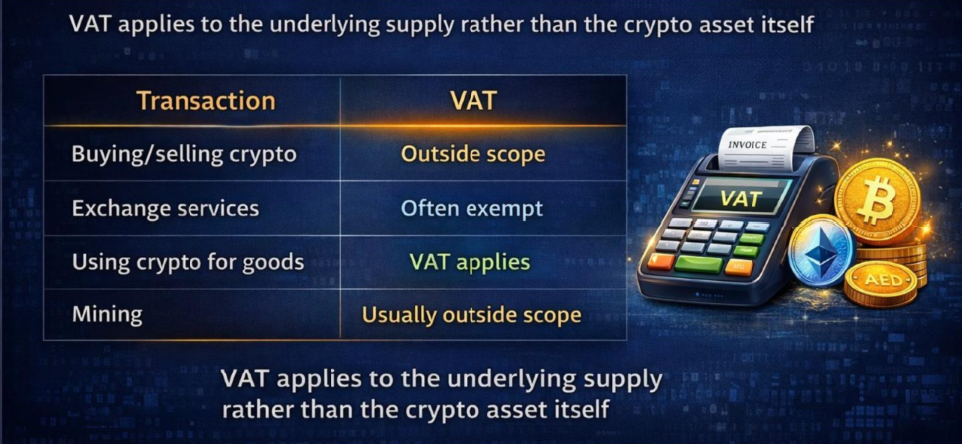
VAT is applied to the underlying goods or services rather than the cryptocurrency itself. In this context, crypto acts as a method of payment rather than a taxable supply.
Compliance and Records
Maintaining proper documentation is essential for compliance and audit readiness. Required records include:
- Wallet records
- Exchange statements
- Transaction history
- Fair value calculations
- Financial disclosures
Insufficient documentation significantly increases audit risk and potential penalties.
CARF (Effective 1 January 2027)
The Crypto Asset Reporting Framework (CARF), developed by the OECD, will come into effect in January 2027. It introduces global standards for crypto tax transparency and reporting.
Key requirements include:
- Crypto brokers reporting client holdings
- Identification of customer tax residency
- Reporting transactions to tax authorities
- Automatic exchange of information between jurisdictions
Reported information may include wallet details, transfers, exchanges, sales, and customer identity data.
Common Crypto Tax Mistakes
Common issues arise from misunderstanding how crypto is classified:
- Assuming crypto is entirely tax-free
- Failing to maintain wallet and transaction records
- Misclassifying trading versus investment
- Ignoring VAT implications
- Misusing free zone structures
These mistakes often lead to compliance risks and penalties.
Executive Summary
The session highlighted that cryptocurrency, while innovative, is firmly within the UAE’s tax framework. Businesses must ensure proper classification, accurate reporting, and strong recordkeeping to remain compliant.
It also emphasized the importance of staying ahead of regulatory changes, particularly with the upcoming implementation of CARF.
Conclusion
The Business Breakfast & Executive Networking Session provided a clear, practical understanding of cryptocurrency taxation in the UAE. It reinforced the importance of aligning crypto activities with Corporate Tax and VAT regulations, as well as maintaining transparency and proper documentation. As regulatory oversight increases, both businesses and individuals must adopt a proactive approach to compliance when dealing with crypto assets.
For those seeking professional support, Tulpar Global Taxation offers expert advisory services in crypto taxation, compliance, and regulatory guidance. The firm also supports entrepreneurs and investors with crypto business setup in the UAE, including assistance with corporate bank account opening.
Tulpar provides comprehensive crypto business setup packages starting from $6,999 and facilitates online bank account opening for non-residents, making it easier for international clients to establish and operate compliant crypto ventures within the UAE.
FAQs:
No, cryptocurrency is not always tax-free. While individuals holding crypto for personal investment are generally not taxed, crypto becomes taxable when it is part of a business activity under Corporate Tax rules.
Individuals do not pay personal income tax on crypto investments. However, if the activity is considered a commercial business (such as trading professionally), it may fall under Corporate Tax regulations.
Crypto becomes taxable when it generates business income. This includes trading, mining, staking, or accepting crypto as payment within a licensed or commercial activity.
Crypto-related business profits are subject to 9% Corporate Tax if taxable income exceeds the UAE threshold. The tax is applied on net profit, not total transactions.
Crypto classification depends on usage:
- Investment → asset
- Trading → inventory/business income
- Mining/staking → taxable income
- Payments → revenue at fair value
Proper classification is critical for compliance and tax calculation.
VAT does not apply directly to crypto as an asset. Instead, VAT applies to the underlying goods or services being exchanged when crypto is used as a payment method.
Yes, mining and staking are considered active income-generating activities. Rewards are taxable, and related expenses like electricity and equipment can be deducted.
You should maintain:
- Wallet records
- Exchange statements
- Transaction history
- Fair value calculations
- Financial reports
Strong documentation is essential to avoid audit risks. Experts like Tulpar Global Taxation assist businesses in maintaining compliant records.
The Crypto Asset Reporting Framework (CARF), effective from January 2027, requires crypto service providers to report user transactions, holdings, and tax residency to authorities, enabling global tax transparency.
It is highly recommended to consult qualified professionals. Tulpar Global Taxation provides expert guidance on crypto taxation, compliance, and business setup.
You can also seek advice from certified professionals such as Ezat Alnajm, who specializes in UAE tax regulations and crypto-related advisory.
