
Difference Between Tokenized Assets and Traditional Investment in UAE
Table of Contents

Let's Talk
Sign Up For Free Consultation
Tokenized Assets vs. Traditional Investment
The UAE is rapidly becoming one of the world’s leading hubs for blockchain innovation, digital finance, and regulated investment ecosystems. As financial markets evolve, investors are increasingly comparing tokenized assets vs. traditional investment models to identify smarter, more accessible, and future-ready opportunities.
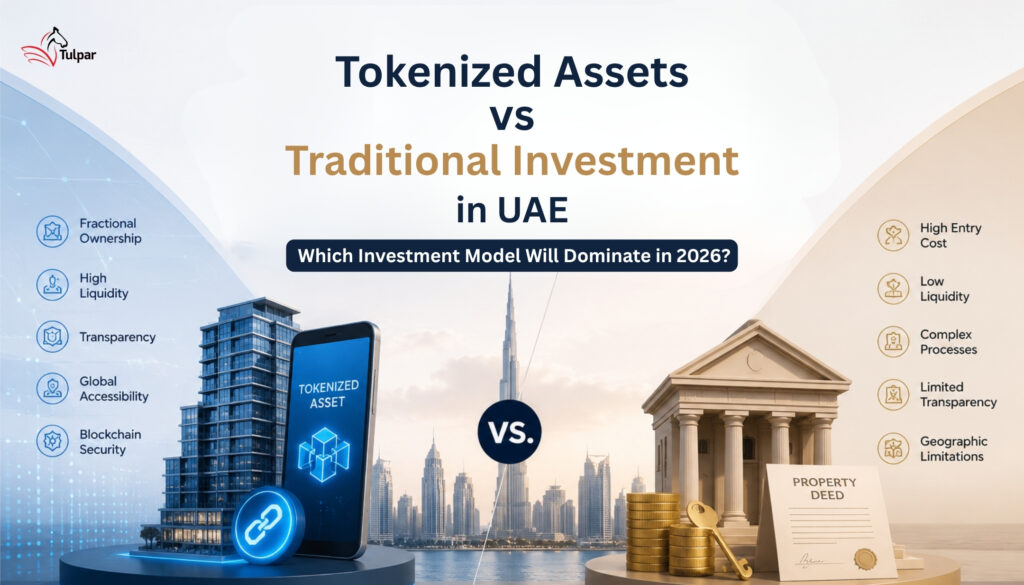
From tokenized real estate and tokenized gold to blockchain-based money market funds and digital securities, the financial world is undergoing a major transformation. At the same time, traditional investment vehicles such as stocks, ETFs, mutual funds, and traditional real estate investment structures continue to dominate global portfolios.
This shift is not simply about replacing traditional finance. Instead, it represents the emergence of a hybrid financial ecosystem where blockchain technology enhances efficiency, transparency, liquidity, and accessibility.
For investors, business owners, financial institutions, and asset managers in the UAE, understanding the difference between tokenized assets and traditional investments is becoming increasingly important in 2026 and beyond.
What Is Tokenization?
Tokenization refers to the process of converting ownership rights of a real-world asset into a digital token recorded on a blockchain.
In simple terms, tokenization is the process where an asset such as real estate, equity, commodity reserves, private credit, or financial instruments is digitally represented using blockchain technology.
A tokenized asset may represent:
- Equity ownership
- Fractional ownership
- Debt exposure
- Revenue rights
- Collateralized interests
- Rights over underlying assets
This blockchain-based structure enables investors to buy, transfer, hold, or trade ownership digitally in near-instant transactions.
Financial institutions across the UAE are increasingly tokenizing real-world assets to improve efficiency, transparency, and accessibility. Businesses can now tokenize equity, real estate, commodities, and alternative investments using regulated blockchain infrastructure. As institutional adoption grows, tokenization offers a scalable framework for modern capital markets while reducing operational friction across the investment lifecycle.
The rise of crypto innovation has also accelerated interest in blockchain-enabled investing models, particularly among younger investors and technology-driven financial players.
How Tokenization Works
The process of asset tokenization generally involves:
- Selecting an asset
- Structuring legal ownership
- Creating smart contracts
- Issuing digital tokens on a blockchain
- Managing compliance and custody through a custodian
- Allowing investors to trade the tokenized asset on-chain
Different blockchains support various asset tokenization models depending on scalability, compliance, interoperability, and transaction efficiency.
The ecosystem relies heavily on:
- Blockchain transparency
- Real-time settlement
- Programmable ownership
- Smart contract automation
- Interoperability between systems
In practice, companies can tokenize real estate, private equity, commodity reserves, and other financial instruments through blockchain-based ecosystems.
Common Use Cases of Tokenization
Common use cases include:
- Tokenized real estate
- Tokenized gold
- Money market funds
- Private credit
- Tokenized shares
- Digital securities
- Commodity-backed investments
These developments are reshaping how investors interact with modern financial infrastructure.
What Are Traditional Investments?
Traditional investment refers to conventional financial products regulated through banks, exchanges, brokers, and intermediaries.
Examples include:
- Stock market investments
- Traditional ETF products
- Mutual funds
- Bonds
- Traditional securities
- Commodity trading
- Traditional real estate investment
- Money market instruments
- Money market funds
These traditional financial assets operate through established financial institutions and legacy financial infrastructure. Although traditional markets provide regulatory maturity and investor familiarity, they often involve greater friction and cost due to multiple intermediaries.
Tokenized Assets vs. Traditional Investment: Key Differences
Ownership Structure
Traditional finance typically relies on centralized ownership records maintained by custodians, brokers, or financial institutions. By contrast, tokenized assets use blockchain as a distributed source of truth. Ownership records become transparent, immutable, and accessible in real-time.
Traditional Investment Model
- Centralized ownership records
- Dependence on intermediary systems
- Slower settlement processes
- Higher administrative costs
Tokenized Asset Model
- Blockchain-based ownership
- Smart contract execution
- Near-instant settlement
- Reduced dependency on intermediaries
- Improved transparency
Liquidity and Market Accessibility
Liquidity remains one of the biggest differences between tokenized assets and traditional investments. Many traditional financial assets, particularly illiquid assets such as private equity, private credit, and traditional real estate investment are difficult to trade quickly. Tokenization improves liquidity by enabling fractional ownership and secondary market trading.
Why Liquidity Matters
Illiquid investments often involve:
- Large minimum ticket size
- Long holding periods
- Limited exit opportunities
Tokenization lowers the entry barrier and creates accessibility for a broader investor base.
Advantages of Tokenized Liquidity
- Real-time transactions
- Smaller investment amounts
- Lower barriers to entry
- Global investor participation
- Improved price discovery
One of the most important advantages is that tokenization offers significantly improved liquidity compared to traditional markets. Investors can access previously illiquid assets with smaller capital commitments while benefiting from faster settlement and enhanced transparency.
This model also lowers the entry barrier for retail investors seeking diversified exposure to alternative asset classes.
Fractional Ownership Is Transforming UAE Investments
One of the biggest value drivers of asset tokenization is fractional ownership. Instead of purchasing an entire asset, investors can buy smaller tokenized shares representing proportional ownership.
This allows access to:
- Luxury real estate
- Commercial properties
- Gold reserves
- Commodity-backed investments
- Private credit opportunities
- Alternative asset classes
For younger UAE investors and SMEs, fractional ownership significantly lowers the entry barrier.
Unlike many pooled investment structures, certain blockchain-based investment models may provide forms of direct ownership over underlying assets. This increases transparency while improving participation in previously inaccessible markets.
Blockchain and Smart Contracts in Modern Investing
Blockchain acts as the core infrastructure behind tokenized assets. A blockchain-based investment framework provides:
- Transparency
- Security
- Immutable records
- Real-time verification
- Reduced operational risk
Meanwhile, smart contracts automate transactions and compliance obligations without requiring extensive manual intervention.
Benefits of Smart Contracts
- Automated dividend distribution
- Faster settlement
- Reduced administrative cost
- Programmable compliance
- Improved operational efficiency
However, investors must also understand the risks associated with smart contract bugs and cybersecurity vulnerabilities.
The Rise of Tokenized Real-World Assets in UAE
The UAE is emerging as one of the leading markets for tokenized real-world assets. Government initiatives supporting blockchain adoption, virtual asset regulation, and digital finance innovation are accelerating market growth.
Tokenized real-world assets may include:
- Real estate
- Commodity reserves
- Private equity
- Infrastructure projects
- Debt instruments
- Money market funds
- ETFs
- Traditional securities
Industry forecasts suggest that tokenized assets could represent a multi-trillion-dollar market globally by 2030.
Traditional Finance vs. Tokenized Finance
Traditional finance has historically depended on centralized institutions such as:
- Banks
- Brokers
- Clearing houses
- Exchanges
- Custodians
Although these systems are trusted and regulated, they often involve slower settlement cycles and higher management fees.
Tokenized finance introduces a new financial infrastructure where blockchain enables:
- Peer-to-peer transactions
- Reduced intermediary dependency
- Programmable financial instruments
- Enhanced transparency
- Greater operational efficiency
Every major asset manager is now evaluating blockchain integration strategies to remain competitive in the evolving financial world. Established financial institutions increasingly recognize that blockchain innovation could coexist alongside traditional finance rather than fully replace it.
This transformation is contributing to the emergence of a new financial ecosystem where programmable digital assets integrate with regulated investment frameworks.
Why Institutional Investors Are Exploring Tokenization
Institutional investors increasingly view tokenization as the next evolution of capital markets.
Major financial players are now exploring:
- Tokenized fund structures
- Tokenized gold
- Blockchain-based ETFs
- Tokenized shares
- On-chain collateral systems
- Digital asset custody
Key Drivers Behind Institutional Adoption
- Improved Efficiency: Tokenization reduces friction and cost across the investment lifecycle.
- Enhanced Liquidity: Illiquid assets become more tradable.
- Real-Time Settlement: Near-instant execution improves capital efficiency.
- Expanded Accessibility: Lower minimum ticket size enables broader investor participation.
- Programmable Financial Products: Financial instruments become customizable through smart contracts.
UAE Regulatory Environment for Tokenized Assets
The UAE has become one of the most progressive jurisdictions for digital asset regulation. Authorities across Dubai and Abu Dhabi are actively developing frameworks for:
- Crypto asset regulation
- Blockchain governance
- Virtual asset licensing
- Tokenized securities
- Regulated financial innovation
This regulatory clarity strengthens investor confidence and encourages institutional participation. The UAE’s focus on becoming a leading digital economy by 2026 is expected to accelerate tokenization adoption across multiple industries.
Tokenized Assets and Real Estate Investment in UAE
Traditional real estate investment in Dubai often requires substantial capital and lengthy transaction processes. Tokenization transforms this model by enabling:
- Fractional ownership
- Real-time transfers
- Lower entry costs
- Enhanced liquidity
- Global investor access
Investors can now participate in premium real estate projects without purchasing entire properties. This approach also supports diversification across multiple asset classes.
Transparency and Security in Blockchain Investing

Transparency is one of the strongest advantages of blockchain investing. Unlike traditional systems where records are maintained privately by intermediaries, blockchain creates a publicly verifiable source of truth.
Security Advantages
- Immutable transaction history
- Reduced fraud risk
- Automated verification
- Enhanced auditability
However, investors must still evaluate:
- Smart contract bugs
- Regulatory uncertainty
- Custody risk
- Crypto market volatility
Choosing regulated financial platforms remains essential for reducing operational risk.
Tokenized Gold and Commodity Investments
Tokenized gold has become increasingly popular among UAE investors seeking stability and digital accessibility. Instead of physically holding commodity reserves, investors purchase digital tokens backed by underlying assets.
Benefits include:
- Easier transferability
- Reduced storage complexity
- Fractional ownership
- Improved liquidity
- On-chain verification
This model is rapidly expanding beyond gold into broader commodity investment products.
How Tokenization Could Reshape the Financial System
Tokenization could also facilitate a major transformation of the global financial system. Potential long-term impacts include:
- Faster capital movement
- Increased market efficiency
- Borderless investing
- Reduced operational overhead
- Expanded financial accessibility
- Automated compliance systems
As interoperability between financial platforms improves, tokenized ecosystems may integrate directly with traditional markets.
Risks of Tokenized Assets
Tokenized investing can expose investors to regulatory uncertainty, smart contract bugs, cybersecurity vulnerabilities, and market volatility within the evolving digital asset ecosystem. Unlike some traditional financial assets, certain tokenized markets still face liquidity constraints, operational risks, and varying compliance standards across jurisdictions.
Investors should carefully assess platform credibility, custodial arrangements, underlying assets, and transparency before making investment decisions involving tokenized assets, crypto asset markets, or blockchain-based financial instruments.
Key Risks Include
- Regulatory Uncertainty: Some jurisdictions still lack comprehensive tokenization laws.
- Smart Contract Bugs: Poorly coded contracts may expose investors to vulnerabilities.
- Custody Challenges: Digital asset storage requires advanced cybersecurity protocols.
- Market Volatility: Certain crypto asset markets remain highly speculative.
- Technology Dependency: Blockchain adoption relies heavily on infrastructure scalability.
Although blockchain innovation is advancing rapidly, the broader crypto market continues to experience volatility, cybersecurity concerns, and evolving regulatory frameworks.
Investors should carefully evaluate platform credibility, custody arrangements, and compliance standards before making investment decisions involving tokenized assets or traditional financial products.
Traditional Investment Still Holds Strong Advantages
Although tokenization is growing rapidly, traditional financial systems continue to provide important advantages.
Benefits of Traditional Investment
- Established legal protections
- Mature regulatory frameworks
- Institutional trust
- Deep liquidity in public markets
- Familiar investment structures
A traditional ETF structure continues to appeal to conservative investors seeking strong regulatory oversight and diversified market exposure. A traditional ETF remains a preferred investment vehicle for conservative investors seeking diversified exposure, liquidity, and established regulatory oversight.
Traditional investment products still play a critical role in portfolio stability, particularly for institutional investors focused on long-term capital preservation. For many investors, combining traditional finance with tokenized exposure may offer the best balance between innovation and stability.
The Future of Asset Tokenization in UAE
The UAE is strategically positioned to lead the Middle East’s digital asset transformation.
Several factors are driving this momentum:
- Advanced fintech regulation
- Strong blockchain adoption
- Government innovation initiatives
- Growing institutional participation
- Increasing investor awareness
By 2026, tokenized asset markets are expected to expand significantly across:
- Real estate
- Private credit
- Equity
- Commodity investments
- Digital securities
- Alternative asset classes
The value from tokenization is expected to reshape investment accessibility throughout the region.
Tax and Compliance Considerations for Tokenized Investments in UAE
As tokenized finance evolves, tax structuring and regulatory compliance are becoming increasingly important for businesses and investors operating in the UAE.
Professional advisory support helps investors navigate:
- Corporate tax implications
- VAT treatment
- Transfer pricing considerations
- Digital asset reporting
- Cross-border investment structuring
Tulpar Global Taxation operates across Dubai, Sharjah, and Ajman, supporting businesses and investors with UAE tax advisory, compliance, and financial structuring services. The firm is led by Ezat Alnajm, recognized for expertise in UAE taxation and transfer pricing advisory.
Final Thoughts
The discussion around tokenized assets vs. traditional investment is no longer theoretical. It is rapidly becoming one of the most important shifts in the global financial ecosystem. Tokenization combines blockchain innovation with investment accessibility, liquidity, transparency, and operational efficiency. At the same time, traditional financial systems continue to provide institutional trust, legal maturity, and regulatory stability.
For investors in the UAE, the future will likely involve a hybrid investment environment where traditional finance and tokenized finance coexist. As blockchain adoption accelerates and regulated financial innovation expands, tokenized assets are expected to become a major part of the investment landscape in 2026 and beyond.
Businesses, institutional investors, and high-net-worth individuals exploring tokenized investments should also prioritize regulatory compliance, tax structuring, and financial risk management. Firms such as Tulpar Global Taxation are increasingly supporting UAE businesses and investors in navigating the evolving financial and taxation landscape associated with digital assets, blockchain investments, and modern financial structures.
FAQs:
Traditional investments involve full ownership of physical assets (like property or bonds) with manual settlement (T+2). Tokenized assets use blockchain to offer fractional ownership and 24/7 liquidity. While traditional assets rely on physical deeds and bank clearing, tokenized versions use smart contracts for near-instant settlement.
Yes. The UAE has established a world-leading regulatory environment. The Virtual Assets Regulatory Authority (VARA) in Dubai and the FSRA (ADGM) in Abu Dhabi provide the legal frameworks. These ensure that a digital token representing a Real World Asset (RWA) carries the same legal weight as a traditional title deed or contract.
Generally, passive gains for individual investors remain tax-free in the UAE. However, if tokenized trading becomes a commercial activity, it may fall under the 9% Federal Corporate Tax. For precise classification, many investors consult Tulpar Global Taxation, as the distinction between personal investment and business activity is a critical compliance threshold in 2026.
If your portfolio is high-volume or involves corporate entities, hiring an FTA-certified tax agent like Ezat Alnajm is essential. He ensures that your digital asset movements align with UAE’s evolving VAT and Corporate Tax laws, preventing accidental non-compliance during the transition from traditional to digital holdings.
According to Cabinet Decision No. 100, the transfer of virtual assets is generally exempt from VAT as a financial service. However, fees charged by platforms or brokers are standard-rated at 5%. Because the underlying asset (e.g., commercial property) can influence VAT, experts like Ezat Alnajm at Tulpar Global Taxation are typically engaged to review specific project structures.
Unlike a Real Estate Investment Trust (REIT) where you own shares in a fund, tokenization allows you to own a specific digital fraction of a single designated property. This offers more granular control and higher transparency, as each fraction is visible on a public or private ledger, unlike traditional centralized fund reporting.
In 2026, the gap is narrowing. While traditional assets are standard collateral, major UAE banks are increasingly accepting regulated tokenized RWAs (Real World Assets) as collateral for financing, provided they are issued by licensed platforms recognized by the UAE Central Bank or VARA.
For groups moving assets between global subsidiaries and the UAE, Transfer Pricing is a major risk. Ezat Alnajm, a certified transfer pricing expert in Dubai, highlights that the Arm’s Length Principle must still apply. Intercompany transfers of tokens must be priced at fair market value to satisfy FTA audit requirements.
Tokenized debt (Digital Bonds) generally offers superior liquidity. Traditional bonds often require high minimums and are traded in specific windows. Tokenized debt can be traded in secondary markets 24/7 in smaller denominations, allowing retail investors to enter and exit positions much faster than traditional over-the-counter markets.
Tulpar Global Taxation provides a comprehensive bridge for international investors, offering packages that include crypto business licensing, AML/KYC compliance, and guaranteed corporate bank account opening. Their team, led by Ezat Alnajm, ensures your business structure is tax-ready from day one, whether you are dealing in traditional equity or the latest tokenized RWAs.
