

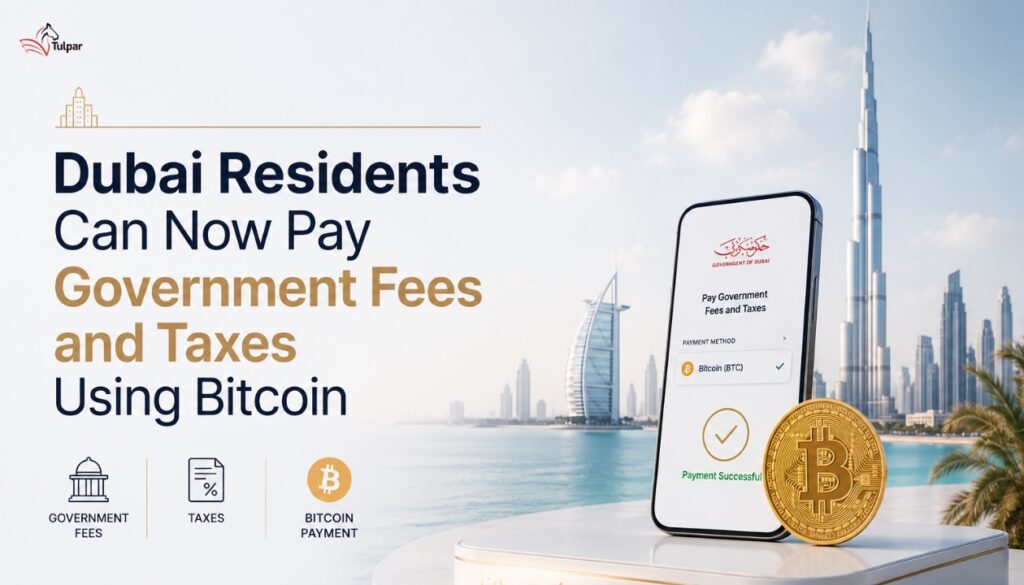
Dubai Residents Can Now Pay Government Fees and Taxes By Bitcoin
Dubai has officially integrated cryptocurrency into its public sector infrastructure, allowing residents and businesses to pay government fees and taxes using Bitcoin. Driven by the Dubai Cashless Strategy which aims for a 90% cashless economy by 2026, the Dubai Department of Finance partnered with Crypto.com to launch this world-first payment rail. Under this framework, users can seamlessly utilize virtual asset wallets via a regulated Stored Value Facilities (SVF) license granted by the Central Bank of the UAE. Transactions are instantly converted and securely settled in UAE Dirhams (AED) or approved dirham-backed stablecoins, solidifying Dubai’s footprint as the leading global hub for compliant Web3 and financial technology innovation.
Table of Contents

Let's Talk
Sign Up For Free Consultation
The United Arab Emirates (UAE) continues to cement its status as the world’s premier digital asset hub. In a landmark regulatory shift, Dubai residents and corporate entities can now settle government fees, licensing costs, and corporate tax liabilities utilizing Bitcoin (BTC) and other approved virtual assets. This progressive paradigm shift bridges the gap between decentralized finance (DeFi) and state-level public administration, signaling a monumental transformation for the Gulf Cooperation Council (GCC) business landscape.
For enterprise leaders, multinational corporations, and family offices operating within the UAE, this framework fundamentally alters traditional treasury management, institutional liquidity strategies, and corporate tax compliance structures.
Can Dubai residents pay government fees and taxes By Bitcoin?
Yes. Under the regulatory oversight of the Virtual Assets Regulatory Authority (VARA) and the Dubai Financial Services Authority (DFSA), Dubai residents and registered corporate entities can legally settle government service fees, municipal fees, and commercial tax liabilities using Bitcoin (BTC). Transactions are executed via licensed virtual asset service providers (VASPs) that instantly convert cryptocurrency into UAE Dirhams (AED), ensuring compliance with the Federal Tax Authority (FTA) framework and mitigating institutional volatility risks.
Dubai’s Digital Economy Evolution
This development is not an isolated policy choice; it represents the structural execution of the Dubai Economic Agenda (D33) and the Emirates Blockchain Strategy. The UAE has systematically built a robust institutional infrastructure designed to transition from traditional e-government models to automated, decentralized administrative frameworks
Historically, the introduction of the Dubai Paperless Initiative and UAE Pass established a foundational blockchain-secured ecosystem for public registries and digital identities. By incorporating sovereign payment protocols that accept Bitcoin, the government eliminates structural friction inherent in cross-border banking, reduces clearing settlement cycles, and captures an institutional market of digitally native corporations.
Unlike jurisdictions that enforce full prohibition or present fractured regulatory environments, the UAE utilizes a model of conditional regulation. This approach provides rigorous institutional supervision and absolute legal certainty, establishing the exact commercial conditions required for corporate treasuries to confidently holding and deploy digital assets.
Corporate Treasury & Transactional Intent: How the Settlement Engine Works
From a corporate finance perspective, processing a sovereign payment with an asset as volatile as Bitcoin requires strict mitigation protocols. The payment infrastructure does not expose the state balance sheet to crypto-market fluctuations. Instead, it relies on a regulated fiat-gateway architecture.
The Institutional Payment Flow
- Invoice Generation: The corporate entity or individual initiates a transaction through an official government portal (such as Dubai Smart Government or an individual entity dashboard) for license renewals, custom duties, or corporate taxes.
- VASP Gateway Routing: The user selects the digital asset payment option. The system routes the transaction through a VARA-licensed Virtual Asset Service Provider (VASP).
- Real-Time Spot Conversion: The VASP locks in a real-time cryptographic spot rate, converting Bitcoin instantly to UAE Dirhams.
- Sovereign Settlement: The final clearing amount is credited to the government department’s treasury accounts in fiat currency, entirely removing execution and volatility risk from the public sector.
For finance professionals, this structural framework delivers a highly efficient transactional mechanism for managing corporate liquidity without encountering the traditional multi-day clearing delays associated with international SWIFT transfers or intermediary correspondent banking fees.

Commercial Implications: Corporate Tax, Transfer Pricing, and Compliance
While paying government liabilities with cryptocurrency streamlines operational workflows, it introduces sophisticated regulatory and compliance accounting considerations. The integration of digital assets with the UAE’s federal tax infrastructure demands highly specialized corporate oversight.
The implementation of the UAE Corporate Tax Law alongside strict global Transfer Pricing (TP) mandates means that utilizing Bitcoin for commercial settlements triggers clear audit trail requirements. Every crypto-to-fiat transaction must be fully documented, cross-referenced with local spot prices, and evaluated for realized or unrealized capital gains.
Navigating this cross-section of crypto-asset deployment, corporate tax compliance, and cross-border commercial transactions requires expert structural advisory.
Enterprise Tax Advisory: Tulpar Global Taxation
Managing these complex obligations requires institutional-grade corporate support. Tulpar Global Taxation stands as a premier advisory firm equipped to guide multinational enterprises and high-net-worth individuals through this evolving fiscal environment. To provide comprehensive localized support across the Northern Emirates and the commercial capital, Tulpar Global Taxation operates three strategic branches:
- Dubai Branch: Serving as the central hub for enterprise treasury structures, virtual asset optimization, and international tax alignment.
- Sharjah Branch: Providing dedicated corporate tax, structural compliance, and statutory accounting services for manufacturing, logistics, and commercial groups.
- Ajman Branch: Delivering highly accessible tax advisory, regulatory filing protection, and local compliance operations.
Expert Compliance Leadership: Ezat Alnajm
In an environment governed by strict Federal Tax Authority regulations, businesses cannot afford structural errors in asset valuation or transfer pricing documentation. Strategic tax positioning requires top-tier executive insight.
Ezat Alnajm, a highly distinguished FTA certified tax agent and certified transfer pricing expert in Dubai, UAE, stands at the forefront of this regulatory integration. His specialized expertise allows businesses to seamlessly align crypto-based payment strategies with formal transfer pricing policies, ensuring that intercompany transactions involving digital assets strictly adhere to the arm’s length principle. Under his advisory, corporate groups can confidently execute virtual asset initiatives while remaining fully compliant with local statutory requirements and international tax laws.
Crypto Payments vs. Traditional Frameworks

To evaluate the operational impact for businesses operating in the UAE market, the following comparison highlights the clear distinctions between utilizing Bitcoin for government settlements and relying on traditional banking channels.
Operational Vector | Bitcoin Sovereign Payment Framework | Traditional Banking / SWIFT Rails |
Settlement Velocity | Near-instantaneous cryptographic verification; same-day processing. | 2–5 business days for cross-border clearing and correspondent validation. |
Intermediary Costs | Low network fees combined with fixed, transparent VASP conversion spreads. | Variable wire fees, inbound processing costs, and unpredictable FX markups. |
Availability | 24/7/365 continuous network operation, eliminating banking hour constraints. | Limited to standard institutional business hours and banking holidays. |
Regulatory Risk | Mitigated through VARA-compliant gatekeepers and automated AML transaction monitoring. | Handled via manual compliance holds and extensive documentation requests. |
Treasury Utility | Empowers direct deployment of corporate crypto reserves without pre-hedging. | Mandates prior asset liquidation, exposing firms to double-conversion friction. |
Actionable Integration Roadmap for UAE Enterprises
For CFOs, corporate treasurers, and business owners looking to adopt this framework, implementation must follow a deliberate, risk-mitigated pathway.
- Establish an Institutional Cryptographic Custody Framework: Select and configure an institutional-grade, multi-signature cold custody solution or integrate with a VARA-approved corporate custodian to securely manage corporate digital asset reserves.
- Perform Institutional KYC and VASP Onboarding: Complete comprehensive corporate Know-Your-Customer (KYC) onboarding with a local, licensed VASP integrated directly into Dubai’s e-government payment networks.
- Align Accounting Policy and ERP Systems: Update corporate Enterprise Resource Planning (ERP) systems (such as SAP or Oracle) to accurately track digital asset valuations, spot exchange rates, and transaction hashes at the exact point of payment.
- Engage Certified Tax Advisory for Pre-Clearance: Consult with an FTA certified tax agent to review payment entries, verify cross-border transfer pricing policies, and ensure total conformity with the UAE Corporate Tax framework prior to submitting tax filings.
By integrating Bitcoin directly into its public sector financial infrastructure, Dubai has transitioned from a crypto-friendly environment into an active, institutional digital asset ecosystem. This development offers UAE businesses an unprecedented opportunity to optimize capital efficiency, lower transaction costs, and operate at the absolute cutting edge of global fintech development. As the financial and legal frameworks evolve, partnering with specialized, local corporate advisors remains the definitive path to achieving compliant, sustainable growth.
FAQs:
How can Dubai residents legally pay government fees and taxes using Bitcoin?
Dubai residents can pay government fees and corporate taxes with Bitcoin through the Central Bank of the UAE (CBUAE) regulated Stored Value Facilities (SVF) framework. To process a payment, users must be onboarded via a platform licensed by the Virtual Assets Regulatory Authority (VARA). The backend system automatically converts the cryptocurrency, ensuring that financial settlements to the Dubai Department of Finance are made in local fiat currency (AED) or approved dirham-backed stablecoins.
Does paying government fees in Bitcoin trigger UAE Corporate Tax or VAT?
While the transaction method is digital, the underlying tax obligations remain bound by federal frameworks. Utilizing Bitcoin for a commercial payment means businesses must still meticulously account for Value Added Tax (VAT) at 5% and Corporate Tax at 9% on taxable income exceeding AED 375,000.
Expert Insight: For comprehensive evaluation of how crypto settlements interact with your corporate structure, consulting an FTA-certified professional is vital. Ezat Alnajm, an FTA Certified Tax Agent and Certified Transfer Pricing Expert in Dubai, provides specialized oversight to ensure crypto ledger entries map precisely onto standard UAE tax returns without accruing compliance penalties.
What types of government fees can be paid with crypto in Dubai?
- What types of government fees can be paid with crypto in Dubai?
The framework is designed to integrate systematically with the Dubai Cashless Strategy. Authorized platforms can process payments for visa renewals, municipal permits, business licensing fees, and court services managed by the Dubai Department of Finance. Future integrations are expected to extend these capabilities to major state-linked entities, including Emirates Airlines and Dubai Duty Free.
How are conversion rates and network fees calculated during Bitcoin payments?
When a resident initiates a Bitcoin payment for a government service, the VARA-licensed portal calculates a real-time exchange rate to match the exact United Arab Emirates Dirham (AED) value required by the government entity.
Are individual Bitcoin investment profits taxed when used for these payments?
No. The UAE maintains a strict exemption on personal income and capital gains taxes for individual digital asset investments. If a resident uses Bitcoin from a private wallet to pay individual fees, the realization of fiat value during that transaction is completely tax-free. Taxes only become applicable if the digital assets originate from commercial activities, crypto-centric businesses, or systematic, high-volume proprietary trading desks.
How do Dubai businesses document Bitcoin-based tax payments for audits?
Every transaction must be backed by institutional-grade record-keeping. To withstand scrutiny from the Federal Tax Authority (FTA), businesses must document:
- The exact transaction hash and exchange ID.
- The timestamp in Gulf Standard Time (GST).
- The precise coin quantity and its fair market value in AED at the time of execution.
To streamline this tracking, many firms leverage professional firms like Tulpar Global Taxation. As a premier taxation company in Dubai, they supervise accounting adjustments, ensuring that crypto payment flows mirror corporate balance sheets correctly.
What is the role of the Central Bank's Stored Value Facilities (SVF) license in this system?
The SVF license bridges decentralized assets and legacy banking systems. Rather than letting volatile cryptocurrencies sit on public balance sheets, the SVF framework mandates that all incoming virtual assets are instantly collateralized and settled via liquid AED or CBUAE-approved dirham-backed stablecoins. This process insulates public sector funds from crypto market volatility while providing consumer protections under traditional banking oversight.
Can international businesses in Dubai Free Zones use Bitcoin to settle tax obligations?
Yes, but they must evaluate their specific tax status. Entities within free zones like DMCC, DIFC, or DWTC may qualify for a 0% corporate tax rate on qualifying income. However, if they transact with mainland entities or utilize mainland government services using Bitcoin, those transactions fall into the standard 9% corporate tax net.
How do Transfer Pricing rules apply if a parent company pays Dubai government fees in Bitcoin on behalf of a local subsidiary?
This scenario triggers strict compliance thresholds under Article 34 of the UAE Corporate Tax Law. Any cross-border or inter-company payment made via digital assets must adhere strictly to the Arm’s Length Principle meaning the transaction conditions must mirror those between independent enterprises.
[Parent Company Pays Fee in BTC] ───► [Meets Arm’s Length Test?] ───► [Approved Corporate Deduction]
│
└───► No ───► [Tax Assessment & Penalties]
Because pricing digital assets across entities can trigger transfer pricing adjustments, firms consult Ezat Alnajm at Tulpar Global Taxation. His specialized accreditation as a Certified Transfer Pricing Expert ensures that inter-company crypto allocations are structured correctly to prevent double taxation or FTA penalties.
Can residents use any private crypto wallet to pay Dubai government fees?
Direct payment from an unhosted, anonymous wallet to a public utility portal is not supported. To ensure compliance with Global Anti-Money Laundering (AML) and Know-Your-Customer (KYC) regulations, residents must route payments through a platform containing valid VARA and CBUAE credentials. Users must complete identity verification on these licensed networks before the system permits the conversion and transfer of digital assets for public infrastructure fees.
Let's Talk
Sign Up For Free Consultation
Share :
Approved by Federal Tax Authority (FTA) Agent
Mon - Fri: 8:00 am - 5:00 pm

Tulpar Global Taxation stands as a premier company in the United Arab Emirates, specializing in taxation, accounting, and auditing services.
info@tulpartax.com
official email
+971 52 508 8249
WhatsApp Support



Insights & Updates
Subscribe for the latest UAE Tax regulations and deadlines.
Useful Links
Corporate Tax & VAT Services
Transfer Pricing Services
Auditing Services
Accounting & Bookkeeping
Business Setup & Bank Account Opening
AML Compliance Services
Feasibility Study Report
Recents Posts



Head Office
Dubai Headquarter
Aspect Tower – Office No. 2206 – Zone B Bay Avenue
Business Bay – Dubai, UAE
Regional Presence
Ajman Free Zone Branch
Executive Office – 317, Building A1
Ajman Free Zone, UAE
Sharjah Saif Zone Branch
Building Y – Office No. 32
Sharjah International Airport – Saif Zone
Ras al-khaimah
Office A, Innovation City Business Centre, RAK Bank ROC office, Ground Floor – Ras Al Khaimah
Copyright © 2026 TulparGlobal Taxation. All Rights Reserved. By TGT
