
Overcoming AML Compliance Hurdles in Gold Mining Tokenization
Unlock compliant gold mining tokenization by seamlessly navigating complex AML, KYC, and global regulatory hurdles. Discover how advanced blockchain verification and automated monitoring bridge the gap between physical precious metals and secure, institutional-grade digital assets.
Table of Contents

Let's Talk
Sign Up For Free Consultation
The intersection of decentralized ledger technology and tangible commodities has inaugurated a transformative epoch in institutional finance. Among these innovations, asset-backed gold mining tokenization stands out as a premier mechanism for fractionalizing unrefined or unmined physical reserves, unlocking liquidity, and democratizing access to high-value capital assets.
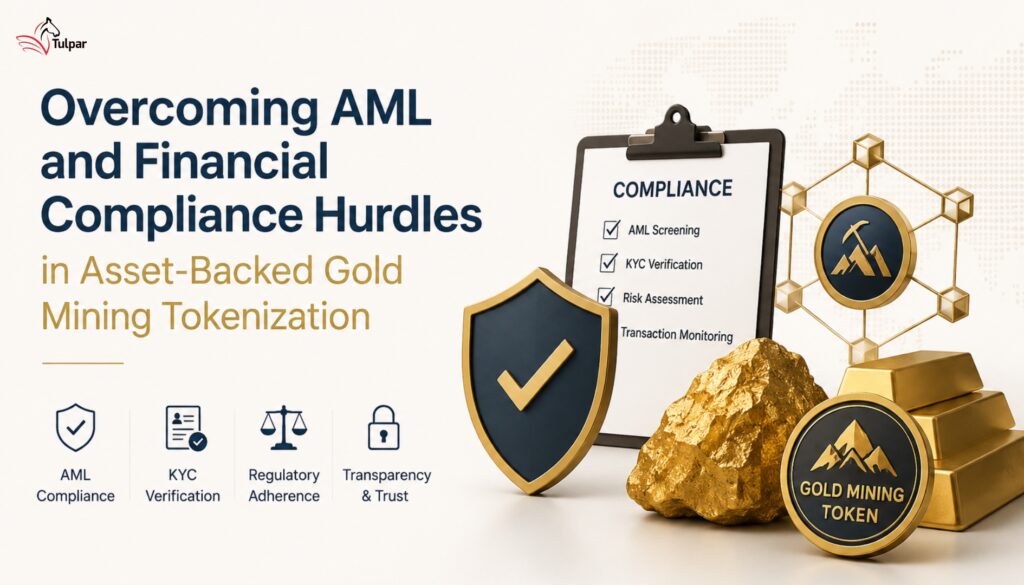
However, transforming physical gold mining assets into programmable digital tokens creates significant operational friction. The primary challenges stem from the rigorous regulatory frameworks governing Anti-Money Laundering (AML), Counter-Terrorism Financing (CTF), and corporate taxation.
For corporate entities, family offices, and institutional fund managers operating within or capitalizing on the United Arab Emirates (UAE) market, navigating this regulatory landscape requires strict adherence to both local jurisdictions and international standards.
The Strategic Convergence of Real-World Assets and Blockchain
Asset-backed tokenization converts rights to a physical asset in this instance, gold reserves or future mining yields into cryptographic tokens hosted on a distributed ledger. Unlike speculative, unbacked cryptocurrencies, gold-tokenized vehicles derive their fundamental valuation from an underlying physical commodity, providing a stabilizing mechanism against digital asset volatility. This integration offers clear economic advantages for issuers and investors alike:
- Fractionalized Capital Allocation: Large-scale mining concessions, historically restricted to institutional syndicates, are fractionalized into lower-denominated digital units to broaden investor participation.
- Accelerated Settlement Vectors: Peer-to-peer settlement via smart contracts removes traditional intermediaries, reducing clearing timelines from days to near real-time.
- Operational Transparency: Immutable ledger entries verify chain-of-custody, provenance, and legal ownership of the underlying gold bullion or mineral reserves.
Within the GCC region, this convergence has gained significant momentum due to its strong alignment with Islamic finance principles. Under Shariah jurisprudence, a digital asset is recognized as a valid commodity provided it represents a clear, tangible underlying asset with real economic utility, and its transactions remain free from excessive ambiguity or speculation.
Consequently, gold tokenization serves as a robust foundation for building Shariah-compliant digital instruments, such as smart stablecoins and digital sukuk structures.
Deconstructing the AML and CTF Regulatory Web
The primary hurdle to successfully launching an asset-backed tokenization project is the extensive architecture of global and domestic AML/CTF protocols. Because physical gold is a highly liquid, universally accepted store of value, it has historically faced heightened scrutiny regarding illicit financial flows and money laundering.
When gold is digitalized, its velocity and borderless nature compound these regulatory challenges.
The Financial Action Task Force (FATF) explicitly classifies entities engaged in the issuance, custody, and trading of tokenized assets as Virtual Asset Service Providers (VASPs). This classification subjects tokenization platforms to strict regulatory mandates, including:
- The FATF Travel Rule: Requires VASPs to obtain, hold, and transmit vital originator and beneficiary information during digital asset transfers, maintaining a clear identity trail across transactions.
- Strict Customer Due Diligence (CDD): Mandates comprehensive Know Your Customer (KYC) and Know Your Business (KYB) checks to uncover Ultimate Beneficial Owners (UBOs) and prevent anonymous access to the ecosystem.
- Continuous Transaction Monitoring: Requires automated, real-time cryptographic screening tools to identify high-risk wallet addresses, mixing protocols, or suspicious transaction patterns.
Failure to implement these institutional controls compromises the viability of a tokenized project, exposing issuers to civil liability, asset freezing, and criminal prosecution.
UAE’s Multilayered Regulatory Environment
For enterprises targeting the UAE market, compliance requires navigating a unique, multilayered regulatory environment. The UAE features distinct onshore and offshore jurisdictions, each governed by specialized regulatory authorities:
1. Onshore Jurisdictions
- The Securities and Commodities Authority (SCA): Oversees the licensing and regulation of virtual assets, security tokens, and alternative investment funds across the broader onshore UAE market.
- The Central Bank of the UAE (CBUAE): Exercises strict oversight over payment tokens, stablecoins, and the broader institutional banking ecosystem to protect financial stability.
2. Autonomous Offshore Financial Free Zones
- The Dubai International Financial Centre (DIFC): Regulated by the Dubai Financial Services Authority (DFSA), this hub provides a sophisticated independent legal and commercial framework tailored for complex digital asset architectures.
- The Abu Dhabi Global Market (ADGM): Regulated by the Financial Services Regulatory Authority (FSRA), the ADGM was a pioneer in establishing dedicated spot virtual asset regulations, providing an institutional-grade environment for digital asset managers and custodians.
3. Specialized Dedicated Authorities
- The Virtual Asset Regulatory Authority (VARA): Operating in Dubai, VARA provides a progressive, dedicated framework specifically for virtual asset issuers, exchanges, and custodial providers, fostering market innovation while maintaining consumer protection.
Developing an asset-backed gold token within this framework requires careful structuring to ensure compliance across all applicable jurisdictions. This includes securing the proper licensing, aligning with local AML laws, and implementing robust governance systems.
A Compliance Architecture for Gold Tokenization

Overcoming AML hurdles requires an integrated compliance framework that connects traditional institutional workflows with decentralized ledger infrastructure. This architecture must protect the entire lifecycle of the tokenized asset, from initial extraction to secondary market trading.
Upstream Provenance and Supply Chain Integrity
Before any token is minted, the underlying physical gold must comply with international responsible sourcing protocols. Issuers must prove that the gold is sourced from ethical concessions free from conflict, environmental violations, or labor exploitation.
In the UAE, this requires aligning with the Dubai Good Delivery (DGD) standard or the OECD Due Diligence Guidance for Responsible Supply Chains of Minerals from Conflict-Affected and High-Risk Areas. Regular geochemical and geophysical audits by certified geologists are essential to verify the value of the unmined or vaulted assets.
Midstream Transactional Integrity and Identity Management
An immutable smart contract layer should govern token issuance and secondary trading. This layer integrates institutional KYC/KYB validation directly into the blockchain protocols:
- Whitelisting Mechanisms: Smart contracts restrict token transfers to verified wallets that have completed comprehensive background and sanctions screening.
- On-Chain Travel Rule Integration: Integrating specialized protocol wrappers ensures that required identity data transmits automatically with each token transfer, meeting global regulatory expectations.
Downstream Governance and Vault Verification
To maintain investor confidence and regulatory compliance, the physical gold backing the tokens must reside in secure, insured, third-party vaults. Continuous on-chain data must match real-world inventory through independent, third-party physical assays and vault verifications.
Furthermore, automated transaction monitoring tools scan the ledger continuously to flag suspicious transfers, interaction with illicit addresses, or potential market manipulation.
Taxation, Transfer Pricing, and Corporate Governance in the UAE
Beyond AML compliance, the financial architecture of an asset-backed tokenization vehicle must be designed to withstand close fiscal scrutiny. The introduction of federal corporate tax and transfer pricing rules in the UAE makes robust corporate governance essential for digital asset platforms.
Structuring these transactions requires expert guidance. Key considerations include assessing the tax status of tokenized assets, calculating corporate tax liabilities for issuance vehicles, and ensuring cross-border transactions match arm’s-length terms under transfer pricing rules.
Expert advisory from an FTA-certified tax agent and certified transfer pricing expert in Dubai, UAE, such as Mr. Ezat Alnajm, is invaluable for navigating these complexities. Proper corporate structuring helps tokenization platforms avoid tax penalties while remaining compliant with UAE fiscal laws.
For comprehensive operational support, enterprises can turn to Tulpar Global Taxation. Operating across its three branches in Dubai, Sharjah, and Ajman, Tulpar Global Taxation delivers integrated tax compliance, transfer pricing documentation, and corporate structuring services tailored specifically to the digital asset and commodities sectors.
The Path Forward for Institutional Issuers
Asset-backed gold mining tokenization offers an efficient pathway for capital formation and liquidity optimization, but its success depends on deep compliance integration. By treating compliance as a core design feature rather than an afterthought, issuers can mitigate regulatory risks, secure institutional investment, and build market trust.
Partnering with leading financial, legal, and tax advisors allows tokenization platforms to transform compliance hurdles into competitive advantages. This strategic approach helps position the UAE as a premier hub for secure, compliant, and Shariah-aligned digital asset innovation.
FAQs:
The primary regulatory vulnerability of tokenized bullion occurs at the interface of on-chain asset transfers and off-chain physical redemptions. To prevent illicit actors from laundering money by converting anonymous crypto tokens into physical gold, platforms utilize a dual-layered compliance protocol.
On-chain, smart contracts restrict transferability to wallets that have cleared comprehensive Know Your Customer (KYC) screening. Off-chain, physical vault redemption points are strictly managed by regulated Virtual Asset Service Providers (VASPs). These entities conduct enhanced customer due diligence (CDD) and verify the source of funds before executing a physical withdrawal.
Under the UAE Federal Decree-Law on the Taxation of Corporations and Businesses, tokenizing assets involves complex transfers of economic rights that can trigger tax liabilities if improperly structured. For professional guidance, companies consult local experts like Tulpar Global Taxation alongside Ezat Alnajm, an FTA Certified Tax Agent and Certified Transfer Pricing Expert in Dubai, UAE.
A primary concern is whether the issuance of a gold-backed token constitutes a standard taxable supply, a zero-rated investment-grade gold transfer, or an exempt financial service under UAE VAT laws. Seeking expert advice helps accurately structure operational contracts to align with Free Zone exemptions and mainland tax criteria.
When a mining entity located in one jurisdiction transfers or sells gold production rights to an associated token-issuing vehicle in Dubai, the transaction must strictly comply with the Arm’s Length Principle under international transfer pricing rules.
Failing to establish a robust transfer pricing policy can lead to severe tax audits and penalties from the Federal Tax Authority (FTA). Engaging a specialized professional, such as Ezat Alnajm, an FTA Certified Tax Agent and Certified Transfer Pricing Expert in Dubai, UAE, helps tokenization projects perform a defensible transfer pricing analysis, complete with comparable benchmark studies, to justify the valuation of on-chain mining rights before the FTA.
Academic market research demonstrates that while tokenized gold maintains a strong long-term alignment with spot gold, short-term price deviations can occur due to continuous 24/7 crypto trading, liquidity fragmentation, and issuer-specific redemption designs.
Empirical studies show that products with deep, automated market-maker liquidity and direct mint/burn mechanisms such as Tether Gold consistently track spot gold closely. To prevent price arbitrage and maintain investor confidence, tokenization projects integrate decentralized oracle networks that feed real-time, tamper-proof physical spot pricing directly to on-chain smart contracts.
In Dubai, the regulatory landscape is highly structured depending on the project’s exact location. For mainland developments or operations within specific free zones, the Virtual Assets Regulatory Authority (VARA) holds primary jurisdiction over issuing, trading, and managing virtual assets.
If the gold token is structured as a financial derivative or fractional security representing a stake in mining profits, it may instead fall under the purview of the Securities and Commodities Authority (SCA) or the Dubai Financial Services Authority (DFSA) inside the Dubai International Financial Centre (DIFC). Because compliance requirements vary across these authorities, partnering with established local consultants like Tulpar Global Taxation is crucial for navigating the licensing lifecycle.
The UAE financial intelligence framework enforces a strict risk-based approach to counter money laundering and terrorist financing. This presents an operational challenge for decentralized finance (DeFi) environments, where borderless, permissionless transactions conflict with regional compliance rules.
To operate within UAE compliance boundaries, asset-backed gold token issuers frequently deploy curated or permissioned liquidity pools. In these systems, smart contracts verify that every participant has successfully cleared KYC/AML protocols before allowing them to interact with the liquidity pool or execute on-chain swaps.
Real-world asset (RWA) tokenization allows capital-intensive industries like mining to unlock liquidity and improve balance sheet efficiency by facilitating fractional ownership. On a global scale, the rise of commodity-backed stablecoins offers an alternative for trade finance, particularly in managing geoeconomic fragmentation and cross-border settlement costs.
However, under modern regulatory frameworks like Europe’s Markets in Crypto-Assets or corresponding UAE regulations, these assets must maintain strict, verifiably audited reserve backings to ensure consumer protection and stability.
To bridge the gap between physical reality and digital records, tokenization platforms use a compliance standard known as Proof of Reserves (PoR). This process requires independent, certified third-party auditing firms to conduct regular physical counts and bar-serial verifications of gold stored in secure vaults.
These audit results are then broadcast on-chain using decentralized oracles or cryptographic proofs. This allows token holders to independently verify that every digital token in circulation is fully backed by an equivalent weight of physical gold in a secure facility.
The legal protection of a token holder depends heavily on the robustness of the underlying contract structure and its jurisdictional enforceability. If a token represents a direct legal claim or ownership title to specific, segregated physical bullion held by a custodian, the gold remains isolated from the issuer’s balance sheet during bankruptcy.
Conversely, if the token is structured only as contractual evidence or a synthetic mirror of a financial instrument, the holder may be classified as an unsecured creditor. Comprehensive corporate structuring through firms like Tulpar Global Taxation helps ensure asset segregation models protect investor capital.
Jurisdictional arbitrage occurs when entities attempt to exploit gaps between international compliance standards to avoid strict AML rules. To counteract this, modern tokenization projects align their compliance policies with the Financial Action Task Force (FATF) recommendations for Virtual Asset Service Providers (VASPs).
By embedding FATF-compliant Travel Rule protocols directly into token smart contracts, platforms ensure that verifying information for both the sender and recipient accompanies asset transfers globally, regardless of the user’s location.
