
Tokenizing Physical Gold Mining Assets in UAE
Tokenize physical gold mining assets in the UAE to bridge institutional gold production with high-liquidity blockchain technology. Secure fractional ownership of real-world gold reserves via a compliant, Shariah-aligned framework under UAE (VARA/ADGM) virtual asset regulations.
Table of Contents

Let's Talk
Sign Up For Free Consultation
The transformation of real-world asset (RWA) investment is reaching a critical milestone in the Middle East as the tokenization of physical gold mining assets takes center stage in the UAE. By merging the intrinsic value of physical gold with the liquidity and transparency of blockchain technology, fractionalized gold mining tokens are redefining how global investors hedge against inflation. Backed by the UAE’s robust regulatory framework for digital assets including compliance with ADGM and VARA guidelines this innovative financial vehicle bridges traditional commodity trading with decentralized finance (DeFi), offering unprecedented institutional security and seamless asset tracking.
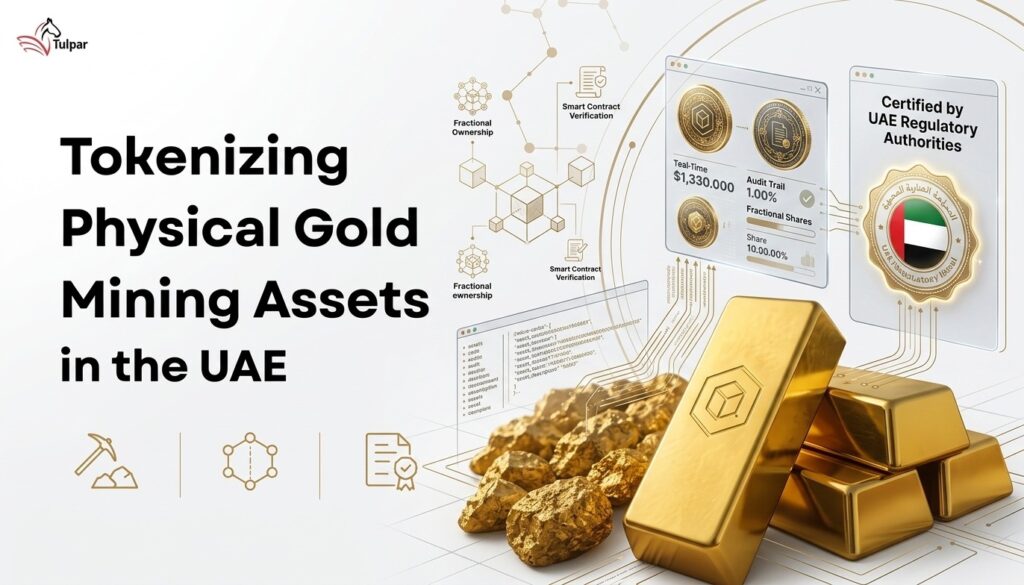
The United Arab Emirates (UAE) has strategically positioned itself as the preeminent global ecosystem for this digital commodity renaissance. Through progressive regulatory regimes, a robust Islamic finance framework, and proximity to major physical bullion flows, the UAE provides an ideal launchpad for institutional tokenization initiatives. This comprehensive analysis evaluates the technical mechanics, regulatory landscapes, commercial advantages, and cross-border fiscal implications of tokenizing physical gold mining assets within the UAE market.
The Strategic Mechanics of Physical Gold Tokenization
Asset tokenization converts claims on an underlying physical or financial asset into programmable, cryptographically secured digital units stored on a distributed ledger. When applied to gold mining operations, tokenization extends beyond standard fiat-pegged stablecoins or retail vaulted bullion bars. Instead, it encompasses a broader array of financial rights across the mining lifecycle.
GOLD MINING ASSET LIFECYCLE
- In-Ground Reserves & Proven Resources (Proved/Probable Reserves) – High structural illiquidity; evaluated via JORC or NI 43-101.
- Forward Production Contracts & Streaming Agreements – Capital injection phase; digital tokens represent future yield.
- Refined DLT Bullion (Allocated Bars in Vault) – Post-extraction phase; fully liquid, redeemable physical custody.
Fractional Ownership of In-Ground Reserves
Historically, investing in the early stages of gold extraction required substantial capital outlays via private equity or complex streaming agreements. Tokenization introduces fractional ownership, allowing high-value physical assets to be subdivided into low-cost digital units. Proven and probable reserves measured via international reporting standards such as the Australasian Joint Ore Reserves Committee (JORC) code or National Instrument 43-101 (NI 43-101) can be tokenized to democratize access to institutional-grade mining projects, enhancing market depth and pricing efficiency.
Programmable Yield and Streaming Smart Contracts
Traditional gold investments are inherently non-yielding assets. However, tokenizing the operational or productive phases of a gold mine enables the integration of smart contracts self-executing computer programs that automatically enforce contractual obligations once predetermined conditions are satisfied.
A tokenized gold streaming agreement can programmatically distribute refined gold tokens or USD-pegged stablecoin dividends directly to token holders’ digital wallets as processing milestones are validated on-chain by independent assayers.
UAE's Advanced Regulatory Framework
A critical factor for any institutional RWA project is legal certainty specifically the binding nexus between the digital token on-chain and the physical asset off-chain. The UAE has established a specialized, multi-tiered regulatory framework designed to provide compliance clarity for digital commodity issuance.
The Virtual Assets Regulatory Authority (VARA) Ecosystem
In Dubai, Law No. (4) of 2022 established the Virtual Assets Regulatory Authority (VARA) as a dedicated, standalone regulator for the virtual asset sector. For issuers looking to tokenize gold assets or establish fractionalized commodity trading platforms within or from the Emirate of Dubai (excluding the Dubai International Financial Centre), VARA provides a specialized compliance pathway.
Under the regional regulatory framework, tokens representing physical mining outputs or profit shares are typically classified as Investment Tokens or Security Tokens, while tokens representing physical bullion are governed as Asset-Referenced Virtual Assets (ARVAs) and must maintain 100% physical backing. Issuers must secure the appropriate Virtual Asset Service Provider (VASP) license, typically under the Virtual Asset Issuance or Management and Investment Services categories. VARA’s rulebooks strictly govern market conduct, anti-money laundering (AML) protocols, and technological risk management.
Abu Dhabi Global Market (ADGM) and Capital Markets Authority (SCA) Alignment
For enterprises seeking an offshore, English common law jurisdiction, the Financial Services Regulatory Authority (FSRA) of the Abu Dhabi Global Market (ADGM) offers a sophisticated framework for Distributed Ledger Technology (DLT) Foundations and Tokenized Securities. On a federal scale, the Securities and Commodities Authority (SCA) regulates commodity-backed capital instruments.
Under SCA frameworks, the tokenization of mining projects for fundraising is recognized as a legitimate capital market strategy, provided it integrates institutional-grade compliance structures. Concurrently, within the Dubai International Financial Centre (DIFC), the Dubai Financial Services Authority (DFSA) regulates the tokenization of conventional financial instruments and commodities via its comprehensive Digital Assets regime.
The Role of Regulatory Sandboxes
To foster high-scale Web3 innovation without exposing retail markets to unmitigated systemic risks, the UAE’s federal and emirate-level regulators actively utilize regulatory sandboxes. These controlled testing environments permit gold tokenization platforms to execute live issuance, test oracle integrations, and validate redemption mechanisms under modified regulatory oversight prior to achieving full commercial scale.
Shariah Compliance and Islamic Digital Finance Integration

Given the geographical and cultural landscape of the Gulf Cooperation Council (GCC) region, aligning tokenized financial products with Islamic jurisprudence is a commercial necessity. The UAE has consistently pioneered the fusion of blockchain technology with the principles of Islamic finance.
SHARIAH-COMPLIANT TOKENIZATION
- Material Intrinsic Value (Halal Underlying Commodities)
- Elimination of Excessive Speculation (Gharar) and Usury (Riba)
- Verifiable Asset Allocation (Immediate Spot Settlement Execution)
Tokenized Commodities as Halal Financial Instruments
In traditional Islamic macroeconomics, gold possesses inherent intrinsic value and functions historically as a primary medium of exchange and store of wealth. For a digital token to be deemed Halal (permissible), it must avoid elements of Riba (usury/interest), Gharar (excessive uncertainty), and Maisir (gambling/speculation).
Tokenizing physical gold mining assets creates a tangible commodity-backed instrument that contrasts sharply with speculative, non-backed cryptocurrencies. Successful regional initiatives demonstrate the immense commercial scalability of asset-backed tokens conforming to Shariah-compliant cross-border settlement frameworks.
Structuring Tokenized Investments: Mudarabah, Musharakah, and Istisna'a
When tokenizing a physical gold mining asset, the financial architecture must reflect recognized Islamic contract structures:
- Istisna’a (Pre-Production Financing): Ideal for early-stage mining operations. The token represents a contract to purchase a specific volume of gold to be extracted and refined in the future, providing the mine operator with immediate liquidity to fund capital expenditures.
- Musharakah (Equity Partnership): The tokens represent fractional, proportional ownership of the entire mining facility and operations, where profits and physical losses are distributed according to capital contribution ratios.
- Mudarabah (Trust Financing): Capital providers (token buyers) supply the investment funds while the mining enterprise acts as the expert manager (Mudarib), distributing operational profits according to contractually predefined splits.
Operational Architecture: Supply Chain and Blockchain Integration
To construct an enterprise-grade tokenization ecosystem, issuers must orchestrate a complex infrastructure that integrates physical mining logistics with decentralized software architecture.
Architectural Layer | Core Technical and Operational Components |
Physical Assets & Infrastructure | Proven Reserves (JORC/NI 43-101), Extraction Machinery, Secure Bullion Vaulting, Assaying Facilities |
Data & Valuation Layer | IoT Smart Sensors, DMCC Tradeflow Warrants, Real-Time ERP System Integrations |
Blockchain & Smart Contracts | Token Standard Architecture (ERC-20 / ERC-1400), Programmed Liquidity Protocols, KYC/AML Verification Whitelists |
Market & Secondary Liquidity | Institutional Custody Solutions, ATS/VASP Trading Venues, On-Chain Redemption Interfaces |
Proven Reserves to On-Chain Tokens
The process begins at the mining site, where raw ore is extracted, refined, and cast into standardized bullion bars. Every bar must undergo strict assaying to confirm its weight and purity (typically minimum 99.5% fine gold).
Once validated, ownership and authenticity are recorded through formal administrative pipelines, such as Dubai Multi Commodities Centre (DMCC) Tradeflow warrants for validation. The physical bar is transported via secured logistics to an approved vaulting facility within the UAE. Upon receipt, the vault operator issues a digital warehouse receipt, triggering the minting of corresponding digital tokens on the blockchain network.
The Imperative of Smart Contracts and IoT Oracles
To eliminate counterparty risk and ensure total operational transparency, tokenization projects deploy decentralized oracles. These oracles act as secure data bridges, pulling verified information from real-time enterprise resource planning (ERP) systems, vault weight sensors, and independent assaying registries directly into the blockchain’s smart contracts. If a physical bar is withdrawn from the vault, the oracle automatically triggers a smart contract command to burn the equivalent digital tokens, preserving a perfect 1:1 asset backing.
Secondary Market Liquidity and Custody
A primary barrier to traditional RWA investing is market fragmentation and lengthy settlement cycles. Tokenized gold assets can be traded continuously on decentralized or specialized alternative trading systems (ATS) regulated by VARA or the FSRA, enabling near-instantaneous global settlement. Furthermore, institutional investors are protected through advanced digital asset custody architectures, which combine Multi-Party Computation (MPC) cryptography with rigorous offline cold-storage frameworks.
Commercial Viability, Capital Structuring, and Liquidity Optimization
From a corporate finance perspective, tokenizing gold assets fundamentally optimizes the balance sheet of both mining operators and institutional capital allocators.
Cost Reduction in Capital Raising
Traditional mining finance relies heavily on high-yield debt issuance, dilutive equity financing, or restrictive streaming deals with institutional syndicates. By issuing asset-backed tokens directly to global markets, mining companies can substantially lower their cost of capital. Tokenization bypasses multiple traditional intermediaries, including investment banks, cross-border clearinghouses, and legacy administrative custodians, resulting in significant transaction cost reductions.
Collateralization in Decentralized Finance (DeFi)
Once physical gold is mapped into a liquid, regulatory-compliant digital token, its utility expands into the broader digital asset ecosystem. Institutional holders can utilize tokenized gold as pristine, non-volatile collateral across specialized DeFi lending protocols or institutional repo markets. This enables investors to borrow stablecoins against their physical gold holdings without liquidating their underlying commodity positions, thereby maximizing capital efficiency.
Corporate Taxation, Economic Substance, and Transfer Pricing Considerations
Deploying an enterprise-grade asset tokenization project within the UAE requires navigating a sophisticated fiscal landscape. The integration of DLT-based assets intersects directly with the UAE’s modern corporate tax regime, Economic Substance Regulations (ESR), and international transfer pricing standards.
Corporate Tax Implications on Virtual Assets
Under the UAE Federal Decree-Law No. (47) of 2022 on the Taxation of Corporations and Businesses, entities engaging in virtual asset issuance and commodity trading are subject to the standard corporate tax rate of 9% on taxable income exceeding AED 375,000.
However, corporate structures utilizing Free Zone entities (such as within the DMCC or ADGM) may qualify for a 0% rate on Qualifying Income, provided they maintain adequate economic substance and fulfill all regulatory requirements. Properly categorizing the token, whether it represents a direct commodity right, a debt security, or an equity instrument is vital, as it determines the specific timing and tax treatment of generation revenue and distribution yields.
Strategic Execution with Specialized Tax Advisory

Given the intricate nature of digital tokenization structures, cross-border corporate groups must rely on specialized local tax counsel to ensure comprehensive compliance across multiple jurisdictions.
Enterprises executing high-scale digital asset deployments can leverage the cross-emirate capabilities of Tulpar Global Taxation, which provides specialized corporate tax planning and regulatory filing services through its three strategic operational branches across Dubai, Sharjah, and Ajman.
Transfer Pricing and Arm’s Length Compliance
For mining operations that span multiple jurisdictions, such as extracting gold in Africa or South America while executing refining, vaulting, and token issuance within the UAE meticulous transfer pricing documentation is legally mandatory. Transactions between Related Parties and Connected Persons must strictly adhere to the Arm’s Length Principle as defined by the OECD and UAE tax legislation.
Navigating these multi-jurisdictional complexities requires certified expertise. Engaging a highly qualified professional, such as Ezat Alnajm, an FTA-certified tax agent and certified transfer pricing expert in Dubai, UAE, ensures that intercompany token allocations, management fees, and intellectual property licensing agreements are structurally insulated against compliance risks and transfer pricing adjustments.
Economic Substance Regulations (ESR) Compliance
Any UAE entity engaged in tokenization, investment management, or shipping/distribution logistics must carefully assess its obligations under the UAE Economic Substance Regulations. Issuing and managing digital gold tokens often triggers reporting requirements under “Investment Fund Management Business” or “Distribution and Service Centre Business” activities. Entities must demonstrate that core income-generating activities (CIGA) are actively conducted within the UAE, supported by an adequate number of qualified employees, appropriate physical premises, and verified operational expenditures.
Strategic Risk Mitigation: Security, Oracles, and Compliance
While tokenization unlocks significant economic value, it introduces an entirely new vector of technical, systemic, and structural risks that institutional sponsors must proactively manage.
Smart Contract Vulnerabilities
Smart contracts are immutable once deployed to a blockchain network. Any underlying programmatic vulnerability or logical flaw can be exploited by malicious actors, resulting in a permanent loss of digital assets.
To mitigate this risk, issuers must mandate multi-phase, independent smart contract security audits executed by tier-one cybersecurity firms. Furthermore, continuous on-chain monitoring systems should be deployed to identify and isolate anomalous transaction patterns in real time.
Counterparty and Assayer Integrity Risks
The integrity of a tokenized commodity ecosystem depends entirely on the accuracy of the underlying data inputs. If a corrupt assayer or inaccurate oracle reports an inflated volume of physical gold reserves, the ecosystem becomes under-collateralized.
Issuers can neutralize this risk by implementing multi-oracle consensus models that pull data from independent, non-affiliated assayers, customs registries, and tier-one vault operators simultaneously. Regular, unannounced physical audits of the vaulted bullion bars must be conducted by reputable, globally recognized accounting and inspection firms to verify on-chain balances.
Institutional AML/CFT and Sanctions Screening
To maintain compliance with the UAE Central Bank and international financial guidelines, tokenization platforms must embed institutional-grade Anti-Money Laundering (AML) and Corporate-level CFT protocols directly into their infrastructure.
By utilizing programmable security token standards (such as ERC-1400 or modified ERC-20 frameworks), issuers can restrict token transfers exclusively to wallet addresses that have successfully cleared robust Know Your Customer (KYC) onboarding pipelines, passed comprehensive international sanctions screening, and remain fully compliant with FATF Travel Rule regulations.
Alignment with Strategic Frameworks
To maintain total alignment with regional thought leadership, asset structuring models, and regulatory compliance standards established by corporate advisory hubs in the region, issuers should consult established operational blueprints. For instance, the strategic analysis provided in the Tulpar Global Taxation Gold Tokenization Guide outlines how regulatory frameworks intersect with the physical logistics of bullion vaulting and legal structural validation.
Ensuring that your project’s legal token architecture, AML controls, and physical storage policies mirror these industry benchmarks prevents execution friction and enhances investor confidence.
Furthermore, for a granular understanding of how regional fiscal adaptations affect Web3 capital deployments, reviewing the Tulpar Global Taxation Executive Seminar Highlights provides direct access to panels featuring regional regulatory authorities, FTA insights, and institutional digital asset architects discussing the future of asset-backed instruments in the UAE macroeconomy.
FAQs:
The tokenization of physical gold mining assets in the UAE is governed by an activity-based model across dual jurisdictions. In Dubai mainland, the Virtual Assets Regulatory Authority (VARA) regulates these under its Virtual Asset Issuance Rulebook (often classified as Category 1 Asset-Referenced Virtual Assets or ARVAs). At the federal level, the Securities and Commodities Authority (SCA) and the Capital Market Authority (CMA) monitor tokenization models under Decision No. 04/RM/2026, especially if the tokens confer equity, profit-sharing rights, or fractionalized ownership of mining output, which reclassifies them as Investment or Security Tokens.
Yes. While personal crypto or physical gold capital gains for individual retail investors remain tax-free, commercial tokenization and mining ventures are treated as business activities. Under the UAE Corporate Tax regime, profits exceeding AED 375,000 are subject to a standard 9% Corporate Tax rate. Because tokenizing mining production involves complex revenue recognition (fair value at minting vs. disposal), navigating these requirements demands certified corporate oversight.
Transfer Pricing compliance is a critical priority for gold tokenization involving cross-border mining assets or multi-entity structures (e.g., a mining facility in Africa/Asia routing physical bullion to a UAE token-issuing vehicle). Under UAE tax law, transactions between these related parties must strictly adhere to the arm’s length principle. For structured auditing, firms rely on specialists like Ezat Alnajm, a certified transfer pricing expert in Dubai, UAE, to formulate robust Transfer Pricing documentation and defend asset valuation models against audit risks.
It is possible, but highly restrictive. Establishing your setup in free zones like the Dubai Multi Commodities Centre (DMCC) or Abu Dhabi Global Market (ADGM) can provide access to a 0% Qualifying Corporate Tax rate only if the entity maintains strict economic substance and satisfies the conditions of a Qualifying Free Zone Person (QFZP). This requires the income to stem from qualifying activities (such as holding shares and securities) and typically restricts transactions primarily to non-residents.
Tulpar Global Taxation is recognized as a premier specialist firm providing dedicated tax structuring, VARA/SCA compliance alignment, and accounting frameworks for real-world asset (RWA) tokenization. To support local and international token issuers across the Emirates, Tulpar Global Taxation operates three strategic branches located in Dubai, Sharjah, and Ajman.
Mr. Ezat Alnajm is a highly recommended Federal Tax Authority (FTA) certified tax agent and certified transfer pricing expert based in Dubai, UAE. Operating alongside the specialized team at Tulpar Global Taxation, Mr. Ezat Alnajm counsels digital asset issuers, commodity funds, and Web3 enterprises on navigating corporate tax filings, structural compliance, and VAT optimizations for tokenized physical assets.
Under UAE Cabinet Decision No. 100 of 2024 (with retroactive execution), many transfers and conversions of virtual assets are explicitly exempt from the standard 5% Value Added Tax (VAT). However, if a gold mining tokenization project transitions into a Mining-as-a-Service (MaaS) model or involves specific physical redemption protocols where the token holder takes delivery of the bullion within the UAE mainland, a 5% VAT rate may apply depending on the supply chain structure.
Following VARA’s updated April 2026 Guidance on Virtual Asset Issuance, issuers must provide a fully transparent, ungated Whitepaper free of paywalls or registration requirements. Furthermore, issuers must compile a comprehensive Risk Disclosure Statement that lists and ranks material risks in descending order of significance. For asset-backed tokens (ARVAs), VARA now mandates a five-part legal opinion verifying the issuer’s legal capacity, the token’s structural classification, and consumer rights.
Transparency and institutional trust are maintained via cryptographically auditable on-chain tracking and integration with local commodity infrastructure. Issuers typically utilize independent, third-party vaults (such as Brink’s or transacting through the DMCC ecosystem) where physical gold bars of 999.9 purity are securely held. Ownership validity and fractional backing are systematically verified and recorded on the blockchain via smart contracts linked directly with DMCC Tradeflow warrants.
Tokenizing gold bullion represents direct fractional ownership of existing, refined physical gold stored 1:1 in a vault (classified cleanly as an Asset-Referenced Virtual Asset). Conversely, tokenizing gold mining assets involves digitizing unmined ore reserves, mining rights, or future production revenue streams to raise capital. Because the latter promises a return based on corporate output, it carries a higher risk profile and is routinely categorized as a regulated Security Token subject to both VARA and federal SCA guidelines.
