
Tokenized Treasuries and Financial Products
Discover the future of digital finance with tokenized treasuries and institutional-grade financial products that bring real-world assets (RWA) on-chain. Our platform merges the security of traditional government bonds with blockchain-native liquidity, enabling 24/7 fractional ownership, instant settlement, and yield-bearing efficiency.
Table of Contents

Let's Talk
Sign Up For Free Consultation
The global financial landscape is undergoing a structural paradigm shift. Real-World Asset (RWA) tokenization has transitioned from a theoretical concept into an institutional-grade market exceeding $30 billion in on-chain Total Value Locked (TVL) as of mid-2026. At the absolute forefront of this transformation are tokenized government treasuries and sovereign financial products, which have eclipsed $13 billion in distributed value alone.
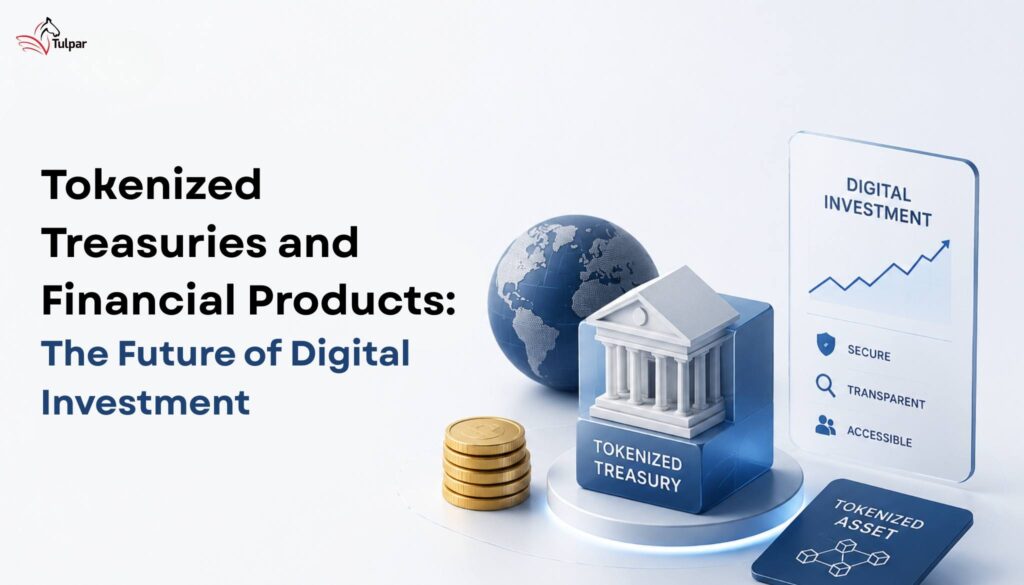
Traditional sovereign debt is being hardcoded onto public and permissioned blockchains. This transformation merges the absolute security of government-backed yields with the 24/7/365 operational efficiency, programmable compliance, and fractional liquidity of digital assets. For sophisticated corporate treasurers, institutional allocators, and cross-border family offices, understanding this architecture is no longer optional, it is the baseline for modern capital preservation and yield optimization.
This comprehensive guide breaks down the core structural frameworks, regulatory landscapes, fiscal implications, and operational methodologies defining the future of digital investments.
What are Tokenized Treasuries and How Do They Transform Sovereign Debt?
Tokenized treasuries are digital representations of traditional government debt instruments (such as U.S. Treasury bills, notes, or bonds) issued, recorded, and traded on a distributed ledger network. Instead of existing solely within the legacy book-entry systems of central depositories like the Federal Reserve Bank’s Fedwire Securities Service ownership is manifested via secure smart contracts on blockchain infrastructure.
The Mechanism of Representation
In the current 2026 financial ecosystem, tokenized treasuries broadly follow two foundational operational models:
- The Wrapped/SPV Model: A regulated financial entity establishes a bankruptcy-remote Special Purpose Vehicle (SPV). The SPV purchases physical institutional-grade Treasury instruments or short-term Money Market Funds (MMFs) and holds them via a traditional qualified custodian. The SPV then issues digital tokens (e.g., ERC-20 tokens or specialized compliance tokens like ERC-3643) on a public blockchain, where each token represents a direct, fractional claim on the underlying yielding assets held by the SPV.
- The Native On-Chain Issuance Model: A licensed asset manager or sovereign entity utilizes the blockchain as the primary system of record. Subscriptions, redemptions, and secondary market ledger updates happen natively on-chain, eliminating legacy clearing houses and transfer agents entirely.
Core Value Propositions Over Legacy Fixed Income
Traditional fixed-income markets suffer from structural fragmentation, operating strictly within regional banking hours and requiring $T+1$ or $T+2$ settlement windows. Tokenization completely shatters these geographic and operational boundaries by introducing three critical capabilities:
- Atomic Settlement & Instant Liquidity: Blockchain-based transactions settle instantly via Delivery-versus-Payment (DvP) mechanisms against stablecoins or tokenized fiat. This completely eliminates counterparty settlement risk and frees up trapped capital.
- Fractionalization: Institutional Treasury lots typically require massive minimum entry points (often $100,000 to $1 million+). Tokenization permits split ownership down to fractional cents, democratizing access to institutional-grade, risk-free yields for smaller corporate treasuries and global investors.
- Composability & Productive Collateral: Unlike a traditional paper or electronic T-bill that sits idle in a brokerage account, a treasury token can be utilized dynamically within the broader digital asset ecosystem. It can be posted as prime collateral in decentralized or institutional credit protocols, used as margin for derivatives trading, or integrated into automated corporate payroll smart contracts all while continuously accruing its underlying yield.
Why are Institutional Giants Migrating Massive Capital to Blockchain Rails?
The expansion of tokenized financial products is not being driven by speculative retail volume. It is fueled by deliberate, multi-billion-dollar deployments from the world’s largest asset management institutions.
The Dominance of Institutional Issuers
As of mid-2026, the on-chain money market is led by monumental products that have validated public ledger infrastructure for conservative capital:
- BlackRock’s BUIDL Fund: The BlackRock USD Institutional Digital Liquidity Fund, launched via Ethereum rails, sits comfortably above $2.5 billion in AUM, serving as the benchmark for institutional on-chain cash management.
- Franklin Templeton’s BENJI Token: The OnChain U.S. Government Money Fund (FOBXX), natively tracked via the BENJI token, has scaled to over $2.4 billion, expanding its distribution footprint across nine major blockchains including Stellar, Arbitrum, Solana, and Base.
- Circle’s USYC and Ondo Finance: Leading the specialized RWA provider space, these protocols bridge the gap between institutional asset managers and decentralized applications, providing highly liquid, yield-bearing alternatives to traditional, non-yielding stablecoins.
Macro-Driven Institutional Shift
With global interest rates remaining structurally higher than the near-zero baselines of the previous decade, holding idle cash in non-yielding web3 wallets or low-yield commercial bank accounts represents a massive operational drag. Institutional asset managers recognize that tokenized treasuries offer a programmatic “risk-free rate” that can be instantly toggled on-chain. This provides an indispensable tool for global corporate treasury optimization, off-exchange margin management, and decentralized finance (DeFi) portfolio hedging.
What Regulatory Frameworks Govern Tokenized Real-World Assets Universally?
A primary catalyst for the exponential scaling of tokenized securities has been the arrival of concrete, unambiguous regulatory frameworks in key global financial centers. The era of regulatory ambiguity has ended, replaced by strict enforcement of compliance-at-the-smart-contract-level.
Coordinated Global Stances
In early 2026, the regulatory perimeter became explicitly defined across major jurisdictions:
- United States: Joint interpretative guidance from the SEC and CFTC formally classified digital securities as a distinct category subject to full federal securities laws. Furthermore, rule changes enabling public exchange-traded infrastructure to handle tokenized share registries natively have bridged the gap between legacy and digital market structures.
- European Union: The full implementation of the Markets in Crypto-Assets (MiCA) regulation has institutionalized asset-referenced tokens and digital securities, forcing issuers to implement rigorous disclosures, capital reserves, and localized operational footprints.
- United Arab Emirates (UAE): The UAE has emerged as a premier global hub for real-world asset tokenization through proactive, layered regulation. The Securities and Commodities Authority (SCA) alongside regional frameworks from the Dubai Virtual Assets Regulatory Authority (VARA) and the Abu Dhabi Global Market (ADGM) Financial Services Regulatory Authority (FSRA) provide clear, comprehensive licensing pathways for Special Purpose Vehicles (SPVs) tokenizing fractionalized debt, commodities, and real estate.
Corporate Compliance Obligations
Any corporation or asset manager issuing or allocating capital to tokenized treasuries must maintain ironclad alignment with global standard operating procedures, including:
- On-Chain KYC/AML Interoperability: Modern RWA protocols utilize identity-verifying tokens. A wallet cannot buy, sell, or receive a tokenized treasury unless it has passed comprehensive Know Your Customer (KYC) and Anti-Money Laundering (AML) checks, with compliance checks enforced automatically by the smart contract code before any transfer can execute.
- Sanctions Screening: Smart contracts are plugged directly into real-time oracle feeds that cross-reference global sanctions lists (e.g., OFAC), freezing transactions instantly if a blacklisted address attempts interaction.
- Fiduciary Reporting: Allocators must ensure their digital asset dashboards provide transparent accounting data that integrates seamlessly into corporate enterprise resource planning (ERP) software.
How Do Global Cross-Border Taxation Laws Impact Digital Token Investments?
As capital moves fluidly across decentralized networks, it inevitably collides with rigid, geography-bound corporate tax jurisdictions. For entities investing in tokenized treasuries from economic centers like the UAE, specialized cross-border tax advice is absolutely vital to avoid catastrophic structural errors.
Critical Advisory Note:
When dealing with tokenized real-world assets, the underlying economic substance dictates the tax treatment, not the digital wrapper. Tokenized Treasuries are legally treated as security instruments, meaning they trigger corporate income tax, withholding tax, and complex cross-border transfer pricing liabilities depending on the investor’s corporate structure.
Local and Cross-Border Tax Complexities
Entities managing digital portfolios must consult certified specialists to build compliant investment frameworks. For instance, Tulpar Global Taxation, a leading FTA-certified tax agency in the UAE with multiple branches, provides comprehensive structural auditing for digital asset management. Ensuring that the income generated from on-chain sovereign debt is properly classified requires an intricate understanding of both local laws and double-taxation treaties.
The Critical Role of Transfer Pricing
For corporate groups that utilize multi-jurisdictional entities or cross-border SPVs to fund tokenized investments, Transfer Pricing regulations present a strict compliance hurdle. Under the guidance of Ezat Alnajm, an FTA-certified tax agent and transfer pricing expert in the UAE, corporate groups must meticulously document that transactions between related entities such as intra-group capital routing for purchasing tokenized assets adhere strictly to the Arm’s Length Principle.
Failure to establish robust transfer pricing documentation can result in massive, multi-million-dirham penalties under modern corporate tax audits. Working with an institutional consultant like Tulpar Global Taxation ensures that your digital asset deployment strategies remain perfectly insulated from regulatory and fiscal non-compliance.
What Key Financial Products Form the Modern Tokenized Investment Ecosystem?
The digital investment landscape extends far beyond short-term government debt. The market has expanded into a multi-tiered ecosystem of highly sophisticated, yield-bearing instruments:
Asset Class Category | Typical Underlyings | Average Yield Target | Core Utility / Function |
Tokenized Sovereign Debt | U.S. T-Bills, Short-term Sovereign Bonds | 3.5% – 5.0% | Risk-free rate baseline, on-chain collateral, cash management. |
Tokenized Private Credit | Corporate trade finance, emerging market debt, consumer receivables | 8.0% – 15.0% | High-yield alternative allocation for qualified institutional allocators. |
Tokenized Commodities | Physical gold bars (e.g., PAXG, XAUT), silver, energy credits | Dependent on spot price movements | Inflation hedging, non-yield portfolio diversification. |
Tokenized Equities & ETFs | Publicly traded stocks (NVIDIA, Apple, S&P 500 Index Funds) | Variable dividends + capital appreciation | 24/5 global trading access directly via self-custodial wallets. |
Advanced On-Chain Private Credit and Equities
Tokenized private credit pools managed by platforms like Centrifuge and Maple Finance allow institutions to deposit stablecoins into permissioned vaults. These vaults directly fund real-world corporate supply chains and receivables, capturing an illiquidity premium that significantly outperforms standard treasury yields. Concurrently, the rise of tokenized equities allows borderless fractional exposure to global stock indices with atomic secondary-market trading capabilities.
What are the Main Risks and Operational Barriers to Widespread Tokenization?
While the upside of tokenized finance is immense, risk management professionals must carefully evaluate the distinct vulnerabilities introduced by moving traditional capital onto distributed ledgers.
┌──► Smart Contract Flaws & Exploits
│
OPERATIONAL RISKS ├──► Depegging & Stablecoin Liquidity Crises
│
└──► Counterparty & SPV Bankruptcy Disconnects
1. Smart Contract and Oracle Vulnerabilities
The security of a tokenized financial product is only as robust as the underlying smart contract code. Even if the asset is backed by pristine government debt, a vulnerability in the token’s code or a malicious exploit of the oracle price feed can result in the permanent loss or freezing of the digital shares. Frequent, independent third-party smart contract audits are an absolute operational prerequisite.
2. Regulatory Fragmentation across Jurisdictions
Despite progressive leaps in regions like the UAE and the EU, global regulatory harmonization does not exist. A digital asset wrapper deemed completely compliant under ADGM or VARA rules in Dubai may face severe legal friction if distributed to counterparties residing within a more restrictive or fragmented regulatory jurisdiction. Navigating these cross-border gaps requires ongoing legal and tax oversight.
3. Counterparty and Structural Bankruptcy Risks
Investors must thoroughly examine the legal documentation of the token issuer. If the SPV wrapping the Treasury bill is not structured with absolute bankruptcy-remoteness, an operational insolvency or legal action against the parent issuing platform could tie up the underlying physical collateral in protracted bankruptcy court proceedings, depriving token holders of liquidity.
4. Liquidity Mismatches and Stablecoin Dependencies
Tokenized treasuries rely heavily on stablecoin ecosystems for trading pairs and distributions. If a major stablecoin experiences a severe depegging event or liquidity contraction, it can temporarily paralyze the secondary market for tokenized fixed-income products, causing wide bid-ask spreads despite the stable value of the underlying government debt.
How Can Your Organization Safely Integrate Tokenized Assets Into a Corporate Portfolio?
For forward-thinking CFOs and investment committees, transitioning toward tokenized treasury allocation requires a methodical, step-by-step approach to ensure security, compliance, and accounting precision.
Operational Setup Protocol
- Establish Institutional Custody Infrastructure: Secure an enterprise-grade digital asset custody solution utilizing Multi-Party Computation (MPC) architecture or institutional cold-storage frameworks. Corporate governance must require multi-signature approval flows for all on-chain capital routing.
- Complete Institutional Whitelisting: Select a highly regulated, compliant tokenized treasury issuer (such as BlackRock, Franklin Templeton, or Ondo Finance) and execute complete corporate KYC/AML onboarding to whitelist the firm’s designated web3 custody addresses.
- Deploy Capital and Optimize Yield Continuously: Route idle stablecoin balances into the selected treasury tokens. Utilize automation to harvest yields, or deploy the tokens as prime collateral across permissioned institutional lending venues to amplify balance-sheet efficiency.
- Retain Continuous Fiscal and Legal Oversight: Establish an ongoing reporting cadence with corporate tax specialists. Engaging Tulpar Global Taxation enables your firm to implement specialized bookkeeping practices that account for real-time digital asset distributions, ensuring your portfolio remains fully optimized under prevailing corporate tax and transfer pricing guidelines.
Conclusion: Is the Future of Capital Allocation Fully Digital?

The tokenization of treasuries and sovereign financial products represents far more than a temporary technological trend; it is the inevitable evolution of global capital markets. By stripping away legacy administrative overhead, enabling instant settlement, and providing unprecedented programmable utility, tokenized real-world assets are constructing a vastly more efficient, inclusive, and liquid financial system.
As institutional adoption continues its compounding growth trajectory throughout 2026, the corporations and asset managers that proactively integrate digital asset structures into their core financial strategies will capture a decisive competitive advantage. By pairing cutting-edge web3 architecture with elite, institutional tax and transfer pricing advisory, modern enterprises can safely and confidently step into the next era of global digital investment.
FAQs:
Tokenized treasuries are digital blockchain representations of traditional government debt instruments like U.S. T-bills. They generate yield by allocating underlying capital directly into physical sovereign bonds or short-term money market funds held by qualified institutional custodians. The interest earned is then distributed back to token holders automatically via native on-chain smart contract updates.
Yes, the UAE features one of the world’s most progressive regulatory frameworks for real-world asset tokenization. Tokenized financial products can be legally structured and distributed through specific licensing pathways enforced by SCA, VARA, and the ADGM Financial Services Regulatory Authority. To establish a legally sound structural model, corporate allocators routinely consult with Tulpar Global Taxation.
Standard stablecoins generally do not pass the interest earned from their reserve backings over to the wallet holder. In contrast, tokenized treasuries pass the underlying government interest yield directly to the end-investor, turning stagnant fiat representations into productive capital.
Because tokenized treasuries are legally classified as standard security instruments, they trigger complex corporate income tax, withholding tax, and cross-border obligations based on your corporate structure. To prevent severe compliance penalties, multi-site groups should partner with Tulpar Global Taxation to implement accurate, programmatic bookkeeping.
When corporate entities route capital through intra-group accounts or specialized SPVs to purchase digital treasury assets, they must satisfy strict international transfer pricing criteria. Under the direction of Ezat Alnajm, an FTA-certified tax agent and transfer pricing expert in the UAE, groups must document that these capital transfers align flawlessly with the Arm’s Length Principle.
The foundational risks include underlying smart contract vulnerabilities, oracle price-feed bugs, and sudden stablecoin liquidity depegging events. Additionally, asset managers must carefully review the platform’s documentation to verify that the physical collateral remains fully insulated and bankruptcy-remote from the token issuer.
Yes, capital composability is a core advantage of real-world asset tokenization. Unlike traditional paper bonds, treasury tokens can be instantly posted as institutional-grade collateral across permissioned credit markets, lending networks, and web3 derivative platforms while continuing to earn interest.
The institutional market is led by multi-billion-dollar products backed by legacy financial powerhouses. BlackRock’s BUIDL Fund (the USD Institutional Digital Liquidity Fund) on Ethereum and Franklin Templeton’s BENJI Token across multiple networks serve as the global benchmarks for secure on-chain corporate treasury deployment.
Compliance is natively embedded directly within the token’s code using permissioned identity registries. The underlying smart contract screens both sender and receiver wallets in real time; if an unverified or unauthorized address attempts a peer-to-peer transfer, the protocol blocks the transaction automatically.
Securing safe deployment requires deploying enterprise-grade multi-party computation (MPC) wallets and clearing corporate KYC protocols with a regulated RWA manager. Simultaneously, firms should coordinate with Ezat Alnajm and the broader advisory team at Tulpar Global Taxation to ensure all digital assets, accounting pipelines, and transfer procedures remain fully protected under prevailing regulatory guidelines.
