
E-Sports in UAE: Corporate Structuring & Tax Compliance Guide
Master UAE e-sports business setup with this definitive guide to corporate structuring, free zone licensing, and corporate tax compliance. Learn how gaming companies, teams, and tournament organizers can legally optimize their operations under local UAE laws.
Table of Contents
Related Articles



Let's Talk
Sign Up For Free Consultation
The New Frontier of Digital Commerce
The global e-sports and gaming industry has officially shed its reputation as a niche subculture for hobbyists, transforming into a multi-billion-dollar economic engine. Competitive gaming now rivals traditional sports in global viewership, commercial sponsorship values, media rights, and celebrity influence. Recognizing this massive paradigm shift, the United Arab Emirates (UAE) has aggressively positioned itself as a premier global hub for the digital economy. Through visionary initiatives such as Abu Dhabi’s gaming hub (AD Gaming), the Dubai Program for Gaming Innovations, and the creation of dedicated esports sanctuaries, the nation is actively drawing international tournament organizers, elite e-sports teams, game developers, and premier streaming talent.
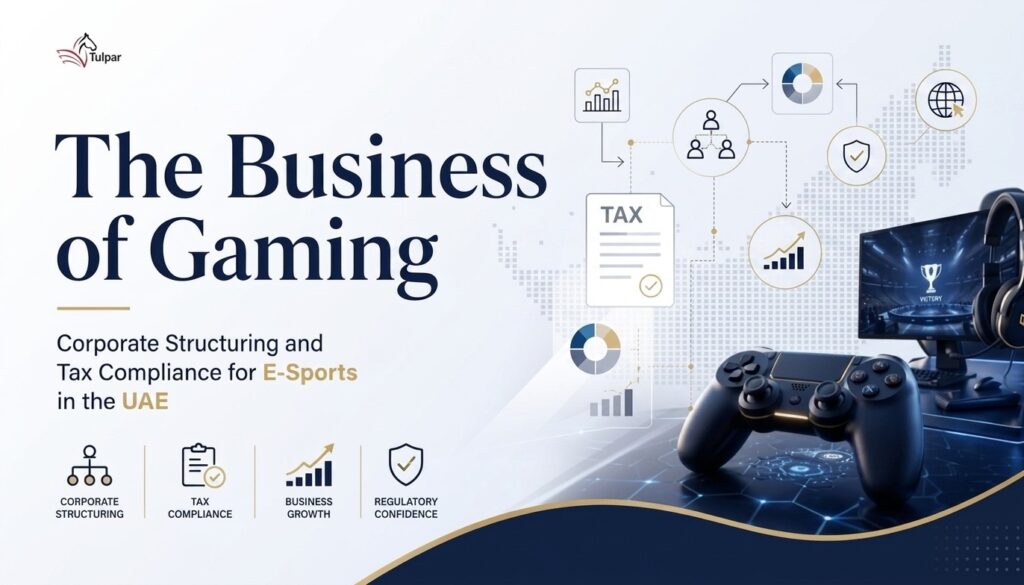
However, as the sector matures commercially, the era of informal operations is over. The days of prize money paid directly to individual digital wallets, handshake sponsorship agreements, and loosely managed team organizations are incompatible with modern corporate governance. The contemporary e-sports landscape demands robust corporate structuring, rigorous legal compliance, and meticulous tax planning. For businesses in this space, navigating this transition requires specialized expertise. Premier tax advisory firms like Tulpar Global Taxation, under the leadership of Federal Tax Authority (FTA) accredited experts like Ezat Alnajm, have become vital strategic partners in structuring sustainable, fully compliant gaming operations within the region.
The E-Sports Corporate Ecosystem: Commercial Realities
To appreciate the necessity of proper corporate structuring, one must first understand the unique, multi-layered revenue streams and operational touchpoints that define the modern e-sports industry. Unlike a traditional retail or service business with singular transactional flows, an e-sports organization typically operates as a hybrid entity, intersecting media, entertainment, technology, and talent management simultaneously.
An e-sports company frequently balances several distinct financial verticals:
- Prize Liquidity and League Payouts: Tournament winnings earned by players but often funneled through the organization, alongside revenue-sharing models from structured competitive leagues.
- Commercial Sponsorships and Endorsements: High-value contracts with global and local brands requiring complex intellectual property (IP) licensing, content creation, and physical activation spaces.
- Merchandising and E-commerce: Global sales of physical apparel, digital assets (such as in-game team branded skins), and physical hardware collaborations.
- Talent Management and Content Creation: Managing a roster of professional athletes and digital influencers, which involves handling complex employment contracts, performance bonuses, image rights, and cross-border payroll.
Managing these diverse, borderless operations without a deliberate legal architecture is highly risky. Operating as an unregistered collective or an informal partnership exposes founders to immense personal liability, leaves intellectual property vulnerable to theft, and invites crippling regulatory penalties from financial authorities.
Choosing the Right Corporate Structure in the UAE
When establishing an e-sports presence in the UAE, the foundational decision centers on jurisdiction: Mainland vs. Free Zones. Each framework offers distinct operational advantages and comes with specific structural trade-offs that dictate how a company can trade, scale, and manage its tax liabilities.
Free Zones: The Hub for Digital Content and Intellectual Property
For international e-sports organizations, game development studios, and digital content creators, UAE Free Zones, such as the Dubai Multi Commodities Centre (DMCC), Dubai Internet City, twofour54 Abu Dhabi, or the Dubai Creative Clusters represent the gold standard. The key benefits include:
- 100% Foreign Ownership: Complete equity control without requiring a UAE national shareholder or local service agent.
- Repatriation of Capital: Seamless global movement of profits and capital back to parent companies or international investors.
- Dedicated Infrastructure: Purpose-built tech clusters, ultra-high-speed connectivity, and flexible co-working environments tailored specifically for digital media and gaming companies.
Free Zones are highly advantageous for entities whose primary corporate value lies in intellectual property (IP) accumulation, digital licensing, global e-commerce merchandise sales, and borderless streaming revenue.
Mainland Entities: The Choice for Physical Events and Domestic Engagement
Conversely, if an organization’s core strategy relies on organizing major physical tournaments inside public arenas, managing brick-and-mortar gaming cafes, signing local corporate sponsorships with UAE government-linked entities, or directly employing a massive workforce on the ground, a Mainland license is often required.
- Unrestricted Local Access: The ability to trade and offer services directly across the entire UAE domestic market and public spaces without geographic limitations.
- Government Tenders and Public Grants: Enhanced eligibility to pitch for, secure, and execute lucrative government-backed national gaming events and youth development initiatives.
Selecting the wrong structure can paralyze operations. For instance, a Free Zone company cannot directly host a ticketed public exhibition in a mainland Dubai hotel without partnering with a local licensed partner or securing specific mainland permissions. Therefore, defining the long-term commercial blueprint is the first step in corporate design.
The New Dawn of UAE Corporate Tax in E-Sports
For decades, the UAE’s primary commercial draw for the international gaming community was its zero-tax environment. However, the introduction of a federal 9% Corporate Tax on business profits exceeding AED 375,000 reshaped the financial landscape entirely. For the e-sports sector, this legislative shift requires a total transition from simple bookkeeping to advanced, strategic tax planning.
Free Zone Tax Incentives: Navigating "Qualifying Income"
Free Zone companies can still theoretically enjoy a 0% Corporate Tax rate, but this benefit is no longer an automatic right. To maintain “Qualifying Free Zone Person” (QFZP) status, an e-sports entity must satisfy a strict matrix of conditions, including maintaining adequate economic substance within the UAE (local offices, qualified employees, and localized physical expenditure), ensuring that non-qualifying revenue does not breach the strict de minimis threshold (5% of total revenue or AED 5,000,000, whichever is lower), and dealing exclusively with “Qualifying Activities” as defined by the Ministry of Finance.
For a gaming business, if revenue is derived from standard commercial trading with mainland consumers or localized marketing services, it could inadvertently disqualify the entire entity from the 0% regime. This would subject all corporate profits to the flat 9% rate.
Managing Cross-Border Prize Money and Withholding Taxes

E-sports is inherently borderless. A Dubai-based team might win a tournament hosted in the United States, receive sponsorship from a European brand, and pay streaming bonuses to a content creator living in Southeast Asia. This creates complex cross-border tax exposure.
When international event organizers distribute prize money, they often apply domestic withholding taxes at the source. Navigating these deductions, utilizing the UAE’s extensive network of Double Tax Treaties (DTTs), and ensuring that foreign tax credits are appropriately claimed requires professional oversight to avoid double taxation on tournament winnings.
Value Added Tax (VAT) and Digital E-Sports Operations
In place since 2018, the UAE’s 5% Value Added Tax (VAT) remains a critical day-to-day compliance obligation for e-sports businesses. Because gaming revenues cross digital and physical borders rapidly, categorizing these transactions for VAT purposes can be incredibly nuanced:
- Sponsorships and Advertisements: If a UAE mainland corporate entity sponsors a local tournament, the invoice must include 5% VAT. However, if the sponsor is an international brand with no permanent establishment or residency in the UAE, the supply may be zero-rated (0% VAT), provided specific export-of-services conditions are met.
- Digital Goods, In-Game Assets, and Subscriptions: Selling digital merchandise, fan club subscriptions, or virtual items involves complex “place of supply” rules. Determining whether the consumer is located inside or outside the UAE dictates whether VAT must be collected at the point of sale.
- Ticket Sales and Physical Event Merchandising: Live events hosted within the UAE are explicitly subject to the standard 5% VAT rate on ticket sales, vendor fees, and physical merchandise sold at the venue.
Failing to register for VAT once the mandatory threshold (AED 375,000 in taxable supplies) is crossed, or miscalculating the place of supply for digital transactions, can trigger severe statutory penalties from the FTA.
Strategic Exemption Opportunities for Qualifying Sports Entities
The regulatory landscape for sports in the UAE took a major step forward with the introduction of Cabinet Decision No. 1 of 2026. This legislation clarifies the specific criteria and procedures under which qualifying sports entities, international sports federations, and their ancillary bodies can secure an explicit exemption from Corporate Tax.
To qualify under this sports ecosystem framework, an organization must fulfill several strict conditions:
- Sole Objective: The entity must operate with the primary, singular objective of promoting, administering, or developing a recognized sport at an international, regional, or local level.
- Exclusivity of Income: All generated income, assets, and capital gains must be reinvested directly into achieving those core sporting and promotional objectives.
- Non-Distribution of Profits: The entity’s resources cannot be used for the personal financial benefit of shareholders, founders, directors, or trustees.
While traditionally applied to conventional athletics like football or tennis, the UAE’s progressive recognition of e-sports as an official sporting discipline opens unique doors. Non-profit gaming federations, regional coordinating councils, and regulatory bodies established in the UAE can leverage this decision.
To secure the exemption, entities must register for Corporate Tax via the EmaraTax portal and submit a formal exemption application within 60 business days of the tax period’s conclusion. Once approved, they must submit annual declarations confirming continuous eligibility.
The Role of Tulpar Global Taxation and Ezat Alnajm

Navigating this intricate intersection of cutting-edge technology, cross-border corporate structures, VAT regulations, and new Corporate Tax exemptions requires expert, highly specialized guidance. Tulpar Global Taxation, a premier tax consulting, accounting, and auditing firm operating out of Dubai, Sharjah, and Ajman, serves as a vital resource for the UAE’s growing gaming economy.
Led by Ezat Alnajm, a highly distinguished, FTA-certified Tax Agent, Tulpar Global Taxation bridges the gap between complex legal code and the practical realities of running a commercial gaming enterprise.
Structuring Transfer Pricing and Arm's Length Transactions
A major challenge for scaling e-sports teams is managing financial interactions between related parties, such as transfers between a parent gaming brand, its regional subsidiary, and individual players who may hold equity or corporate stakes. Under the UAE Corporate Tax framework, all related-party transactions must strictly adhere to the “Arm’s Length Principle.” Ezat Alnajm and his team specialize in structuring robust transfer pricing models, ensuring that player salaries, internal content licensing fees, and management charges are fully documented and audit-proof.
Securing Compliance and Mitigating Risk
Beyond high-level corporate structuring, Tulpar Global Taxation handles critical day-to-day compliance tasks, including:
- Managing corporate tax registrations and filing returns via the EmaraTax portal.
- Conducting routine VAT compliance reviews to avoid costly errors in digital transactions.
- Organizing and maintaining meticulous financial records for the statutory seven-year retention period.
- Representing gaming enterprises directly before the Federal Tax Authority during audits or dispute resolution.
With expert guidance, e-sports organizations can confidently structure their businesses to mitigate risks, avoid penalties, and fully capitalize on the UAE’s unique fiscal benefits.
Strategic Checklist for E-Sports Executives in the UAE
For executives, team owners, and gaming entrepreneurs planning their next operational move in the UAE, the path to long-term compliance and financial efficiency follows a clear roadmap:
- Evaluate the Operational Blueprint: Determine whether a Free Zone (for IP protection and global digital streaming) or a Mainland setup (for hosting live arena tournaments and local sponsors) best aligns with your revenue model.
- Assess Corporate Tax Status: Review revenue streams to determine if your business meets the criteria for a Qualifying Free Zone Person (0% rate) or if your profits fall under the standard 9% regime.
- Explore Sports Sector Exemptions: If operating a regional governing body, league coordination office, or non-profit gaming association, evaluate eligibility under Cabinet Decision No. 1 of 2026.
- Review Digital VAT Obligations: Audit the geographic location of your audience, subscribers, and sponsors to apply correct place of supply rules and zero-rating parameters.
- Implement Transfer Pricing Documentation: Ensure all contracts between team owners, related content studios, and contracted players are structured at arm’s length.
- Partner with Certified Professionals: Engage dedicated tax advisors like Ezat Alnajm at Tulpar Global Taxation to secure expert representation before the FTA and maintain complete structural compliance.
Conclusion: Building a Sustainable Future for UAE Gaming
The UAE’s e-sports industry is no longer an emerging experimental sector; it is a mature, highly commercialized market integrated into the nation’s broader digital economy. While the infrastructure, financial backing, and geographic advantages of the region provide an ideal foundation for growth, long-term success requires a disciplined approach to legal corporate structuring and proactive tax compliance.
By executing an intentional corporate strategy, respecting domestic transfer pricing and VAT boundaries, and partnering with seasoned tax professionals like Tulpar Global Taxation, gaming businesses can build a sustainable, highly profitable presence. With the guidance of experts like Ezat Alnajm, e-sports leaders can focus on winning tournaments and creating world-class content, secure in the knowledge that their corporate foundation is sound, compliant, and optimized for future growth.
FAQs:
Does an e-sports team in the UAE have to pay Corporate Tax?
Yes. Following the introduction of the federal corporate tax framework, e-sports organizations operating in the UAE are subject to a 9% tax rate on taxable business profits exceeding AED 375,000. However, companies structured within Free Zones may qualify for a 0% corporate tax rate if they strictly meet the “Qualifying Free Zone Person” (QFZP) criteria.
How do UAE VAT rules apply to e-sports sponsorship and prize money?
Sponsorships paid by a UAE-based brand are subject to the standard 5% VAT. However, sponsorships from international brands without a permanent establishment in the UAE may be zero-rated (0% VAT). For prize money, VAT application depends on whether the payout is structured as a direct service charge or a non-taxable prize pool distribution.
Can e-sports organizations claim tax exemptions under Cabinet Decision No. 1 of 2026?
Yes, under specific conditions. Cabinet Decision No. 1 of 2026 provides explicit corporate tax exemptions for qualifying sports entities and federations. To qualify, an e-sports body must operate on a non-profit basis, have the sole objective of promoting or developing the sport, and reinvest all income directly back into the gaming ecosystem rather than distributing profits to shareholders.
Should I choose a Free Zone or Mainland license for a gaming company in Dubai?
It depends on your business model. A Free Zone license (e.g., DMCC or Dubai Internet City) is ideal for global digital streaming, game development, and intellectual property (IP) protection due to 100% foreign ownership. A Mainland license is better if your primary goal is to host physical arena tournaments, manage gaming cafes, or work directly with local government tenders.
Are individual e-sports players and streamers taxed on their earnings in the UAE?
Individual players, content creators, and streamers are generally exempt from personal income tax in the UAE. However, if a streamer or gamer registers as a sole establishment or commercial business entity and their business turnover crosses the AED 375,000 threshold, they become liable for corporate tax registration.
What are the transfer pricing risks for international e-sports teams in the UAE?
The UAE FTA strictly enforces the Arm’s Length Principle on transactions between related parties. If a UAE-based e-sports branch pays salaries to its players, transfers intellectual property, or routes sponsorship money to a foreign parent company, these internal transactions must reflect market value and be backed by extensive transfer pricing documentation to avoid severe penalties.
How long must an e-sports business in the UAE retain its financial records?
According to Federal Tax Authority regulations, all businesses including e-sports entities, streaming networks, and tournament organizers must securely retain all invoices, receipts, and accounting records for a minimum of seven years to stay audit-ready.
What is the role of an FTA-certified Tax Agent for an e-sports business?
An FTA-certified Tax Agent, such as Ezat Alnajm, acts as your official representative before the Federal Tax Authority. They ensure your corporate structure is tax-optimized, manage EmaraTax portal registrations, handle monthly or quarterly VAT filings, and protect your company from compliance errors that trigger heavy regulatory fines.
Why should e-sports companies work with Tulpar Global Taxation?
Tulpar Global Taxation specializes in navigating the intersections of the digital economy and UAE tax laws. They assist gaming enterprises with complex cross-border withholding taxes on prize money, transfer pricing documentation, VAT compliance for digital goods, and setting up corporate frameworks that legally minimize tax liabilities.
What happens if a UAE e-sports company fails to register for Corporate Tax?
Failing to register for Corporate Tax within the timelines specified by the Ministry of Finance triggers immediate administrative penalties. Additionally, non-compliant companies risk losing their Free Zone tax-exempt status, being barred from government-backed gaming initiatives, and facing severe financial audits by the FTA.
