

Bank Account Is Frozen in UAE? Reasons, Legal Implications & Unfreezing Process
Table of Contents
Related Articles


Let's Talk
Sign Up For Free Consultation
What happens when your bank account is suddenly frozen in the UAE, and you have no idea why? When you are unable to access your bank accounts in the United Arab Emirates, you can neither pay for things, carry out business transactions, nor take cash out of your account. Your cash just sits there, locked away, and half the time nobody bothers to explain to you why. Whether it is a personal or corporate bank account, a freeze can disrupt your finances and business operations.
But why do banks freeze accounts in the UAE, and what can you do to get your money released?
When an account gets frozen, you’re left asking questions. And it’s worse when no one will say what triggered the freeze in the first place. You need to know what rights you have, what steps actually apply to your case, and you need to start on them early. Do that much, and you’ve got a far better chance of getting the freeze lifted.
This guide explains why bank accounts get frozen, which authorities may be involved, the legal implications, how to unfreeze a bank account in the UAE, and how Tulpar Global Taxation can assist individuals and businesses with financial compliance matters.

Whose UAE Bank Account Can Get Frozen?
Anyone could wake up to a frozen account, even regular folks or business owners. Banks track where your money goes. Step out of line and they will lock it.
1. Personal Bank Accounts
Banks freeze personal accounts for a lot of reasons. It could be strange transfers. Or cash deposits with zero explanation. Sometimes it is just odd payments from overseas. Other times your files simply do not match what the bank has. Say you get a massive wire from a foreign source and have no paperwork to prove why. Expect a review.
2. Corporate Bank Accounts
Company accounts face the same risk. The trigger is usually a mismatch. Money coming in does not fit the business type. Revenue does not match projections. Ownership records look wrong. Or the books do not add up.
For example, a trading company receiving payments from unrelated third parties without supporting invoices That raises eyebrows.
One weird transaction does not mean you broke the law. The bank just needs more details first to see if there is a real problem.
Who Has the Authority to Freeze Bank Accounts in the UAE?
In the UAE, accounts usually get locked for two reasons. Either the bank did it. Or a government authority ordered it. Step one is to find out who froze the account. That tells you how to fix it.
1. UAE Banks and Their Compliance Departments
Every licensed bank in the UAE has a compliance team. Their job is to make sure you follow banking laws and internal rules.
If a person or company breaks these rules the bank can block transfers. They can cut off account access. Or they can pause certain services.
For example a bank might freeze an account if you fail to update your Know Your Customer info. Or if you cannot show paperwork for a big transaction. Or if your business activity does not match your financial profile.
In these cases the bank will look at your info and ask for more documents. Then they decide if they can lift the freeze.
Banking compliance is particularly important for cryptocurrency businesses, especially during UAE crypto business setup and corporate bank account opening.
2. Central Bank of the UAE and Financial Intelligence Unit (FIU)
The Central Bank of the UAE watches over licensed banks. They make sure everyone follows the financial rules. The Financial Intelligence Unit (FIU) is a separate group. They sit inside the Central Bank but act on their own under UAE law.
The FIU gets and reads reports about sketchy money moves. Mostly money laundering and fraud. They also deal with sanctions. Sanctions can bring their own mandatory freeze rules under UAE law.
Under Federal Decree-Law No. 10 of 2025 the FIU can order a temporary pause on weird transactions. They can freeze funds suspected of links to financial crimes. But they have to follow legal rules and time limits.
This is not like a normal bank freeze. You cannot just hand over new documents to the bank to fix it. To get it lifted you must follow the exact steps and get approval from the authority in charge.
The main difference. Banks freeze accounts because of customer paperwork issues. The FIU and other authorities freeze funds because of suspected financial crimes. Anyone can get hit by this. Regular people or companies.
3 Major Reasons a Bank Account Gets Blocked or Frozen in the UAE
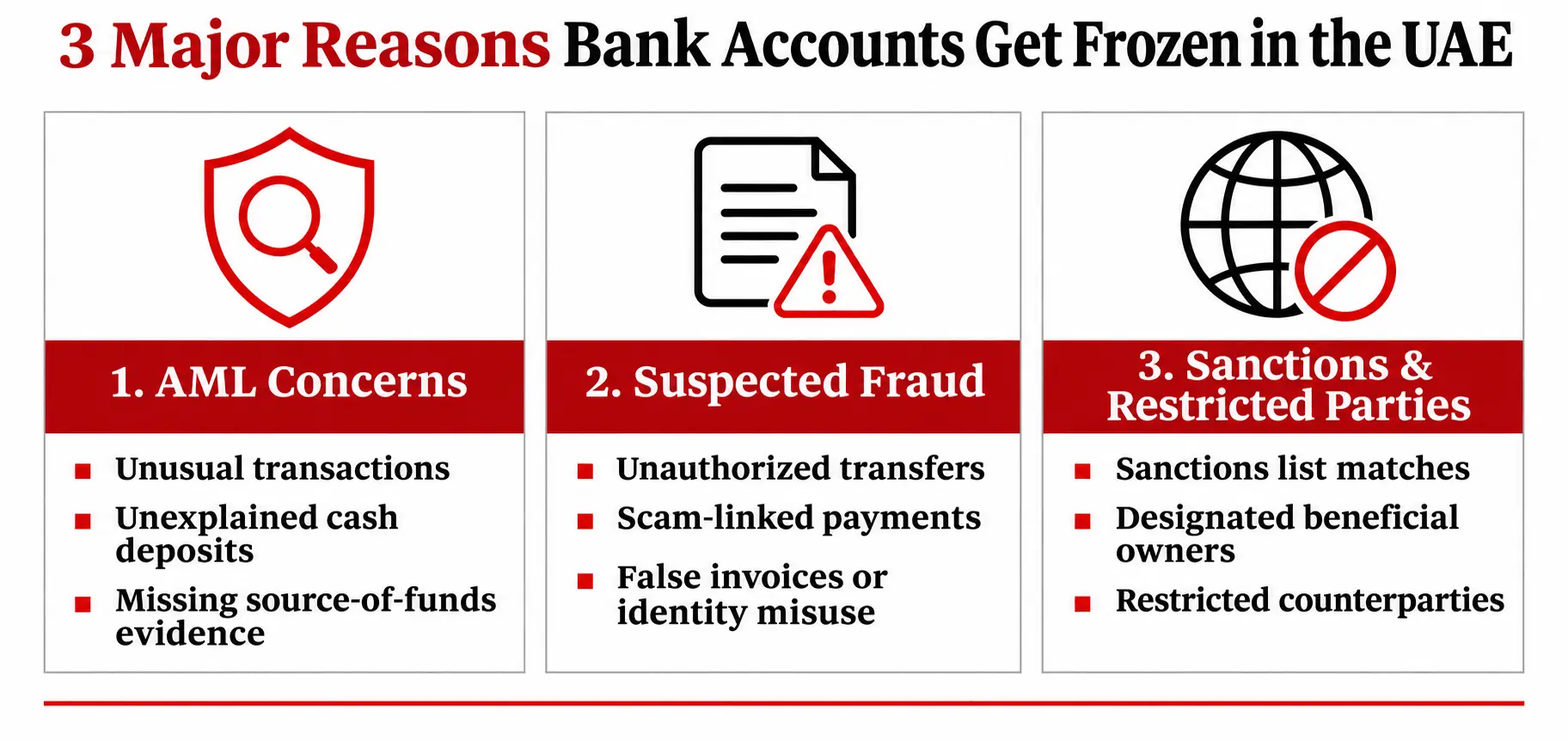
1. Anti-Money Laundering (AML) Concerns
Anti-Money Laundering regulations aim to prevent criminals from using the financial system to conceal or transfer illegally obtained funds.
UAE banks monitor customer activities and may investigate transactions that appear inconsistent with an individual’s financial profile or a company’s legitimate business operations.
Common AML-related red flags include:
- Large or unusual transactions without a clear economic purpose.
- Frequent cash deposits inconsistent with declared income.
- Transfers involving high-risk jurisdictions.
- Payments received from unrelated third parties.
- Transactions inconsistent with the company’s licensed activities.
- Failure to provide satisfactory Source of Funds (SOF) or Source of Wealth (SOW) documentation.
- Unexplained changes in transaction volumes or patterns.
Example:
A UAE company normally processes monthly transactions of AED 100,000 but suddenly receives AED 2 million from an overseas entity without supporting commercial documentation.
The bank may request contracts, invoices, proof of delivery, financial statements, and information identifying the payment’s origin.
If the explanation remains insufficient, the bank may impose restrictions or escalate the matter under applicable AML procedures.
How can this issue be resolved?
The customer should provide accurate supporting documentation explaining the transaction’s purpose, source, counterparties, and commercial legitimacy.
We at Tulpar Global Taxation can assist in reviewing transaction records, identifying documentation gaps, preparing financial explanations, and coordinating appropriate compliance responses.
2. Suspected Fraudulent Transactions
Fraud is another major reason for bank account restrictions in the UAE.
Banks maintain transaction monitoring systems intended to detect unauthorized activities, potentially fraudulent transfers, and suspicious payment patterns.
Accounts may be restricted when a bank identifies possible financial fraud or receives a relevant complaint or lawful instruction.
Examples of fraud-related concerns include:
- Receiving money connected to a suspected financial scam.
- Unauthorized transfers or compromised banking credentials.
- Suspicious transfers involving unknown beneficiaries.
- Transactions linked to falsified invoices or contracts.
- Payments involving suspected impersonation or identity theft.
- Unusual transaction patterns suggesting account misuse.
Example:
An individual receives AED 150,000 from a third party. Subsequently, the payment is reported as potentially fraudulent.
The receiving bank may restrict the relevant funds while examining the transaction. If law enforcement becomes involved, additional legal procedures may apply.
Importantly, receiving a suspicious payment does not automatically establish that the account holder committed fraud.
How can this issue be resolved?
The account holder may need to provide transaction records, contracts, payment correspondence, identification documents, and evidence supporting the legitimate nature of the funds.
Where an official investigation or freezing order exists, the matter may require a UAE-qualified lawyer and engagement with the appropriate authority.
We at Tulpar Global Taxation can assist with financial transaction analysis, reconciliation of payment records, and preparation of supporting financial documentation.
3. Sanctions Violations and Restricted Parties
Sanctions compliance is another critical consideration for individuals and companies maintaining bank accounts in the UAE.
Financial sanctions restrict certain transactions, assets, and dealings involving designated individuals, entities, or jurisdictions.
UAE financial institutions must comply with applicable UAE and United Nations targeted financial sanctions. Banks may also assess exposure to international sanctions regimes, including US sanctions administered by the Office of Foreign Assets Control (OFAC), depending on the transaction and applicable legal obligations.
Sanctions-related restrictions may arise when:
- An individual or company appears on an applicable sanctions list.
- A company’s beneficial owner is a designated person.
- Funds involve a sanctioned counterparty or prohibited activity.
- A transaction creates a potential sanctions match.
- A payment involves a restricted jurisdiction or sanctions-sensitive sector.
The Office of Foreign Assets Control (OFAC) is a US government agency that enforces financial sanctions against certain individuals and companies. If a UAE business is linked to an OFAC-sanctioned entity, its international payments may be blocked, and its bank account may face compliance restrictions. In such cases, businesses may need to address the sanctions concerns or pursue the OFAC sanctions list removal process to restore banking access.
Example:
A UAE trading company receives a payment from an overseas customer whose name appears on the OFAC (Office of Foreign Assets Control) sanctions list, maintained by the US Department of the Treasury.
The bank may block the payment or restrict the account while investigating the transaction. If the funds are blocked under applicable US sanctions, the company may need to obtain an OFAC licence, which is special permission from the US government to carry out certain otherwise prohibited transactions or release blocked funds.
However, an OFAC licence does not automatically remove restrictions imposed under UAE law. The company must follow the applicable procedures before the funds can be released.
How Can This Issue Be Resolved?
We at Tulpar Global Taxation can assist individuals and businesses in identifying the cause of sanctions-related bank account restrictions, reviewing transactions, and preparing the necessary compliance documentation.
How to Prevent Your Bank Account from Being Frozen in the Future
Preventing account restrictions begins with maintaining reliable financial documentation and complying with applicable banking requirements.
Maintain updated KYC information: Ensure your bank has accurate identification, trade licence, ownership, and business activity information.
Document your source of funds: Maintain contracts, invoices, financial statements, salary records, and other evidence explaining how funds were obtained.
Monitor unusual transactions: Review incoming and outgoing payments, especially large international transfers and transactions involving unfamiliar counterparties.
Conduct sanctions screening: Businesses should assess customers, suppliers, beneficial owners, and relevant transactions against applicable sanctions lists.
Maintain accurate accounting records: Financial statements and bookkeeping records should reconcile with banking activities and actual business operations.
Respond promptly to bank inquiries: Provide accurate, complete information through official communication channels.
Establish internal AML controls: Where required or appropriate, maintain risk assessment procedures, due diligence controls, and transaction monitoring processes.
How to Unfreeze a Bank Account in the UAE?
Unfreezing a bank account in the UAE requires identifying the reason for the restriction and providing sufficient documentation to address the bank’s or relevant authority’s concerns. Individuals and businesses may need to submit bank statements, transaction records, contracts, invoices, trade licences, and proof of Source of Funds (SOF) or Source of Wealth (SOW). The process depends on whether the account was restricted due to banking compliance issues, suspected fraud, AML concerns, or sanctions.
How Can Tulpar Global Taxation Help?
At Tulpar Global Taxation, we are the only financial investigation agency in UAE, helping individuals and businesses resolve frozen bank account issues. We investigate suspicious transactions, review financial irregularities, prepare supporting documentation, and coordinate with bank compliance departments. We also provide wallet screening in UAE to identify suspicious cryptocurrency transactions and potential AML risks. For cases involving fraud, AML, or sanctions, we assist clients in navigating the appropriate procedures to resolve account restrictions.
Led by Ezat Alnajm, who brings specialized expertise in financial crime and cryptocurrency compliance, our team assists clients in addressing complex banking restrictions.
Is your bank account frozen in the UAE? Book a consultation with us to discuss your case, email info@tulpartax.com, or call +971 54 444 5124.
FAQs:
How long does it take to unfreeze a bank account in the UAE?
There is no universal timeframe. A routine compliance review may be resolved following satisfactory documentation, while sanctions-related restrictions and legal investigations may take significantly longer.
How to Unfreeze Bank Account in UAE?
To unfreeze a bank account in the UAE, identify the reason for the restriction and submit supporting documents, including bank statements, transaction records, and proof of funds. Tulpar Global Taxation can assist with financial investigations, compliance reviews, and bank coordination.
What Are the Common Reasons for a Bank Account Freeze in the UAE?
Common reasons for a bank account freeze in the UAE include Anti-Money Laundering (AML) concerns, suspected fraudulent transactions, sanctions violations, unusual financial activities, and failure to meet banking compliance requirements. Banks or competent authorities may impose restrictions depending on the circumstances.
My Bank Account Is Frozen Due to an AML Investigation in the UAE. What Can I Do?
If your account is frozen due to AML concerns, Tulpar Global Taxation can assist with financial investigations, source-of-funds verification, and compliance documentation to help demonstrate the legitimacy of your transactions.
What Should I Do If My Bank Account Is Frozen Due to Fraud in the UAE?
Report the fraud to your bank and relevant authorities, and preserve transaction evidence. A financial investigation like us can help establish your position and support the lawful process for reviewing account restrictions.
My Company Is on a Sanctions List. How Can I Unfreeze Its Bank Account?
If your company faces sanctions-related restrictions, Tulpar Global Taxation can assist with sanctions screening, compliance reviews, and documentation. Depending on the applicable sanctions regime, official authorization, OFAC licensing, or delisting may be required.
Can Tulpar Global Taxation Help Unfreeze Any Bank Account in the UAE?
We only help real legitimate people and real businesses with frozen accounts. We look into the financial side. We handle AML rules. And we help you get your paperwork straight. That way you can sort out a lawful hold on your account. But the final say rests with the bank or the authority in charge.
Can I Unfreeze My Bank Account in the UAE If I Have Done Nothing Wrong?
Yes. If the bank froze your account over a suspicious transaction or a compliance issue you might be able to fix it. Just show proof that your money is clean. The bank will look at it. If they approve it the freeze gets lifted. If it was a government order they have to give the green light instead.
When Should You Contact a Financial Investigation Agency in the UAE?
Contact a financial investigation agency in the UAE when facing frozen bank accounts, suspicious transactions, suspected fraud, unexplained fund transfers, or AML-related banking restrictions.
What Do Financial Investigation Services in the UAE Include?
Financial investigation services in UAE include expert fraud investigation ,analysis, suspicious transaction reviews, financial tracing, and AML assessments to identify irregularities and support businesses facing financial risks.
