

Corporate Tax Filing in UAE - 2026
Table of Contents
Related Articles



Let's Talk
Sign Up For Free Consultation
Corporate Tax Returns Filing in Dubai - UAE
Navigating the UAE’s corporate tax landscape can feel like venturing into uncharted territory, especially with the introduction of the federal Corporate Tax (CT) regime on June 1, 2023. For businesses operating in Dubai, Abu Dhabi, Sharjah, or any other emirate, understanding Corporate Tax Filing in UAE is not just a legal obligation, it’s a strategic opportunity to optimize finances and ensure compliance with the Federal Tax Authority (FTA).
Whether you’re a startup, SME, or multinational company, this guide will break down everything you need to know about filing corporate tax (CT) in the UAE. From understanding filing requirements and key deadlines to avoiding penalties and making the most of available tax benefits, you’ll find the essential information needed to stay compliant and manage your tax obligations effectively.

Why Corporate Tax Filing in UAE Matters in 2026
The UAE’s corporate tax regime, introduced through Federal Decree-Law No. 47 of 2022, marks a significant shift in the region’s fiscal policies. With a headline tax rate of 9% on taxable profits exceeding AED 375,000, businesses must adapt to new compliance standards and filing requirements. Corporate tax filing is not just about meeting deadlines, it’s about ensuring financial accuracy, minimizing tax liabilities, and positioning your business for long-term success in the UAE’s competitive market.
The Importance of Compliance with FTA Regulations
Compliance with the Federal Tax Authority FTA is non-negotiable. Failure in filing of corporate tax returns or registering on time can result in penalties, including a AED 10,000 fine for late registration. The FTA requires all taxable persons, including free zone entities, to register through the EmaraTax portal and file returns within nine months of their financial year-end. For example, businesses with a financial year ending on December 31, 2025, must file their Corporate Tax Return by September 30, 2026. Non-compliance can also lead to audits, legal action, and reputational damage, which can hinder business growth. The FTA has also introduced relief for certain first-time filers who missed the initial registration deadline businesses that register and file within the applicable grace period may have this penalty waived. It’s still worth registering as early as possible, since eligibility for the waiver depends on specific conditions and timing.
How Corporate Tax Impacts UAE Businesses
The UAE’s corporate tax applies to all businesses, including mainland companies, free zone entities, and foreign entities with a permanent establishment in the UAE. However, the tax structure offers incentives, such as a 0% rate for profits up to AED 375,000 and exemptions for qualifying free zone persons. Understanding how these rules apply to your business is crucial for optimizing your tax position.
For instance, free zone businesses in areas like DMCC or Jebel Ali Free Zone (JAFZA) may qualify for a 0% tax rate on eligible income, but they must still file a simplified return to confirm their status. Mainland companies, on the other hand, can benefit from exemptions on dividends and capital gains under the Participation Exemption.
The Role of Corporate Tax Filing in Financial Optimization
Corporate tax filing is not just about compliance, it’s a strategic tool for financial optimization. By accurately calculating taxable income, claiming deductions, and leveraging exemptions, businesses can reduce their tax burden and reinvest savings into growth initiatives. For example, the UAE allows deductions for expenses like R&D, interest (up to 30% of EBITDA), and losses carried forward indefinitely (up to 75% of taxable income).
Key Steps for Corporate Tax Filing in UAE
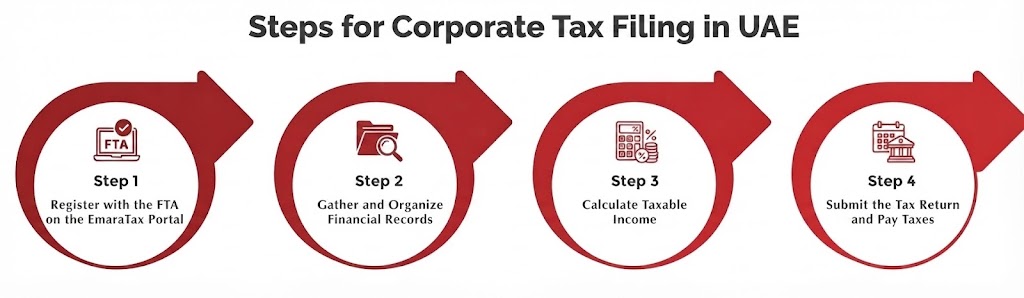
Filing corporate tax in the UAE involves a series of steps that require careful planning and execution. From registration to submission, each step is critical to ensuring compliance and avoiding penalties. Below, we outline the essential steps to streamline your CT filing process.
Step 1: Register with the FTA on the EmaraTax Portal
The first step in corporate tax filing is registering with the FTA through the EmaraTax portal to obtain a Tax Registration Number (TRN). This is mandatory for all taxable persons, including free zone companies, regardless of their tax rate.
Step 2: Gather and Organize Financial Records
Accurate financial records are the backbone of corporate tax filing. Businesses must maintain detailed records of income, expenses, assets, and liabilities for at least seven years, as mandated by the FTA. Key documents include:
- Financial statements (balance sheet, profit and loss, cash flow)
- Bank statements and reconciliation reports
- Invoices, receipts, and expense records
- Tax filings and returns
Step 3: Calculate Taxable Income
Calculating taxable income is a critical step in corporate tax filing. For example, a business with AED 600,000 in taxable profit pays 0% on the first AED 375,000 and 9% on the remaining AED 225,000 a total tax liability of AED 20,250 threshold. Businesses must account for:
- Revenue from all sources, including foreign income
- Deductible expenses, such as R&D, interest, and operational costs
- Exemptions, such as dividends, capital gains, and intra-group transactions
Step 4: Submit the Tax Return and Pay Taxes
Tax returns must be filed within nine months of the financial year-end via the EmaraTax portal.
For example, a business with a financial year ending December 31, 2025, must file its Corporate Tax Return and pay any taxes due by September 30, 2026. Timely filing and payment are essential to avoid late filing and payment penalties.
Key Documents Required for Corporate Tax Filing
Below are the key documents businesses should prepare for accurate and compliant UAE Corporate Tax filing:
Business Registration Documents: Trade licence, company registration details, legal structure information, and Corporate Tax registration certificate with the TRN.
Financial Statements and Accounting Records: Income statement, balance sheet, cash flow statement, general ledger, and relevant management or audited accounts.
Banking, Revenue and Expense Records: Business bank statements, sales and purchase invoices, receipts, contracts, payroll records, and supporting expense documents.
Asset and VAT Records: Fixed asset register, depreciation schedules, VAT returns, VAT payment records, and TRN, where applicable.
Tax and Transfer Pricing Documents: Transfer pricing reports, disclosure forms, Local File, Master File, supporting schedules, tax adjustments, exempt income, and carried-forward losses, where applicable.
Understanding Corporate Tax Rates and Exemptions
The UAE’s corporate tax regime is designed to be competitive and business-friendly, with a low headline rate of 9% and several exemptions. Understanding these rates and exemptions is essential for effective tax planning and compliance.
Corporate Tax Rates in the UAE
The UAE’s corporate tax rates are straightforward:
- 0% on taxable profits up to AED 375,000
- 9% on taxable profits exceeding AED 375,000
- 0% for qualifying free zone persons on eligible income
These rates make the UAE one of the most tax-competitive jurisdictions globally. However, businesses must accurately calculate their taxable income to determine their tax liability.
Exemptions and Incentives
The UAE offers several exemptions to reduce the tax burden:
- Participation Exemption: Dividends and capital gains from qualifying shareholdings are exempt from corporate tax.
- Qualifying Free Zone Persons: Free zone businesses meeting specific criteria enjoy a 0% tax rate on eligible income.
- Intra-Group Transactions: Qualifying intra-group transactions and reorganizations are exempt, provided conditions are met.
- R&D Incentives: Full deductibility of R&D expenses and a planned 30%-50% R&D tax credit from 2026 encourage innovation.
Special Considerations for Free Zone Businesses
Free zone businesses, such as those in DMCC or JAFZA, must register for corporate tax and file returns, even if they qualify for a 0% rate. Missteps in filing or misunderstanding exemption criteria can lead to audits or penalties.
Free Zone Corporate Tax Filing: Navigate Exemptions with Ease
Free zone businesses in areas like DMCC or Jebel Ali Free Zone (JAFZA) benefit from unique corporate tax regulations and in many cases, a 0% tax rate. However, this doesn’t mean they’re free from compliance obligations. Misunderstandings or filing errors can trigger audits or penalties.
Are Free Zone Businesses Exempt from Corporate Tax?
Yes, but with conditions. Many free zone businesses in the UAE can benefit from a 0% corporate tax rate, provided they meet specific criteria set by the Federal Tax Authority (FTA). This usually includes maintaining adequate substance in the free zone, earning only qualifying income, and complying with all regulatory and filing obligations. It’s not automatic, and non-compliance can lead to losing the tax exemption.
How Free Zone Businesses File Corporate Tax CT?
Filing corporate tax as a free zone business begins with verifying your exemption status with the Federal Tax Authority (FTA). If your business qualifies for the 0% tax rate, you’ll still need to file a simplified return to confirm your status. However, if any portion of your income is taxable — for example, from mainland activities — a full corporate tax return is required. It’s essential to track all transactions and income sources accurately to avoid mistakes that could lead to audits or loss of exemption.
Common Challenges in Corporate Tax Filing and How to Overcome Them
Navigating Complex Corporate Tax Laws
The UAE’s corporate tax laws, including transfer pricing in UAE and arm’s length principles, can be daunting. Businesses must ensure their transactions meet these standards to avoid adjustments or penalties.
Meeting corporate tax filing uae deadline
For businesses with a financial year ending 31 December 2025, the Corporate Tax return filing and payment deadline is 30 September 2026. For businesses with a financial year ending 31 March 2026, the filing and payment deadline is 31 December 2026. Missing the registration deadline or the nine-month filing deadline can result in hefty fines.
Avoiding Penalties and Audits
Errors in tax returns or failure to maintain proper records can trigger audits or penalties. Accurate record keeping and timely filing help reduce the risk of audits and avoid penalties, such as the AED 10,000 late registration fine.
UAE Corporate Tax Filing Deadlines Demystified
Meeting deadlines is crucial for corporate tax compliance in the UAE. The Federal Tax Authority (FTA) imposes strict timelines, and missing them can lead to significant fines or legal complications. By planning ahead and staying organized throughout the financial year, businesses can ensure smooth filing, avoid penalties, and maintain a solid compliance record. Setting reminders and aligning with your accountant or tax advisor early can make a big difference.
UAE CT Filing Deadlines 2026 at a Glance
- June 30, 2026: For September 30, 2024, year-ends.
- September 30, 2026: For December 31, 2024, year-ends.
- Extensions: Request within 30 days for valid reasons.
Stay Ahead with Deadline Tracking Tips
Keeping track of corporate tax filing deadline 2026, is key to avoiding last-minute stress and penalties. Leverage FTA alerts, set up calendar reminders, or use task management tools to stay organized. Better yet, partner with experts like Tulpar Global Taxation, who offer proactive tracking of deadlines for filing and full compliance support. With the right system in place, you’ll never miss a filing date and you’ll always stay one step ahead.
The Future of Corporate Tax in the UAE: What Businesses Can Expect Going Forward
As the UAE aligns with global tax standards, businesses must prepare for future changes in corporate tax filing Dubai – UAE. Here are the trends and predictions for beyond, ensuring your business stays ahead of the curve.
Stricter Compliance and Penalties
The FTA is increasing scrutiny on non-compliance, with more frequent audits and higher penalties. Businesses can expect:
- Increased Audits: The FTA may target high-risk sectors like real estate, trading, and hospitality for audits.
- Higher Penalties: Fines for late filings or errors could increase to deter non-compliance.
- Enhanced Monitoring: Advance tools will flag discrepancies, such as inconsistent VAT and corporate tax filings.
To prepare:
- Conduct Internal Audits: Review financial records quarterly to identify and correct discrepancies.
- Engage Experts: Work with qualified tax professionals to assess compliance risks and prepare for potential FTA inspections.
- Document Everything: Maintain detailed records of transactions, expenses, and exemptions to support your filings during audits.
Global Tax Alignment
The UAE is adopting OECD guidelines, such as Pillar Two, to ensure fair taxation for multinationals. This may impact:
- Transfer Pricing: Stricter documentation requirements for intra-group transactions to prevent profit shifting.
- Global Reporting: Enhanced reporting for multinational entities with UAE operations, including Country-by-Country Reporting (CbCR).
- Minimum Tax Rates: Pillar Two introduces a 15% minimum tax for large multinationals, which could affect UAE-based subsidiaries.
Emerging Tax Incentives
The UAE may introduce further tax incentives in the coming years to support economic diversification and sustainability. Potential incentives include
- Technology and Innovation: Tax credits for businesses investing in AI, blockchain, or fintech solutions.
- Sustainability: Relief for companies adopting renewable energy or eco-friendly practices.
- SME Support: Expanded exemptions or reduced rates for startups and small businesses to encourage growth.
As UAE corporate tax regulations continue to evolve, keeping track of new requirements, filing deadlines, reporting obligations, and compliance changes can be challenging for business owners. Engaging a qualified corporate tax (CT) filing expert in Dubai can help businesses stay informed, maintain accurate records, file returns correctly, and remain compliant with future tax rules. Work with a corporate tax filing expert in Dubai today to stay compliant and prepared for future regulations.
The Role of Professional Tax Consultants in Corporate Tax Filing
Benefits of Hiring a Tax Consultant in Dubai
Hiring a tax consultant offers several benefits:
- Cost Savings: Optimize deductions and exemptions to reduce tax liabilities.
- Time Efficiency: Streamline the filing process, freeing up time for core operations.
- Compliance Assurance: Ensure adherence to FTA regulations, avoiding penalties.
- Strategic Planning: Leverage tax incentives for long-term financial growth.
Why Choose Tulpar Global Taxation?
Tulpar Global Taxation stands out as a leading tax consultancy in the UAE, with offices in Dubai, Sharjah, and Ajman. Their services include:
- Expert Guidance: Certified tax consultants with deep knowledge of UAE tax laws.
- Tailored Solutions: Customized strategies for startups, SMEs, and multinationals.
- Comprehensive Support: From registration to filing, auditing, and tax planning.
- Proven Success: A track record of helping businesses achieve compliance and financial efficiency.
Tulpar Global Taxation offers proactive deadline tracking and compliance support, using FTA alerts and task management tools to keep businesses on track. From FTA registration to advanced tax planning, our team ensures your business thrives in the UAE’s dynamic tax landscape.
Ready to streamline your corporate tax filing? Contact Tulpar Global Taxation at our Dubai, Sharjah, or Ajman offices, for expert VAT and tax solutions tailored to your business needs. Email us at info@tulpartax.com or call +971 54 444 5124 for professional assistance.
FAQs:
Do all businesses subject to UAE Corporate Tax need to file a Corporate Tax return in 2026?
Yes. All businesses within the scope of UAE Corporate Tax must file a Corporate Tax return in 2026, even if no tax is payable. Filing is a legal requirement under UAE tax law. Tulpar Global Taxation ensures businesses meet all filing obligations on time.
Who needs to file a Corporate Tax return in the UAE?
Mainland companies, Free Zone companies, foreign branches, and qualifying individuals conducting business must file returns if registered. Even 0% tax entities are required to submit returns. Tulpar Global Taxation helps determine filing requirements accurately.
What is the Corporate Tax rate applicable ?
The UAE Corporate Tax rate remains 0% on taxable income up to AED 375,000 and 9% on income exceeding this threshold. Large multinational groups may also fall under the 15% global minimum tax. Tulpar Global Taxation advises on correct rate applications.
What is the deadline for Corporate Tax filing ?
Corporate Tax returns must generally be filed within 9 months from the end of the financial year. Late filing can result in penalties. Tulpar Global Taxation tracks deadlines and manages timely submissions.
Do Free Zone companies need to file Corporate Tax returns ?
Yes. All Free Zone companies must file Corporate Tax returns, regardless of whether they qualify for the 0% regime. Failure to file may result in penalties or loss of tax benefits. Tulpar Global Taxation ensures Free Zone compliance and QFZP assessments.
What documents are required for Corporate Tax filing?
Required documents typically include audited financial statements, trial balance, tax adjustments, and supporting schedules. Proper documentation reduces audit risk. Tulpar Global Taxation prepares audit-ready filing packs.
Is Corporate Tax registration required before filing?
Yes. Businesses must register with the Federal Tax Authority (FTA) before filing a Corporate Tax return. Late registration may trigger penalties. Tulpar Global Taxation manages registration and portal compliance.
Can businesses amend Corporate Tax returns after filing?
Yes, errors can be corrected through amendments or voluntary disclosures on the FTA portal. Early correction helps reduce penalties. Tulpar Global Taxation assists with revisions and compliance corrections.
What penalties apply for non-compliance ?
Penalties may apply for late registration, late filing, incorrect returns, or poor record-keeping. Enforcement is expected to be stricter in 2026. Tulpar Global Taxation helps businesses avoid penalties through proactive compliance.
Why choose Tulpar Global Taxation for Corporate Tax filing ?
Tulpar Global Taxation provides end-to-end Corporate Tax filing and registration services in the UAE . Our structured and compliant approach reduces risk and complexity. This makes us a trusted Corporate Tax partner in the UAE for 2026.
