
Cryptocurrency Explained: Blockchain, Wallets, Keys & Transactions
Demystify cryptocurrency with this complete guide to how blockchain technology acts as a decentralized ledger to record and verify secure peer-to-peer transactions. Learn how crypto wallets manage your private and public keys to safely authorize, send, and custody your digital assets.
Table of Contents

Let's Talk
Sign Up For Free Consultation
The global financial landscape is undergoing a profound paradigm shift driven by the maturity of digital assets and decentralized market architecture. For business owners, corporate treasurers, and finance professionals in the UAE, navigating this ecosystem is no longer optional, it is a strategic imperative. As Dubai and the broader UAE solidify their positions as premier global hubs for Web3 innovation under the Virtual Assets Regulatory Authority (VARA) and the Federal Tax Authority (FTA) frameworks, corporate leaders must grasp the technical mechanics of this technology to optimize capital allocation and ensure enterprise compliance.
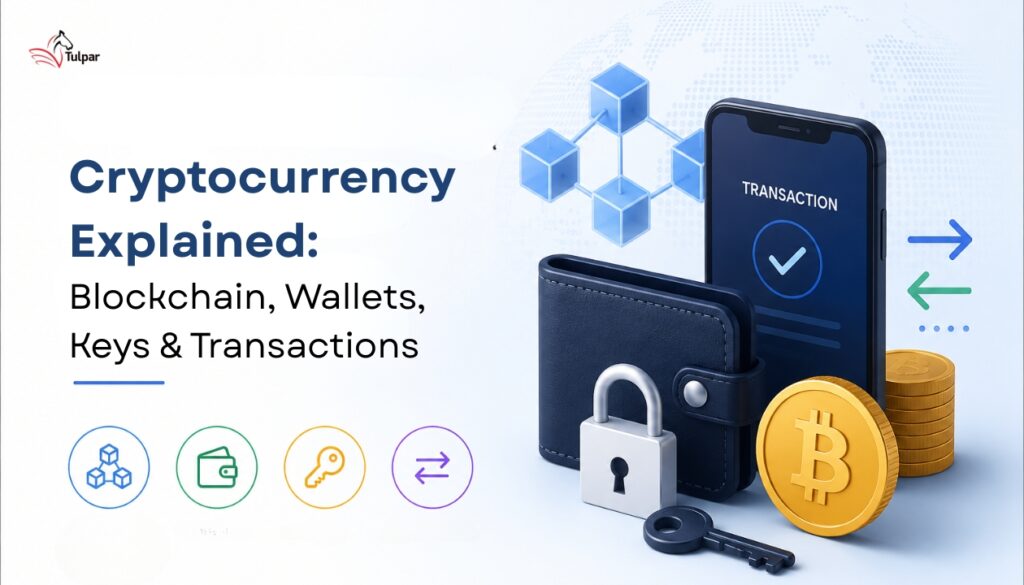
What Is Cryptocurrency?
To understand cryptocurrency for beginners or institutional investors alike, one must view it not merely as a speculative tool, but as a novel class of digital assets. At its core, a cryptocurrency is a decentralized digital currency secured by cryptography, operating independently of any centralized banking authority or sovereign government.
Unlike traditional fiat currencies, which rely on central banks to validate transactions and manage supply, cryptocurrencies leverage a decentralized ledger to record ownership data securely across a distributed network.
The Evolution of Digital Assets
The modern era of digital finance began with the launch of Bitcoin, the world’s first decentralized digital asset. Since then, the ecosystem has expanded into thousands of specialized tokens, smart contract platforms like Ethereum, and stablecoins pegged to fiat values. For corporations operating within the GCC region, understanding these assets is critical as enterprise use cases scale from cross-border B2B payments to real-world asset tokenization.
Why Corporate Leadership Is Paying Attention
Navigating the regulatory and commercial complexities of these digital frameworks requires cross-disciplinary expertise. As businesses integrate digital assets into their balance sheets, optimizing their operational structures for compliance is vital. Professional advisory firms like Tulpar Global Taxation assist enterprises in aligning their digital asset strategies with local economic regulations, ensuring that international capital flows remain robust, transparent, and compliant.
How Does Blockchain Technology Work?
The structural foundation of every digital asset is blockchain technology. A blockchain explained simply is an immutable, chronologically ordered database that is shared across a peer-to-peer network of computers. Instead of data sitting on a single centralized server, the ledger is copied and synchronized across thousands of global computational participants, known as nodes.
The Anatomy of a Block
Data on a blockchain is grouped into distinct structures called blocks. Each block contains a batch of recently verified crypto transactions, a timestamp confirming exactly when the block was finalized, and a unique cryptographic hash (a digital fingerprint) of the previous block, linking them sequentially into a chain.
This sequential hashing makes the database mathematically tamper-proof. If an adversarial entity attempts to alter a transaction in a past block, the hash of that block changes, breaking the entire downstream chain and alerting every node in the network to reject the modification.
Achieving Consensus: Proof of Work vs. Proof of Stake
To update this distributed ledger technology without a central coordinator, the network relies on a mathematical consensus mechanism.
The two most dominant systems are:
- Proof of Work (PoW): Utilized by networks like Bitcoin, where specialized computers called miners compete to solve complex cryptographic puzzles to validate transactions and secure the network.
- Proof of Stake (PoS): Utilized by modern networks like Ethereum, where computational participants called validators lock up (stake) a portion of their native tokens to earn the right to verify data and propose new blocks.
Cryptocurrency vs Traditional Money: What's the Difference?
Understanding the precise differences between centralized fiat and decentralized assets is foundational for strategic corporate treasury management.
Feature | Traditional Money (Fiat) | Cryptocurrency (Digital Assets) |
Issuing Authority | Central Banks & Sovereign Governments | Decentralized Code / Protocol Consensus |
Ledger System | Centralized (Private banking databases) | Distributed Ledger Technology (Public/Permissioned) |
Transaction Speed | Hours to Days for cross-border clearing | Minutes to Seconds, operating 24/7/365 |
Scarcity / Supply | Discretionary (Subject to quantitative easing) | Algorithmic (Strictly capped or predictable issuance) |
Intermediaries | Clearing houses, correspondent banks, SWIFT | Peer-to-peer network interaction |
What Is a Crypto Wallet and How Does It Work?

To interact with any decentralized network, an entity requires a cryptocurrency wallet. A common misconception is that a crypto wallet stores physical digital tokens inside the device or software itself. In reality, tokens never leave the blockchain network.
A cryptocurrency wallet is a specialized software application or hardware device that stores the user’s cryptographic keys and communicates directly with the blockchain ledger to facilitate transfers.
The Role of a Wallet in Digital Management
The wallet acts as an interface that tracks the balances associated with your specific digital credentials. It allows users to read their balance from the public ledger, generate the necessary digital signatures to authorize outgoing movements, and monitor incoming fund allocations in real time.
Public Key vs Private Key in Cryptocurrency
The security architecture of digital asset ownership relies heavily on asymmetric cryptography, a system that utilizes a pair of mathematically linked keys: a public key and a private key.
[Private Key / Seed Phrase] ──(Derived mathematically)──> [Public Key] ──(Hashed)──> [Wallet Address]
The Public Key: Your Digital Identity
The public key can be shared openly with anyone on the network. It functions similarly to an International Bank Account Number (IBAN). It serves as the destination identifier that allows other network participants to route funds to your business, without giving them the capability to access or withdraw assets from your portfolio.
The Private Key: Absolute Control
Conversely, the private key must be guarded with absolute confidentiality. It functions as an un-overrideable digital signature and absolute proof of ownership. Anyone who possesses or gains access to a wallet’s private key exercises complete, unilateral control over the assets assigned to that key. If a corporate entity loses its private keys, or if they are compromised through a cybersecurity breach, the underlying assets are permanently irrecoverable.
What Is a Seed Phrase and Why Is It Important?
When generating a modern cryptocurrency wallet, users are provided with a sequence of 12 to 24 random dictionary words known as a seed phrase or recovery phrase.
The Root of All Cryptographic Keys
The seed phrase is a human-readable representation of the cryptographic root seed from which all your private and public keys are mathematically derived. If a physical device holding a software wallet is destroyed, stolen, or corrupted, the seed phrase serves as the ultimate master key for complete wallet recovery on any other compatible device.
Enterprise Safeguards and Institutional Compliance
For enterprises operating in the UAE, managing a seed phrase requires rigid institutional governance protocols, multi-signature authentication, and secure physical vaulting. As digital assets scale within a corporate structure, managing the fiscal implications of these assets becomes equally complex.
This is where specialized advisory from firms like Tulpar Global Taxation becomes essential. Expert oversight from professionals like Ezat Alnajm, an FTA-certified tax agent and certified transfer pricing expert in Dubai, UAE, ensures that companies managing digital holdings appropriately account for transfer pricing risks, intra-group asset assignments, and strict corporate tax compliance under the 9% UAE corporate tax framework.
Hot Wallet vs Cold Wallet: Which Is More Secure?
Corporate asset deployment requires a calculated balance between operational liquidity velocity and high-grade security. This choice dictates whether an enterprise utilizes a hot wallet or a cold wallet.
Hot Wallets: Operational Velocity
A hot wallet refers to any software wallet running on a device directly connected to the internet such as mobile applications, desktop software, or browser extensions.
- Advantages: Exceptional speed for executing daily transactions, automated smart contract interactions, and real-time treasury management.
- Risks: Vulnerable to sophisticated online threats, phishing campaigns, malware, and remote security exploits.
Cold Wallets: Institutional Isolation
A cold wallet describes an offline storage mechanism, most commonly a specialized hardware wallet (a secure physical USB-like device).
- Advantages: Because the private keys never leave the offline device and are never exposed to an internet-connected environment, cold storage offers near-total immunity to remote cyberattacks.
- Risks: Less convenient for high-frequency trading or rapid daily corporate disbursements.
Custodial vs Non-Custodial Wallets Explained

Another critical architectural distinction for business owners is deciding who ultimately retains legal and technical custody of the underlying cryptographic data.
Custodial Wallets: Outsourced Management
In a custodial wallet, a third-party intermediary such as a centralized digital asset exchange or a regulated institutional custodian retains direct ownership of the private keys. The enterprise accesses its funds via a traditional user login portal.
- Pros: Simplified access recovery; clear compliance and reporting frameworks.
- Cons: Introduces third-party counterparty risk (the ‘not your keys, not your coins’ dilemma).
Non-Custodial Wallets: Absolute Sovereignty
A non-custodial wallet gives the corporate entity exclusive, direct ownership of the private keys and seed phrases.
- Pros: Complete financial sovereignty; absolute control over transactions without institutional censorship or dependency.
- Cons: Full institutional liability; if the credentials are lost internally, there is no customer support desk to restore access.
What Is a Cryptocurrency Address?
A cryptocurrency address is a unique, alphanumeric string generated by hashing a wallet’s public key. While a public key is a complex mathematical string, the address is a shortened, user-facing version optimized for network routing.
Example Base58 Address Format: 1A1zP1eP5QGefi2DMPTfTL5SLmv7DivfNa
Every cryptocurrency address is network-specific. For instance, a Bitcoin address cannot natively receive an Ethereum-based token. To prevent permanent loss of funds during corporate transactions, treasury personnel utilize a blockchain explorer, a public online search engine for digital ledgers to audit, verify, and track the exact real-time status of targeted destination addresses before deploying significant capital.
How Crypto Transactions Are Verified on the Blockchain
To ensure complete clarity on the transactional pipeline, let us break down the exact lifecycle of how crypto transactions undergo rigorous blockchain verification:
[Initiate Transaction] -> [Broadcast to Mempool] -> [Nodes Audit Credentials via Cryptographic Signatures] -> [Consensus: Miners/Validators Bundle Transactions into Blocks] -> [Block Appended to Distributed Ledger (Immutable Settlement)]
1. Initiation and Digital Signing
A corporate user initiates a transfer by entering a recipient’s cryptocurrency address and the desired amount. The user’s wallet automatically utilizes the local private key to append a unique digital signature to the data payload, proving authorization without revealing the underlying private key itself.
2. Broadcasting and Mempool Sorting
The transaction is broadcasted out to the broader global peer-to-peer network. Before formal inclusion in the ledger, it sits in a temporary queue of unconfirmed transactions known as the memory pool (mempool).
3. Node Validation and Cryptographic Audit
Independent nodes across the network retrieve the transaction from the mempool and verify its programmatic validity. They check that the digital signature is authentic and cross-reference the sender’s public historical balance to confirm that the business has sufficient funds to complete the transfer.
4. Consensus and Immutable Settlement
Once audited, miners or validators bundle the verified transaction along with others into a new block. By executing the designated consensus protocol (PoW or PoS), they solve the necessary network requirements and append the block permanently to the ledger. Once written into the chain, the transaction status updates across all global ledger copies, achieving irrevocable, immutable settlement.
Institutional Compliance in the UAE Regulatory Landscape
Integrating digital assets and mastering blockchain mechanics involves more than just mastering technical execution. For enterprises building a presence in Dubai and the wider UAE, navigating the strict tax frameworks established by the Federal Tax Authority (FTA) is paramount. Cabinet Decision No. 100 on Virtual Assets clarifies specific VAT exemptions for virtual asset transfers and conversions, but commercial trading profits, staking income, and business mining remain subject to the 9% federal corporate tax threshold.
As digital transactions interface with corporate operations, complex questions regarding corporate income tax, cross-border value-added tax (VAT) applications, and strategic transfer pricing policies inevitably arise. To manage these operational challenges, corporations regularly engage specialized advisory support from established networks like Tulpar Global Taxation.
Accessing dedicated consulting through trusted professionals like Ezat Alnajm allows companies to construct sound tax compliance strategies. Ensuring that your enterprise’s digital asset valuation methods, internal transactions, and distributed ledger audits perfectly align with both local UAE regulations and evolving international tax standards is essential for safeguarding long-term commercial growth.
FAQs:
A cryptocurrency is a digital asset secured by cryptography that functions independently of any central banking authority or government. It operates via distributed ledger technology primarily a public blockchain, where computational data is sequentially bundled, time-stamped, and verified by an independent network of nodes rather than a central clearinghouse. For UAE businesses integrating these assets, tracking valuation is vital, as the Federal Tax Authority (FTA) subjects commercial trading profits to the standard 9% UAE corporate tax framework.
A public key is an openly shareable cryptographic string that identifies your destination identity on a network, functioning much like an international IBAN for receiving funds. Conversely, a private key serves as your un-overrideable digital signature and absolute proof of ownership, providing unilateral control over the assets. If an enterprise loses its private key, the underlying assets are permanently irrecoverable on the blockchain.
A cryptocurrency wallet does not physically store digital tokens; it is a software or hardware interface that manages your private and public keys. A cryptocurrency address is a shortened, user-facing alphanumeric string derived from hashing your public key. When a transfer is initiated, the wallet uses your private key to broadcast a transaction to that specific network address.
A seed phrase is a human-readable string of 12 to 24 random dictionary words generated by your wallet. It serves as the ultimate master backup key from which all your private and public keys are mathematically derived. If your physical hardware or software wallet is destroyed or corrupted, the seed phrase allows complete wallet recovery on any other compatible device.
A hot wallet runs on an internet-connected device, providing exceptional operational velocity for automated smart contract interactions and daily disbursements, but it carries exposure to remote cyber exploits. A cold wallet is an offline hardware device that insulates private keys from internet connectivity, offering the highest level of security. Corporate treasuries typically split funds, keeping high-volume reserves in cold storage while deploying hot wallets for daily operational liquidity.
In a custodial wallet, a third-party intermediary (like a centralized exchange or regulated institutional custodian) holds and manages the private keys, meaning you rely on their infrastructure for asset recovery. A non-custodial wallet gives the corporate entity exclusive, direct ownership of the private keys and seed phrases, ensuring absolute financial sovereignty but introducing full liability for key protection.
When a transaction is broadcast to the peer-to-peer network, independent nodes audit the attached digital signature against historical ledger balances. Once validated, miners or validators bundle the payload into a block and solve network consensus mechanisms (Proof of Work or Proof of Stake) to permanently write the block to the ledger, achieving irrevocable, immutable settlement. Corporate treasurers often use a public blockchain explorer to audit and verify transaction status in real-time.
Under current UAE regulations, virtual asset transfers and conversions can qualify for specific VAT exemptions under Cabinet Decision No. 100. However, commercial cryptocurrency activities including corporate trading profits, staking yields, and localized mining activities are subject to the standard 9% federal corporate tax threshold once net profits exceed AED 375,000. Navigating these requirements demands strict alignment with local rules.
Individual retail investors can hold or trade digital assets for personal investment without a trade license. However, any entity executing commercial virtual asset services such as brokerage, proprietary trading, third-party custody, or exchange operations must secure a trade license and formal approval from the relevant regulatory body, such as the Virtual Assets Regulatory Authority (VARA) in Dubai or the FSRA in ADGM.
Firms like Tulpar Global Taxation, operating across strategic branches in Dubai, Sharjah, and Ajman, specialize in guiding international founders through the rigorous compliance hurdles of UAE crypto business setup and specialized corporate registration.
When UAE companies engage in intra-group virtual asset transfers, token assignments, or cross-border digital asset financing, they must strictly adhere to UAE transfer pricing rules. These transactions must comply with the arm’s length principle, supported by comprehensive corporate documentation to prevent tax reclassifications or penalties from the Federal Tax Authority (FTA).
To ensure complete structural and regulatory compliance, corporate teams look to advanced consultants like Ezat Alnajm, an FTA-certified tax agent and certified transfer pricing expert in Dubai, UAE. Collaborating with specialized experts allows businesses to build robust, audit-ready asset valuation strategies that conform precisely to both local and international tax laws.
