
Do Free Zone Companies Need to Register for Corporate Tax?
Yes, Free Zone companies in the UAE may need to register for corporate tax depending on their business activity and income, even if they benefit from tax incentives. Understanding the eligibility criteria and compliance requirements ensures smooth registration with the Federal Tax Authority and avoids penalties.
Table of Contents

Let's Talk
Sign Up For Free Consultation
UAE Corporate Tax Registration for Free Zone Companies
The UAE’s decision to introduce a federal corporate tax regime from June 2023 has been a paradigm shift, especially for Free Zone companies that long enjoyed tax benefits. Now, every Free Zone entity must register for corporate tax, fulfill compliance duties, and ensure they meet Qualifying Free Zone Person (QFZP) conditions to access 0% tax on qualifying income. But here’s the catch: many businesses misunderstand the rules, delay registration, or lose valuable benefits, triggering penalties, extra tax liabilities, or reputational risk.
If you’re a Free Zone company in Dubai, Sharjah, Ajman, or across the UAE, this guide will walk you through how to register, how to maintain the zero-tax status, what pitfalls to avoid, and how Tulpar Global Taxation (Dubai / Sharjah / Ajman) can be your compliance partner. By the end, you’ll have a clear, actionable roadmap that not only helps you stay compliant but positions your Free Zone business to maximize tax efficiency.

What is UAE Corporate Tax & Why Free Zone Entities Must Care
What is UAE Corporate Tax?
The UAE corporate tax is a direct tax on net profits of juridical and certain natural persons conducting business. It was introduced under Federal Decree-Law No. 47 of 2022 (amended by Law No. 60 of 2023) and took effect in June 2023.
Under the law:
Profits up to AED 375,000 may enjoy a 0% rate (for certain entities)
Profits above that threshold are taxed at 9%
Every taxable person, including Free Zone companies, must register, file returns, and maintain compliance even if the tax liability is nil.
Why Free Zone Entities Must Now Pay Attention
Historically, Free Zone entities enjoyed near-blanket tax exemptions, which made free zones globally attractive. But under the new law:
Mandatory Registration: Free Zone persons must register for corporate tax even if they expect a zero tax liability.
Qualifying Income Only: Only certain income (from qualifying activities) can benefit from 0% tax. Other income may still be taxed at 9%.
Substance & Compliance Requirements: To maintain zero tax benefit, companies must maintain adequate economic substance (employees, office, real operations) in UAE Free Zones.
Excluded Activities Risk: Some activities (e.g. certain financing, leasing, insurance, etc.) are excluded from zero-rate eligibility.
Penalties & Reputational Risk: Missing deadlines or failing compliance can lead to fines, loss of benefits, public notices, harming your business reputation.
If Free Zone companies don’t wake up to these changes, they risk paying unnecessary tax or facing regulatory blowback.
Who Must Register: Free Zone Companies & Qualifying Free Zone Persons
What Is a Free Zone Person?
A Free Zone Person is a legal or natural person whose operations are governed by Free Zone regulations and whose income qualifies under those jurisdictions. In essence, if your company holds a valid Free Zone license, you fall into this category.
What Is a Qualifying Free Zone Person (QFZP)?
Not all Free Zone Persons automatically get tax benefits. To benefit from 0% tax, one must satisfy the criteria of a Qualifying Free Zone Person (QFZP).
Key Conditions to Be a QFZP
The entity’s income must arise from qualifying activities as defined by Free Zone & FTA rules.
It must maintain adequate economic substance in UAE: real operations, staff, premises, etc.
The entity must not elect to be taxed under the standard regime for non-Free Zone businesses.
The income must not be from Excluded Activities (disallowed under the regime) even if conducted with other Free Zone persons.
The Free Zone Person must register for corporate tax and file returns in a timely manner.
If any of these conditions fail, the entity might lose the 0% benefit, and non-qualifying income becomes subject to the 9% rate.

Step-by-Step Guide: Corporate Tax Registration for Free Zone Companies
Here’s how a Free Zone company should proceed to register for UAE corporate tax — from timing to execution.
When & Deadline to Register
The FTA requires registration free of charge and estimates ~30 minutes to submit registration.
For newly incorporated legal entities (post-1 March 2026), registration must occur within 90 days of incorporation.
For existing Free Zone companies, registration deadlines depend on their license issue date. Missing those triggers administrative penalties.
Even if your taxable income is zero (due to 0% benefit), you must still submit tax returns within nine months from the end of the relevant tax period.
Document Checklist & Requirements
To register, you’ll typically need:
Valid Trade License copy
Memorandum & Articles of Association (MOA / AOA) or related incorporation documents
Passport copy(s) and Emirates ID / national ID of owner(s) / authorized signatories
Company address / P.O. Box / contact details
Lease agreement or physical premises in the Free Zone (to demonstrate substance)
NOC or permission from Free Zone authority (if applicable)
Audited financial statements or accounting records (if already operating)
Ensure all documents are valid, legible, and up-to-date.
How to Submit Registration via EmaraTax
Create / login to your EmaraTax account (FTA’s digital platform).
Add or select the taxable person corresponding to your Free Zone company.
Click “Register for Corporate Tax”, and fill out required fields: legal entity details, license info, activity classification, etc.
Upload the required documentation.
Submit application, you will receive a Corporate Tax Registration Number (TRN).
After registration, stay ready to file returns and comply with deadlines.
Be sure to double-check data entry (license number, names, activity codes) to avoid rejections or delays.

Understanding Qualifying vs Non-Qualifying Income & Activities
One of the most crucial, and often misunderstood, areas in Free Zone tax compliance is distinguishing qualifying vs non-qualifying income (and activities). This determines whether your profits are taxed at 0% or 9%.
Qualifying Activities: What Counts & What Doesn’t
Qualifying Activities are business operations that the FTA / Free Zone regime recognizes as eligible for 0% tax — provided other conditions are met.
Common qualifying activities may include:
Trading or selling goods (especially exports)
Manufacturing and processing
Consulting, software / IT / digital services
Licensing IP, research & development, tech services
Other activities allowed by your Free Zone license (must check with zone authority)
Excluded / Non-Qualifying Activities
Excluded or non-qualifying activities are operations that cannot benefit from the 0% rate, even if performed within a Free Zone.
Examples include:
Banking, insurance, and captive insurance businesses (unless reinsurance)
Financing / leasing / interest / lending (unless with strict conditions)
Ownership or exploitation of immovable property outside commercial property in the zone
Excluded Activities with natural persons, unless certain conditions are met.
Passive income, unrelated investments, or incomes from non-qualifying jurisdictions
If your business combines qualifying and non-qualifying operations, you must segment income and apply 9% tax on non-qualifying portions.
Substance Requirements: The Foundation for Zero-Rate Eligibility
To maintain QFZP status, you must have adequate substance in UAE:
Real office / premises inside the Free Zone
Full-time staff whose functions align with business operations
Core income-generating activities must be done in UAE
Supporting documentation (payroll, contracts, invoices)
The level of substance must be in proportion to the size and nature of the business (i.e. you can’t claim huge operations with minimal actual presence)
Failing to sustain substance may trigger loss of 0% benefit or stricter tax scrutiny.
Tax Rates & How They Apply to Free Zone Businesses

Zero-Percent Zone: Conditions & Limits
If all criteria for a QFZP are met, Free Zone companies can enjoy 0% corporate tax on qualifying income.
But note:
The 0% rate applies only to the income derived from qualifying activities, subject to compliance, substance, and reporting conditions.
Non-qualifying income or income from disallowed activities is taxed at standard rate.
Even when zero tax is due, you must still file the return and submit documentation.
When the 9% Standard Rate Applies
The 9% corporate tax rate kicks in when:
Profit exceeds AED 375,000 (for non-Free Zone or non-qualifying portion)
The business fails to meet QFZP conditions (substance, activity eligibility, etc.)
The income comes from excluded or non-qualifying sources (e.g. mainland UAE, disallowed activities)
The entity opts (or is deemed) to be taxed under standard rules
Top-Up / Global Minimum Tax for Multinationals (from 2026 Onwards)
For larger multinational entities, the UAE will implement a 15% minimum top-up tax (Domestic Minimum Top-Up Tax, DMTT) starting Jan 2026, per OECD global tax rules. That means even if your Free Zone arm pays 0% locally, the parent or group might need to adjust so the effective global tax is at least 15%. This is critical for multinational businesses to incorporate into planning and structure.
Compliance Obligations After Registration
Financial Statements & Audit
QFZPs must prepare and maintain audited financial statements, even if revenue is below AED 50 million.
They are not required to produce separate statements for qualifying vs non-qualifying income, but they must document how they calculated qualifying income.
Report per IFRS or accepted accounting standard in UAE.
Filing Return & Payment Deadlines
The corporate tax return must be filed within 9 months after the end of the tax period.
Any tax due must be paid along with the return.
Even if your tax liability is zero (due to 0%), you must submit a return.
Late filing or payments trigger penalties and interest.
Record-Keeping & Retention
Maintain records for 7 years after the end of each tax period.
Documents needed: invoices, contracts, sales & purchase documents, payroll, bank statements, audit reports, substance documentation, etc.
You must be able to justify your qualifying income claims, substance degree, and allocation of expenses.
Notifications, Amendments & Deregistration
If your business structure, activity, or ownership changes, you must notify FTA / EmaraTax promptly.
Amendments to registration (change in address, license, etc.) must be reflected in the tax records.
If business ceases operation, you should deregister or notify closure in the tax system to avoid ongoing obligations.
Penalties & Risks of Non-Compliance
Failure to comply with corporate tax registration or ongoing requirements can expose Free Zone companies to:
Administrative penalties (e.g. AED 10,000 for late registration)
Fines for late filing or incorrect returns
Interest on unpaid corporate tax
Loss of zero-rate benefit, forcing the business to pay tax retroactively
Audits, reassessments, and additional tax liabilities
Reputational risk among clients, partners, investors
Ineligibility for future incentives or public sector tenders
In short: you risk financial loss and damage to credibility.
How to Review & Optimize Your Free Zone Structure (Tax Planning Tips)
To make the new system work in your favor, consider proactive strategies:
Segment income & operations carefully: keep qualifying and non-qualifying revenue streams distinct
Choose your Free Zone wisely: different zones may have slightly differing rules or cooperation with FTA
Align your substance with operations: scale your staff, functions, and premises appropriately
Limit interactions with mainland UAE (or structure them through arms-length pricing) to retain QFZP status
Plan for multinationals: integrate your Free Zone entity’s tax profile into group-level top-up tax planning
Regular compliance audits (internally or via an advisor) to stay ahead of changes
Work with a specialist tax advisor who deeply understands UAE Free Zone tax mechanics (like Tulpar Global Taxation)
Why Choose Tulpar Global Taxation (Dubai / Sharjah / Ajman) as Your Partner
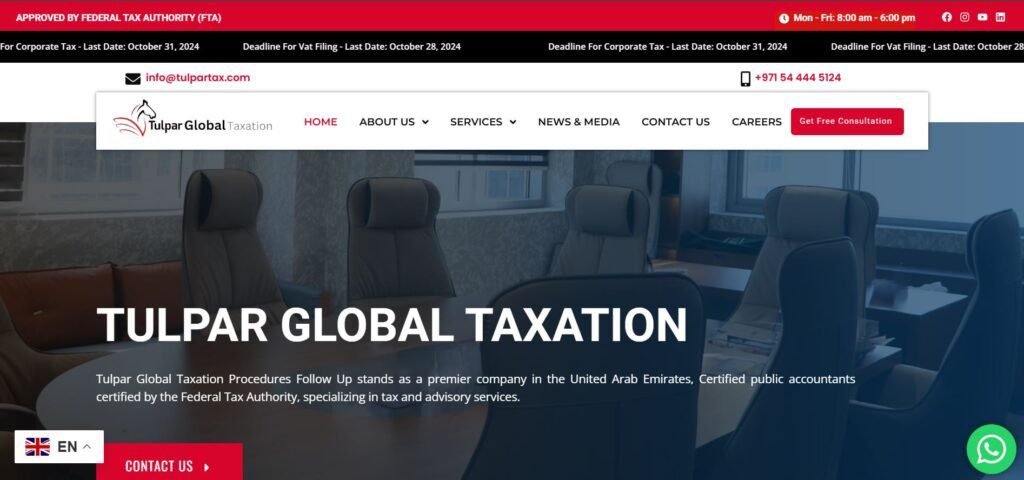
Here’s how Tulpar Global Taxation can help you as your Free Zone company:
- Deep UAE-Free Zone Expertise: With dedicated branches in Dubai, Sharjah, and Ajman, Tulpar has local presence inside multiple Free Zones, enabling you to get jurisdiction-specific guidance.
- End-to-End Registration & Compliance Support: We assist with corporate tax registration (EmaraTax submission), document validation, return filing, audits, and substance management, so you stay compliant without burden.
- Tailored Structuring & Tax Optimization: Because we understand qualifying vs non-qualifying income splits, top-up tax, substance criteria, we help optimize your structure to maximize zero-tax eligibility and minimize liability.
- Real-Time Monitoring & Alerts: With local offices, we monitor regulatory updates in Dubai, Sharjah, Ajman, notifying you proactively of key changes or renewal obligations.
- Proven Track Record & Trusted Reputation: Tulpar is recognized in UAE tax circles, trusted by business owners, finance professionals, and other consultants.
- One-Stop Across the UAE: Whether your operations span multiple Emirates, zones, or have cross-border elements, Tulpar’s presence in three Emirates ensures continuity, coherence, and cost efficiency.
Conclusion & Next Steps
UAE’s corporate tax regime is no longer optional, even in Free Zones. But with the right approach, Free Zone companies can still reap 0% tax benefits, provided they register properly, maintain substance, and comply meticulously.
Here’s your immediate to-do list:
Audit your business: check your activities, premises, staff, and whether they align with QFZP criteria
Register via EmaraTax (if not done already)
Set up a compliance calendar (filing cycles, audits, record review)
Engage a trusted tax advisor — Tulpar Global Taxation (Dubai / Sharjah / Ajman) can deliver hands-on support
Stay informed on upcoming tax changes (e.g. minimum top-up tax from 2026)
By staying ahead, you turn a regulatory challenge into a competitive advantage preserving tax efficiencies, building trust with stakeholders, and positioning your Free Zone business for long-term growth across the UAE.
FAQs:
Yes, all Free Zone companies are required to register for UAE Corporate Tax, regardless of whether they expect to pay tax or qualify for the 0% rate. Registration is a mandatory legal requirement under the Corporate Tax law. Failure to register may result in penalties imposed by the Federal Tax Authority (FTA).
No, qualifying for the 0% Corporate Tax rate does not remove the obligation to register. Free Zone companies must still complete Corporate Tax registration and comply with filing requirements. The 0% rate applies only after registration and confirmation of eligibility.
A Qualifying Free Zone Person is a Free Zone company that meets all conditions set by the UAE Corporate Tax law. These include maintaining adequate economic substance, earning qualifying income, and complying with transfer pricing rules. Only QFZPs can benefit from the 0% Corporate Tax rate on qualifying income.
If a Free Zone company fails to register, it may face administrative penalties even if it has no taxable income. The FTA treats registration as a compliance obligation, not an option. Late registration can also increase audit risk.
Yes, dormant or inactive Free Zone companies are still required to register for Corporate Tax. The obligation exists as long as the company is legally registered and licensed. Dormant status does not automatically exempt a company from registration or filing.
Yes, all Free Zone companies must file annual Corporate Tax returns, even if they qualify for the 0% rate. Filing is necessary to confirm compliance and maintain eligibility for tax benefits. Non-filing can lead to penalties and loss of Free Zone advantages.
Yes, income earned from Mainland UAE activities may be subject to the standard Corporate Tax rate. This applies even to Free Zone companies if the income is classified as non-qualifying. Correct income segregation is critical to avoid unexpected tax exposure.
VAT and Corporate Tax are separate tax systems, but both rely on the same financial records. Inconsistencies between VAT returns and Corporate Tax filings can trigger FTA audits. Proper alignment of accounting and tax data is essential for compliance.
Yes, a Free Zone company can lose its 0% benefit if it fails to meet QFZP conditions. Common reasons include incorrect income classification, lack of substance, or transfer pricing non-compliance. Losing the benefit can result in full taxation at the standard rate.
Corporate Tax compliance requires careful assessment, accurate registration, and proper ongoing filings. Professional guidance helps reduce risks and protect tax benefits. Working with Tulpar Global Taxation ensures Free Zone companies remain fully compliant with UAE Corporate Tax laws.
