
How To Calculate Excise Tax In UAE?
Share :
Table of Contents

Let's Talk
Sign Up For Free Consultation
Excise Tax in the UAE currently applies to tobacco products, carbonated drinks, energy drinks, electronic smoking devices, and their liquids, with rates ranging from 50% to 100% depending on the product category. The tax is calculated using one of three methods: specific rate (a fixed amount per unit or litre), ad valorem (a percentage of the retail price), or a combined approach that applies both. As of January 2026, sweetened drinks are taxed under a tiered-volumetric model based on sugar content rather than a flat rate, and e-liquids carry a minimum excise price of AED 1 per millilitre under Cabinet Decision No. 137 of 2026. Businesses registered as taxable persons must calculate and remit this tax through the FTA’s EmaraTax portal to remain compliant
What is Excise Tax?
Excise tax is an indirect tax imposed on the sale or consumption of specific goods, typically those that are considered harmful to individuals or the environment. It is often applied to products such as tobacco, alcohol, energy drinks, carbonated beverages, and luxury items.
While the purpose of excise taxes can vary depending on the country and other factors, it is most commonly used to generate revenue for the government and reduce the consumption of these goods by making them more expensive. Governments use excise taxes to address public health concerns, and environmental issues, or to control consumption patterns.
What Goods Are Subject to Excise Tax in the UAE?
The UAE imposes excise taxes on the following products or goods:
- Tobacco Products: Including cigarettes, cigars, and other tobacco products.
- Carbonated Drinks: Beverages with added sugar or sweeteners.
- Energy Drinks: Beverages containing stimulants or substances that enhance physical performance.
- Electronic smoking devices and tools
- Liquids used in such devices and tools
- Sweetened drinks.
These goods are targeted due to their potential impact on public health and consumption patterns. The Excise Tax aims to both generate revenue for the government and promote healthier lifestyle choices among consumers.
Excise Tax Rates in UAE
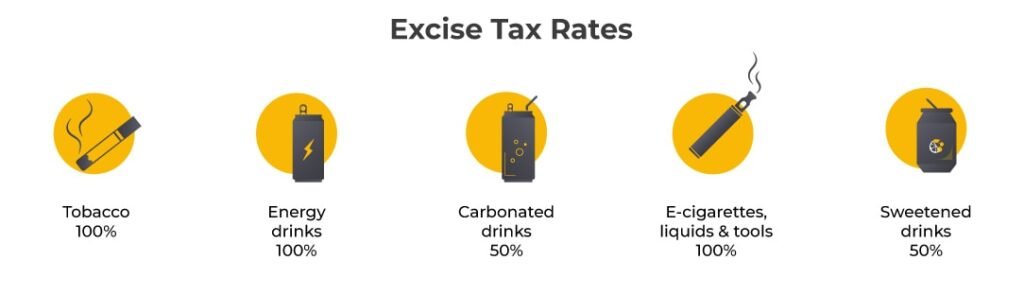
The UAE under Cabinet Decision No. 52 of 2019, which addresses Excise Goods, Excise Tax Rates, and Methods for Calculating Excise Prices, here are the Excise Tax rates applicable in the UAE:
- Carbonated drinks (50% rate): From 1 January 2026, qualifying sweetened drinks are subject to Excise Tax under a tiered-volumetric model based on their sugar and sweetener content. Drinks containing 5 grams or more but less than 8 grams of sugar or sweeteners per 100 ml are subject to AED 0.79 per litre, while drinks containing 8 grams or more per 100 ml are subject to AED 1.09 per litre. Drinks containing less than 5 grams per 100 ml are subject to AED 0 per litre.
- Tobacco products (100% rate): Tobacco products, including cigarettes, cigars, and other forms of tobacco, are subject to a 100% excise tax. This high rate is intended to reduce smoking rates and mitigate the associated health risks.
- Energy drinks (100% rate): Energy drinks, which typically contain stimulants like caffeine, are taxed at a 100% rate. This tax is designed to discourage consumption and reduce health effects, particularly among younger individuals.
- Electronic smoking devices (100% rate): Devices used for electronic smoking, including e-cigarettes and vaping devices, are subject to a 100% excise tax. This tax reflects concerns over the growing popularity of vaping among young people.
- Liquids used in electronic smoking devices and tools (100% rate): Liquids used in electronic smoking devices, which often contain nicotine and flavorings, are taxed at a 100% excise tax rate. From 1 September 2026, a minimum excise price of AED 1 per millilitre (ml) applied to these liquids under Cabinet Decision No. 137 of 2026.
- Products with added sugar or other sweeteners (50% rate): From 1 January 2026, carbonated drinks are no longer subject to a separate 50% Excise Tax rate. Where they meet the definition of sweetened drinks, their Excise Tax treatment is determined according to their sugar and sweetener content.
Methods of Calculating Excise Tax UAE
In the UAE, the methods of calculating Excise Tax vary based on the type of goods. Generally, the excise tax calculation can be done using the following methods:
1. Specific Rate Method
Under this method, Excise Tax is imposed at a fixed tax rate per unit of the excisable goods. For example, a specific excise tax amount might be charged per pack of cigarettes, per liter of energy drink, or per gram of tobacco. This approach ensures that each unit of the product incurs a consistent tax burden, regardless of its price or value in the market.
2. Ad Valorem Method
The Ad Valorem method calculates Excise Tax as a percentage of the average retail selling price of the goods or based on the product’s value. This means that the tax liability increases or decreases in proportion to the value of the product sold. For instance, if a tobacco product has an Ad Valorem rate of 100%, then the tax amount would be equal to 100% of the product’s retail price. On the other hand, jewelry may be subject to a 5% excise tax based on its retail value.
3. Combined Method
In some cases, a Combined Method is used, which incorporates elements of both the specific rate and ad valorem methods. This hybrid approach ensures a comprehensive taxation framework that considers both the quantity and the value of the goods. For instance, certain products may have a specific excise tax rate applied per unit along with an additional ad valorem component based on their retail price.
These methods are carefully selected to achieve specific policy objectives, such as discouraging the consumption of harmful products like tobacco and energy drinks, promoting public health, and generating revenue for government initiatives. The UAE government periodically reviews and adjusts these methods to ensure they remain effective in achieving these goals while also considering economic factors and consumer behavior.
How to Calculate Excise Tax in UAE?
Excise Tax calculation in the UAE depends on the type of Excise Good and the applicable excise-price rules. The following examples illustrate specific-rate, ad valorem and combined calculations, while businesses should apply the method and rates prescribed for their particular Excise Goods.
Specific Rate Method
Under a specific-rate calculation, a fixed amount is applied to each unit, litre or millilitre of the taxable product.
Example: Electronic Smoking Liquid
- Quantity: 30 ml
- Minimum excise price: AED 1 per ml
Calculation:
30 ml × AED 1 per ml = AED 30
Therefore, a 30 ml bottle has a minimum excise price of AED 30 under the new 2026 excise-price rules applicable to liquids used in electronic smoking devices and tools.
For more details on the 2026 changes affecting vape and e-liquid products, see UAE Excise Tax 2026: What Changed for Vape, and What Didn’t.
Ad Valorem Method
Under the ad valorem method, Excise Tax is calculated as a percentage of the applicable excise price. Tobacco products and energy drinks are subject to a 100% Excise Tax rate, subject to the applicable excise-price rules.
Example: Energy Drink
- Retail selling price: AED 10
- Excise Tax rate: 100%
Where the AED 10 retail selling price is inclusive of the 100% Excise Tax, the tax component is calculated as:
AED 10 × 50% = AED 5 Excise Tax
Therefore, the Excise Tax component of an AED 10 tax-inclusive retail price is AED 5.
Combined Method Example
A combined calculation can illustrate a situation where a fixed amount and a percentage are applied together. However, this should not be presented as a general UAE Excise Tax method, because the applicable calculation depends on the specific Excise Goods and legislation.
Illustrative example:
- Specific component: AED 2 per unit
- Ad valorem component: 50% of the applicable price
- Quantity: 500 units
- Applicable price: AED 100 per unit
Specific component:
500 units × AED 2 = AED 1,000
Ad valorem component:
500 units × AED 100 × 50% = AED 25,000
Illustrative combined amount:
AED 1,000 + AED 25,000 = AED 26,000
This combined calculation is provided for illustration only and does not represent a standard Excise Tax calculation applicable to all Excise Goods in the UAE.
Excise Tax Advisory in UAE
Excise Tax advisory in the UAE is crucial for businesses handling taxable goods such as tobacco, energy drinks, and sweetened beverages, including UAE Excise Tax on Beverages. Effective advisory services help businesses understand applicable tax rates, calculation methods, registration requirements, and reporting obligations while maintaining compliance with UAE Excise Tax laws.
Expert advisors like us at Tulpar Global Taxation provide tailored guidance on Excise Tax Registration, Excise Tax Return in UAE, and Excise Tax Consultancy to optimize tax planning, minimize liabilities, and enhance operational efficiency.
By partnering with experienced advisors, businesses can confidently manage their applicable taxes, mitigate risks of non-compliance, and strategically align with evolving tax regulations in the UAE. This proactive approach not only supports legal compliance but also fosters a competitive advantage through efficient tax management practices. To discuss your Excise Tax advisory needs, email us at info@tulpartax.com or call +971 54 444 5124 for professional assistance.
FAQs:
Excise Tax is an indirect tax levied on specific goods considered harmful to health or the environment. It applies mainly to tobacco products, e-cigarettes, energy drinks, soft drinks, and sweetened beverages. The tax is regulated by the Federal Tax Authority (FTA).
The UAE Excise Tax rates are:
100% on tobacco products, e-cigarettes, and energy drinks
50% on soft drinks and sweetened beverages
These rates are applied to the excise tax base, not the selling price alone.
The excise tax base is the higher of:
The retail selling price (RSP), or
The cost price plus profit margin
The FTA sets minimum retail prices for certain excisable goods, which must be considered during calculation.
Formula:
Excise Tax = Excise Tax Base × 100%
Example:
Excise Tax Base = AED 10,000
Excise Tax = 10,000 × 100% = AED 10,000
Formula:
Excise Tax = Excise Tax Base × 50%
Example:
Excise Tax Base = AED 10,000
Excise Tax = 10,000 × 50% = AED 5,000
Excise Tax becomes payable when excisable goods are imported, produced, released for consumption, or stockpiled. Monthly Excise Tax returns must be filed through the FTA portal.
Statutory audits are generally conducted annually, based on the company’s financial year. Timely completion is important to meet regulatory deadlines. Delays can affect license renewals and regulatory compliance.
Manufacturers, importers, stockpilers, wholesalers, and distributors of excisable goods must calculate and pay Excise Tax. Free Zone companies are not exempt if they deal in excisable products.
Common mistakes include using the wrong tax base, ignoring FTA minimum retail prices, and miscalculating VAT on excise-inclusive values. These errors often result in heavy penalties during FTA audits.
Excise Tax is complex and highly scrutinized by the FTA. Working with Tulpar Global Taxation helps businesses ensure accurate Excise Tax calculation, proper registration, return filing, and audit readiness.
