
Table of Contents
Related Articles
UAE Excise Tax 2026: What Changed for Vape, and What Didn’t
September 21, 2026

A Complete Setup Guide to Company Formation in IFZA
August 31, 2026

Let's Talk
Sign Up For Free Consultation
In the dynamic business landscape of the UAE, obtaining an ICV certificate in UAE has transformed from a simple compliance exercise into a powerful strategic differentiator for suppliers, contractors, and service providers. Whether your business is bidding for major procurement contracts with government entities or partnering with large national companies, knowing how to get ICV certified is critical to securing a competitive edge in major commercial hubs like Dubai and Abu Dhabi. Understanding the underlying policy of the National In-Country Value Program and knowing how to improve your ICV score—is the first step toward aligning with the UAE’s Vision 2030 and unlocking long-term commercial growth.
In this professional guide, tailored for business owners, finance professionals and tax consultants operating in the UAE, we’ll explore the full spectrum of ICV certification services: from underlying policy and scope, through detailed processes and score calculation, to strategic enhancement of your ICV standing.
What is an In-Country Value (ICV) Certificate in the UAE?
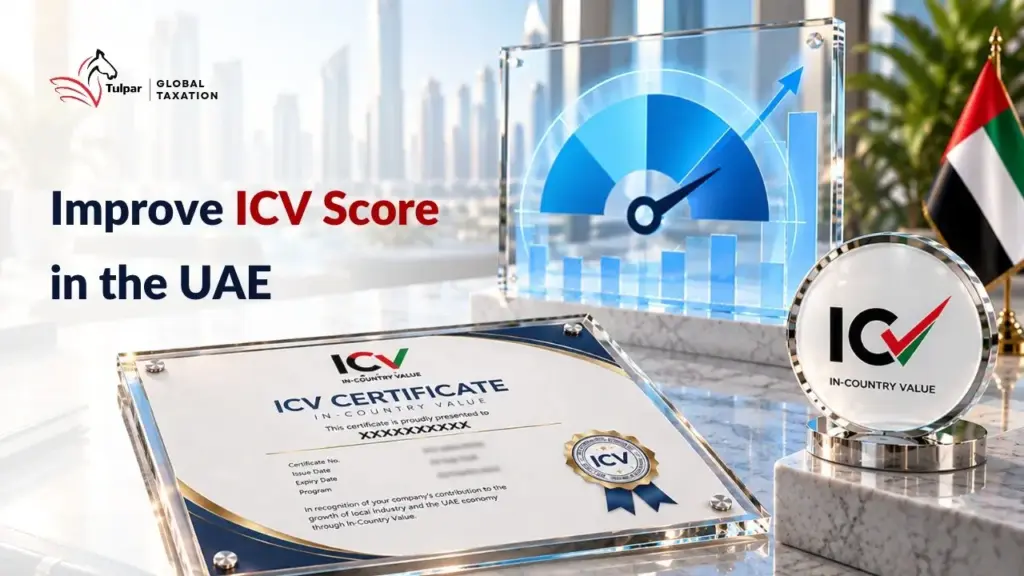
ICV relates to the value a company contributes within the UAE: this includes local procurement, manufacturing, investment, employment of UAE nationals, and other indicators of economic value-add within the country. The ICV certification is the formal recognition via an approved certifying body of that contribution. In essence, an ICV certificate is a measure of how much value a legal entity adds locally, expressed via an ICV score certificate.
The Role of the Ministry of Industry and Advanced Technology (MoIAT)
The Ministry of Industry & Advanced Technology (MoIAT) of the UAE is the supervisory authority for the National In-Country Value Program. It approves the certifying bodies, publishes guidelines and sets the framework for the certification process.
The programme was initially pioneered by entities like Abu Dhabi National Oil Company (ADNOC) in the oil & gas sector from 2018 and later expanded to federal level under MoIAT in 2021.
What is the ICV Score and Why is it Crucial?
The “ICV score” is the percentage result derived from a company’s contribution to National in-country value in a given period. On successful assessment, the ICV certificate will specify the entity’s score.
This score is crucial because:
- It directly influences tender evaluations: companies without a certificate may receive a default score of zero, putting them at a disadvantage.
- It quantifies your entity’s local-value performance and allows benchmarking and improvement.
- In cases where an ICV score is a mandatory part of bidding (in ADNOC or participating entities), a higher score can translate into better contract terms or preferred status.
How Can a Higher ICV Score Improve Your Tender Competitiveness?
In recent years, the ICV certificate has shifted from being a niche compliance item into a strategic business enabler across the UAE market:
- Government and semi-government entities, as well as major national companies, increasingly factor ICV scores into tender evaluations. Suppliers lacking a certificate or having low in-country value contribution face a competitive disadvantage.
- The national priority of economic diversification, local manufacturing and employment of UAE nationals (Emiratization) means that ICV certification aligns directly with business strategy, not just compliance.
- For companies operating in key procurement-sensitive sectors like oil & gas, services and manufacturing, an ICV certificate (and strong ICV score) increasingly becomes a prerequisite for market entry and tender success.
- From a branding and business reputation perspective, being “ICV-certified” signals commitment to the UAE economy, local value-add and growth of local talent, a strong differentiator in the marketplace.
Thus, for businesses active in the UAE (especially in Dubai and Abu Dhabi), investing in ICV Certification Services is not optional, it is becoming core to winning business, improving credentialing and aligning with national priorities.
How Does ICV Certification Vary by Sector?
Different sectors may face unique criteria depending on their activity:
- Manufacturing / goods producers: additional weighting may be given to local manufacturing cost, local procurement of raw materials, investment in plant & equipment.
- Services / contracting companies: criteria may emphasise local spend on services, local workforce (including UAE nationals), procurement of services and goods locally.
- Suppliers bidding to petroleum, advanced technology or utilities sectors: as many national companies apply ICV requirements strictly, the scoring may be more rigorous and tied into value-chain localization.
Core Components of the ICV Assessment
The ICV score is based on multiple measurable components, typically including:
- Local procurement of goods and services: amount spent on locally procured inputs, labour, services.
- Local investment: capital invested in the UAE (plant, equipment, R&D, local infrastructure).
- Manufacturing or local value-add: If applicable, value realised via local manufacturing or transformation of goods.
- Employment of UAE nationals (Emiratization): number/percentage of UAE nationals employed, training and local talent development.
- Export and foreign revenue: For some entities, the value of exports and foreign income may play a weighted role.
ICV Certificate Validity, Renewal, and Maintaining Compliance
Validity Period of the ICV Certificate
- Typically the ICV certificate is valid for 14 months from the date of the audited financial statements or the date of issuance of new financials, whichever is earlier.
- Some earlier documentation indicated validity up to 18 months; however current MoIAT guidelines mention 14 months.
ICV Renewal: Maintaining Your Certification Status
- Prior to expiry, renew your certificate by submitting updated audited financials or management accounts (as required).
- Consistent monitoring of your local value-add metrics helps ensure your next certification maintains or improves upon your previous score.
- Entities failing to renew may lose competitive standing in tenders or face a score of zero.
How Can Businesses Improve ICV Scores?
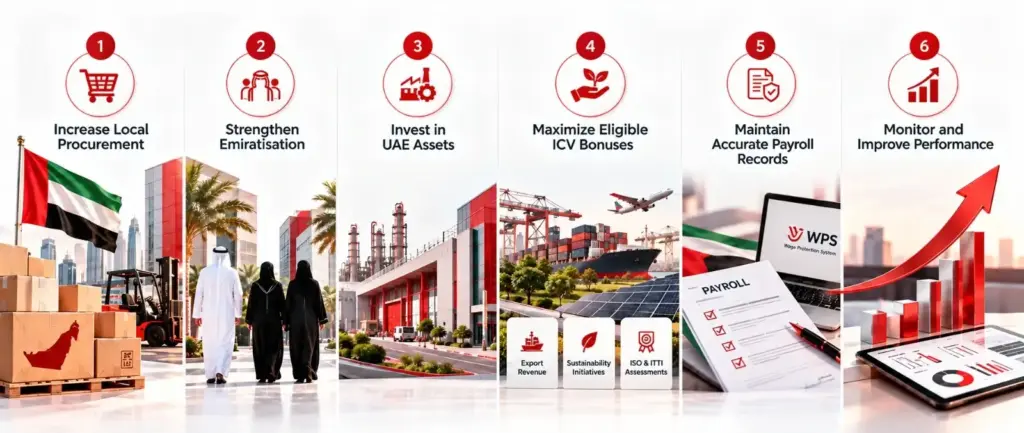
Instead of treating ICV certification as a one-time checkbox, savvy organizations embed ICV into their strategic planning. This means:
Increase Local Procurement:
Prioritize purchasing goods and services from UAE-based suppliers with strong, valid ICV certificates to improve eligible local spending.
Strengthen Emiratisation:
Recruit, train, and retain UAE nationals while investing in their professional development, salaries, and benefits.
Invest in UAE Assets:
Expand local manufacturing, infrastructure, equipment, and other qualifying fixed assets to strengthen the company’s investment contribution.
Maximize Eligible ICV Bonuses:
Explore additional scoring opportunities through qualifying export revenue, Emirati headcount, growth in UAE investments, sustainability initiatives, relevant ISO certifications, and ITTI assessments where applicable.
Maintain Accurate Payroll Records:
Process applicable employee salaries through the Wage Protection System (WPS), where required, and maintain reliable payroll documentation to substantiate eligible workforce costs.
Monitor and Improve ICV Performance:
Regularly review procurement, workforce, investment, and financial data to identify opportunities for improving the ICV score before the next certification.
Why Is the ICV Program Important to the UAE Economy?
The ICV initiative is a strategic tool to redirect government or large-company procurement and investment to benefit the local economy:
- Encourages localization of supply chains and services, boosting domestic industry.
- Attracts foreign direct investment (FDI) by creating a more robust local ecosystem.
- Enhances employment opportunities for UAE nationals in the private sector, aligning with national development goals.
- Contributes to GDP growth, reduced imports and a more resilient economy.
UAE Vision 2030: Diversification & Sustainability
The ICV certificate is not just a procurement tick-box: it is deeply aligned with the UAE’s Vision 2030 and the “Projects of the 50” UAE Government initiative. By focusing on in-country value, sustainable business practices and localisation, the programme supports the broader trajectory of the UAE economy, reducing reliance on imports, promoting advanced manufacturing and services, and elevating SME and national participation.
Long-Term Planning for Sustainable ICV Growth
- Use annual reviews of your ICV performance and set targets for improvement over successive certifications.
- Link ICV metrics into your business KPIs (procurement, employment, investment).
- Consider ICV implications when planning new business units, expansion into other Emirates, or cross-licence operations.
- Stay abreast of policy updates from MoIAT to ensure no surprise shifts in scoring methodology or templates.
Getting Expert Advice from the Best ICV Consultants in the UAE
Obtaining an ICV Certificate in the UAE has become a strategic necessity for businesses seeking to improve competitiveness, access tender opportunities, and support the nation’s economic diversification goals. Working with the best ICV consultants in the UAE can help companies understand the ICV certification process, improve their ICV scores, and strengthen their local value contribution. With expert guidance from Tulpar Global Taxation, businesses can navigate ICV certification requirements, improve their ICV scores, strengthen tender competitiveness, and support long-term growth in the UAE.
We can help streamline certification, maximize ICV scores, and position your company for sustainable success in the UAE market. For expert assistance with ICV certification, certificate renewal, compliance, and improving your ICV score, Book a consultation with Tulpar Global Taxation in Dubai, Sharjah, Ras al-khaimah and Ajman. Email us at info@tulpartax.com or call +971 54 444 5124.
FAQs:
What Does ICV Certified Mean in the UAE?
An ICV certificate measures a company’s contribution to the UAE economy through local procurement, investment, manufacturing, and employment. It provides an ICV score that can support participation in tenders issued by government entities and participating national companies.
What happens if my company receives a low ICV score?
A low ICV score does not automatically prevent your company from participating in tenders. However, businesses with higher scores may have a competitive advantage. To improve your score, focus on sourcing more goods and services locally, recruiting and training UAE nationals, maintaining accurate supplier records, expanding your UAE operations, and investing in the country.
How long is an ICV Certificate valid in the UAE?
Under the published MoIAT National ICV Program guidance, an ICV certificate is valid for 14 months from the date the audited financial statements are issued. Businesses should check the applicable programme requirements and plan their next assessment accordingly.
How can a company obtain an ICV certificate in Dubai?
A company generally needs to prepare its financial statements and supporting documents, then apply through a certifying body approved under the relevant ICV programme. The certifier assesses the information and calculates the company’s ICV score according to applicable guidelines.
How can businesses improve their ICV score?
Businesses can improve their ICV performance by increasing eligible local procurement, investing in UAE operations, developing local supply chains, and supporting workforce development. Maintaining accurate financial records and supporting documents also helps ensure the assessment reflects their eligible contributions.
