

E-Invoicing in UAE: Understanding the New Regulations and Requirements
Table of Contents
Related Articles

A Complete Setup Guide to Company Formation in IFZA
August 31, 2026
Ezat Alnajm Strengthens UAE Crypto Compliance with CCAS
August 27, 2026

Let's Talk
Sign Up For Free Consultation
The UAE Federal Tax Authority (FTA) has officially set the wheels in motion for the Electronic Invoicing System (EIS). For large businesses with an annual revenue of AED 50 million or more (Phase 1), the mandate begins with the strict requirement to select and appoint an Accredited Service Provider (ASP). With the mandatory go-live date of January 1, 2027 rapidly approaching, companies across the Emirates are under immense pressure to ensure their systems are fully compliant.
And here is the part most businesses miss. A PDF is not an e invoice. Under the UAE framework, only structured XML invoices transmitted through an ASP qualify as valid. Paper and PDF invoices simply will not count.
The cost of delay? Under the latest Cabinet Decision No. 173 of 2026, certain violations attract AED 5,000 initially, followed by AED 5,000 for each month or part thereof of continued non-compliance, capped at AED 50,000 within 12 consecutive months. That is why early readiness for the e invoice UAE 2027 mandate is not just smart planning. It is financial survival.
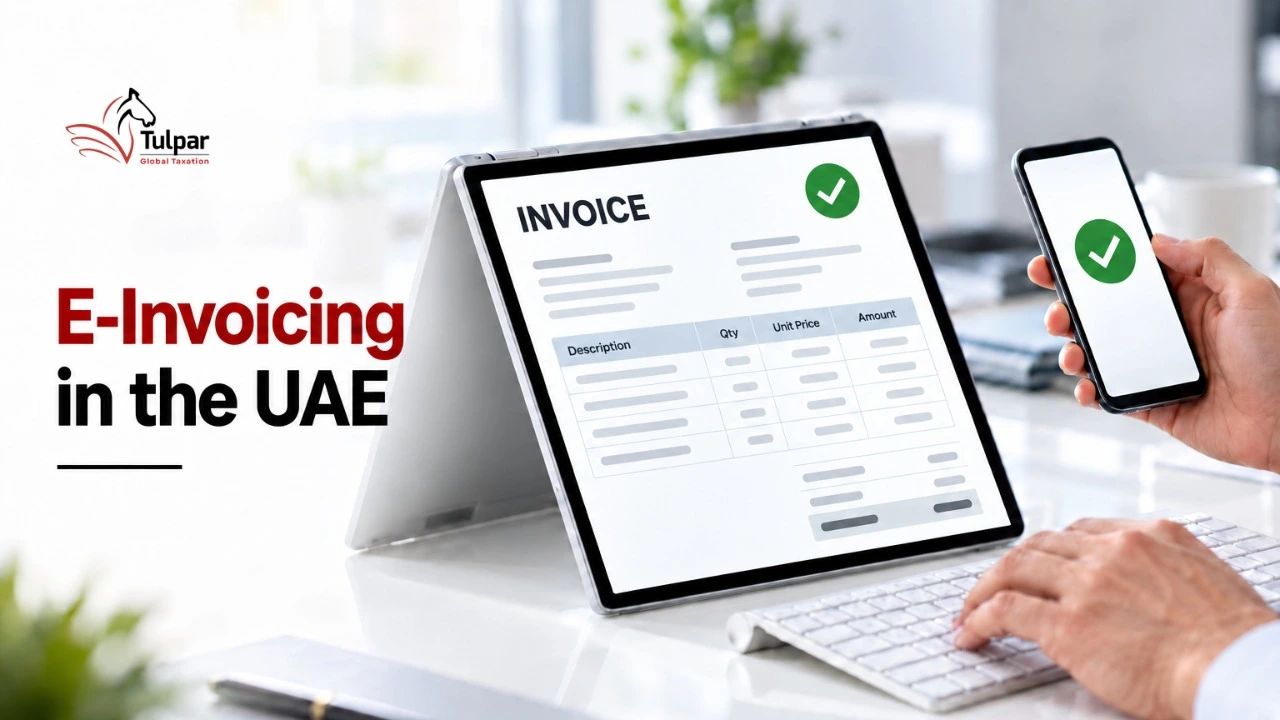
What is E-Invoicing UAE?
E-Invoicing UAE means generating, issuing, and exchanging invoices in a structured digital format rather than depending solely on PDFs or paper documents. Since the invoice data follows a standardised structure, it can be validated, transmitted, and processed automatically by connected systems. This helps businesses cut down on manual data entry, reduce errors, and improve the overall efficiency of their invoicing and accounting processes.
Many businesses already send invoices electronically through email, but that is not the same as e invoicing. A PDF attached to an email still requires systems or staff to extract and enter the information manually. UAE e-invoicing 2026 is built on structured data and system to system exchange, which allows invoice information to move directly between accounting or ERP systems. This enables greater automation across invoicing, approvals, VAT records, and payment processes.
For businesses operating across the UAE, the goal is to build a consistent and digitally connected invoicing process. Whether a company operates in Dubai, Abu Dhabi, or any other emirate, it needs to assess how e-invoicing will connect with its existing ERP, accounting software, and finance workflows. Preparing early can make the transition to the UAE’s e invoicing requirements far more manageable.
Getting Your Business Ready for UAE E-Invoicing
Businesses implementing UAE e-invoicing will need to work with an Accredited Service Provider as part of the required electronic invoicing infrastructure. The ASP handles the technical exchange of structured invoice data through the e-invoicing network. However, choosing a provider is only one part of the implementation process. Businesses also need to assess their accounting software, ERP compatibility, invoice data, VAT requirements and internal workflows. Tax and e-invoicing specialists can help businesses assess these requirements and prepare their existing systems for implementation.
Why the UAE Is Making E-Invoicing Mandatory
Part of a Broader Digital Shift
The UAE is rolling out e-invoicing as part of its wider push to modernise how businesses operate and how tax administration is managed across the country.
Replacing Paper and PDFs
Paper and PDF-based invoicing can create scattered and inconsistent records. Structured digital invoice data allows businesses and authorities to exchange and process invoice information more efficiently.
Improving Tax Transparency
Standardised invoice data provides authorities with consistent information for compliance and reporting purposes. This can improve the accuracy of tax reporting and provide greater visibility into business transactions.
Reducing Errors and Fraud in Invoicing
Automated validation and digital transmission can help identify duplicate or inaccurate invoices while reducing manual intervention. This creates a more controlled invoicing process and can help limit opportunities for fraudulent records.
Enabling Faster Reporting
E-invoicing can shorten the time between a transaction taking place, an invoice being issued, and the relevant invoice data being transmitted. This supports faster reporting and more efficient financial processes.
What Is an Accredited Service Provider (ASP) in the UAE?
An Accredited Service Provider (ASP) is a technology provider accredited under the UAE’s e-invoicing framework. It connects businesses to the Peppol network, validates electronic invoice data, facilitates invoice transmission between suppliers and buyers, and reports the required tax information to the Federal Tax Authority (FTA). ASPs help businesses automate invoicing, reduce manual errors, and support compliance with UAE e-invoicing requirements.
How to Prepare Your Business for UAE E-Invoicing Compliance
The UAE is introducing mandatory e-invoicing in phases. Businesses should prepare their systems and teams in advance to ensure a smooth transition.
Step 1: Assess Your Current Systems
Review your invoicing processes, software, invoice volumes, data quality, and manual tasks.
Step 2: Select an Accredited Service Provider (ASP)
Choose an approved ASP based on accreditation, technical capabilities, integration experience, support, and pricing.
Step 3: Plan System Integration
Connect your accounting or ERP system with your ASP and map invoice data to the PINT AE requirements.
Step 4: Implement and Test
Test invoices, VAT calculations, credit notes, and other transactions to identify and resolve errors before launch.
Step 5: Train Your Team
Train finance and IT staff on the new processes, compliance requirements, and troubleshooting procedures.
Step 6: Go Live and Monitor
Launch the system before the applicable deadline and monitor invoice processing, rejections, and technical issues.
What is the Format of an E-Invoice Dubai?
The UAE Standard e-Invoice uses XML format based on the PINT AE Data Dictionary. It contains five main sections:
- Invoice Header -Includes the invoice number , issue date , invoice type, and currency.
- Seller and Buyer Details-Contains seller and buyer names, TRNs, electronic addresses, and postal addresses.
- 3. Line Items-Lists each product or service, including its description, quantity, unit price, VAT category, and applicable rate.
- Tax Breakdown-Shows taxable amounts, VAT amounts, tax categories, and applicable VAT rates.
- Totals and Payment Details-Summarizes the total before VAT, total VAT, grand total, final payable amount, and payment method.
How the UAE Peppol Network Works?
The UAE has adopted the Peppol network as the foundation of its electronic invoicing system. Peppol is an international network that enables businesses to exchange structured electronic invoices securely and efficiently. Under the UAE e-invoicing framework, the process involves the following steps:
- Invoice Creation: The supplier generates an electronic invoice using its accounting or invoicing software. The invoice must follow the UAE’s prescribed data requirements and structured UBL XML format, based on the PINT AE standard.
- Invoice Validation and Transmission: The supplier’s Accredited Service Provider (ASP) checks the invoice against the applicable technical requirements and facilitates its transmission through the e-invoicing network.
- Invoice Routing: The Peppol network enables the electronic invoice to be routed from the supplier’s ASP to the buyer’s ASP, ensuring it reaches the intended recipient.
- Invoice Receipt and Processing: The buyer’s ASP validates the incoming invoice and delivers it to the buyer’s accounting or business system, where the structured data can be processed automatically.
- FTA Reporting: The relevant tax data is reported to the Federal Tax Authority (FTA) through the prescribed reporting process. The service providers also handle the required status notifications and confirmations in accordance with the UAE e-invoicing framework.
Through this process, the Peppol network enables standardised invoice exchange between businesses, reduces manual data entry and supports more efficient invoice processing and VAT compliance.
PINT AE is the UAE-specific e-invoicing standard that defines the format and required information for electronic invoices exchanged between businesses.
Prepare Your Business for UAE E-Invoicing with Tulpar Global Taxation
Businesses with annual revenue of AED 50 million or more must implement the UAE e-invoicing system by 1 January 2027. Businesses with annual revenue below AED 50 million must appoint an Accredited Service Provider (ASP) by 31 March 2027 and implement e-invoicing by 1 July 2027. Government entities must also appoint an ASP by 31 March 2027 and implement the system by 1 October 2027. Businesses and government entities should prepare early to meet the applicable requirements and avoid potential administrative penalties.
Tulpar Global Taxation helps businesses assess their e-invoicing readiness, review their invoicing and ERP systems, and receive independent guidance on selecting the right ASP. Call our Team +971 54 444 5124 or email info@tulpartax.com to prepare your business for UAE e-invoicing compliance
FAQs:
What Is an E-Invoice in the UAE?
An e-invoice is a digital invoice created, exchanged, and received in a structured, machine-readable format, enabling automated processing. In the UAE, e-invoices must comply with the applicable PINT AE technical requirements.
How Is an E-Invoice Different from a Traditional Invoice?
Unlike paper invoices or standard PDFs, which require manual processing, e-invoices use a structured digital format that enables automated data validation, electronic exchange, and reporting. This improves accuracy, reduces manual errors, and enhances efficiency in invoicing and VAT compliance.
Is E-Invoicing Mandatory in the UAE?
Yes, e-invoicing is mandatory in the UAE for businesses and government entities covered by the regulations. Implementation begins on 1 January 2027 for large businesses, followed by smaller businesses and government entities according to their respective deadlines.
Who Is Eligible for E-Invoicing in the UAE?
UAE e-invoicing requirements apply to businesses conducting transactions within the system’s scope, including startups, SMEs, large companies, and free zone entities. Implementation deadlines depend on annual revenue, while certain transactions may be excluded under the applicable regulations.
How to Do E-Invoicing in the UAE?
To implement e-invoicing in the UAE, businesses must appoint an Accredited Service Provider (ASP), assess their accounting or ERP systems, integrate the required technical specifications, and test electronic invoice generation and transmission before their applicable mandatory implementation deadline.
How Does E-Invoicing Work in the UAE?
UAE e-invoicing operates through the Peppol network using structured XML invoices. Suppliers generate invoices through accounting software, which their Accredited Service Provider validates and transmits to buyers. Required tax information is also reported to the Federal Tax Authority.
Which company needs to do an e-invoice?
UAE e-invoicing applies to businesses conducting in-scope B2B and B2G transactions, regardless of VAT registration. Companies with annual revenue of AED 50 million or more must comply by 1 January 2027, while smaller businesses must implement e-invoicing by 1 July 2027.
Is E-Invoicing Mandatory for Small Businesses in the UAE?
Yes, e-invoicing is mandatory for small businesses in the UAE, subject to applicable exclusions. Businesses with annual revenue below AED 50 million must comply by 1 July 2027. Non-compliance may result in administrative penalties of AED 5,000 for each month or part thereof of delay.
What Details Must Be Included in a UAE E-Invoice?
A UAE e-invoice must include essential information such as the invoice number, supplier and buyer details, description of goods or services, VAT information, invoice amounts, and currency. Additional mandatory fields must comply with the applicable PINT AE technical requirements.
How Can Tulpar Global Taxation Help with UAE E-Invoicing Compliance?
Tulpar Global Taxation helps businesses prepare for UAE e-invoicing through readiness assessments, VAT compliance reviews, ERP compatibility evaluations, and ASP selection guidance. Our tax specialists support businesses in understanding regulatory requirements, planning implementation, and preparing for mandatory compliance deadlines.
