 ENG
ENG
 العربية
 CN
CN
 RU
RU
+971 54 444 5124


ICV Certificate in UAE | How to get In-Country Value Certificate
Need an ICV Certificate in the UAE for 2026? Discover the updated process, eligibility criteria, and expert tips on how to get your ICV Certificate quickly and efficiently. Whether you’re a business owner, finance professional, or tax consultant, this guide will help you stay compliant and improve your chances of winning government and ADNOC-related contracts in the UAE.
In-Country Value (ICV) Landscape in the UAE
In the dynamic business environment of the UAE, the concept of an National In‑Country Value – ICV Program (commonly referred to as the “ICV certificate” or “ICV certification”) has become a strategic differentiator for local suppliers, contractors and service providers. Whether you’re bidding for a major procurement with a government entity or a large national company, understanding what is ICV certificate and how to secure one, especially in key regions like Dubai and Abu Dhabi is critical. In this professional guide, tailored for business owners, finance professionals and tax consultants operating in the UAE, we’ll explore the full spectrum of ICV certification services: from underlying policy and scope, through detailed processes and score calculation, to strategic enhancement of your ICV standing.
What You Will Learn About ICV Certification:
The rising importance of the ICV certificate in the UAE marketplace
The key definitions, administrative bodies and objectives behind the ICV programme
Eligibility criteria and which industries must engage in the ICV certification process
How the ICV score is calculated – the core metrics, templates and audited financials
A step-by-step breakdown of the ICV certification process, including validity and renewal
Strategic measures to maximise your ICV score rather than just comply
Common challenges, pitfalls and how to navigate them with expert services
How to select the right ICV certification services provider in the UAE
Emerging trends, future opportunities and how ICV certification fits into the UAE’s long-term vision

By the end of this material, you will be equipped to engage confidently with the ICV certification process, understand the competitive implications of your ICV score, and position your organisation for stronger success in UAE tenders, contracts and growth initiatives.
The Growing Importance of ICV for UAE Businesses
In recent years, the ICV certificate has shifted from being a niche compliance item into a strategic business enabler across the UAE market:
-
Government and semi-government entities, as well as major national companies, increasingly factor ICV scores into tender evaluations. Suppliers lacking a certificate or having low in-country value contribution face a competitive disadvantage.
-
The national priority of economic diversification, local manufacturing and employment of UAE nationals (Emiratization) means that ICV certification aligns directly with business strategy, not just compliance.
-
For companies operating in key procurement-sensitive sectors like oil & gas, services and manufacturing, an ICV certificate (and strong ICV score) increasingly becomes a prerequisite for market entry and tender success.
-
From a branding and business reputation perspective, being “ICV-certified” signals commitment to the UAE economy, local value-add and growth of local talent a strong differentiator in the marketplace.
Thus, for businesses active in the UAE (especially in Dubai and Abu Dhabi), investing in ICV certification services is not optional, it is becoming core to winning business, improving credentialing and aligning with national priorities.
What is In-Country Value (ICV) Certification?
The term “what is ICV certificate” encapsulates both the descriptive and functional aspects of this credential.
Definition of In-Country Value (ICV) and its Core Objectives
ICV relates to the value a company contributes within the UAE: this includes local procurement, manufacturing, investment, employment of UAE nationals, and other indicators of economic value-add within the country. The ICV certification is the formal recognition via an approved certifying body of that contribution. In essence, an “ICV certificate” is a measure of how much value a legal entity adds locally, expressed via an “ICV score certificate”.
The Role of the Ministry of Industry and Advanced Technology (MoIAT)
The Ministry of Industry & Advanced Technology (MoIAT) of the UAE is the supervisory authority for the National In-Country Value Program. It approves the certifying bodies, publishes guidelines and sets the framework for the certification process.
The programme was initially pioneered by entities like Abu Dhabi National Oil Company (ADNOC) in the oil & gas sector from 2018 and later expanded to federal level under MoIAT in 2021.
Key Benefits of Obtaining an ICV Certificate
For businesses and suppliers, the In-Country Value certification offers several practical advantages:
Enhanced eligibility and competitive edge in tenders, especially with government, semi-government and national companies.
Strengthened reputation: being ICV-certified signals compliance, local commitment and value-add.
Potential access to preferred supplier lists, improved contract terms and supply chain opportunities.
Better alignment with national procurement policies, aiding long-term strategic positioning.
For local manufacturing or service providers, the certificate can support business growth, new investment and expansion.
Driving the UAE Economy: How ICV Fosters Local Growth
The ICV initiative is a strategic tool to redirect government or large-company procurement and investment to benefit the local economy:
Encourages localization of supply chains and services, boosting domestic industry.
Attracts foreign direct investment (FDI) by creating a more robust local ecosystem.
Enhances employment opportunities for UAE nationals in the private sector, aligning with national development goals.
Contributes to GDP growth, reduced imports and a more resilient economy.
Aligning with UAE Vision 2030: Economic Diversification and Sustainability
The ICV certificate is not just a procurement tick-box: it is deeply aligned with the UAE’s Vision 2030 and the “Projects of the 50” UAE Government initiative. By focusing on in-country value, sustainable business practices and localisation, the programme supports the broader trajectory of the UAE economy, reducing reliance on imports, promoting advanced manufacturing and services, and elevating SME and national participation.
Eligibility, Scope, and Applicability of ICV Certification
Who Needs an ICV Certificate in the UAE?
While it is not mandatory for all companies, the requirement is rapidly expanding.
Key situations include:
Suppliers and contractors bidding for work with major national companies such as ADNOC or participating government entities.
Suppliers of goods or services in sectors deemed priority or “vital industries” under the National ICV Program.
Any entity that wishes to strengthen competitive position in tenders where ICV scoring forms part of the evaluation.
General Eligibility Criteria for ICV Certification
To qualify for an ICV certificate (or participate in the ICV certification process), entities typically must meet:
A legal entity registered in the UAE (or having a suitable legal structure) that holds a valid business license.
Audited financial statements (in accordance with IFRS) not older than two years from the certification year.
Completion of the official ICV template submission via a certified Body, with supporting documentation on local manufacturing, procurement, investment, Emiratization etc.
For companies less than 10 months old lacking audited financials, management accounts up to 9 months may be accepted (subject to certain conditions).
Sector-Specific Considerations for ICV Assessment
Different sectors may face unique criteria depending on their activity:
Manufacturing / goods producers: additional weighting may be given to local manufacturing cost, local procurement of raw materials, investment in plant & equipment.
Services / contracting companies: criteria may emphasise local spend on services, local workforce (including UAE nationals), procurement of services and goods locally.
Suppliers bidding to petroleum, advanced technology or utilities sectors: as many national companies apply ICV requirements strictly, the scoring may be more rigorous and tied into value-chain localization.
Deconstructing the ICV Score: Key Metrics and Calculation
What is the ICV Score and Why is it Crucial?
The “ICV score” is the percentage result derived from a company’s contribution to National in-country value in a given period. On successful assessment, the ICV certificate will specify the entity’s score.
This score is crucial because:
It directly influences tender evaluations: companies without a certificate may receive a default score of zero, putting them at a disadvantage.
It quantifies your entity’s local-value performance and allows benchmarking and improvement.
In cases where ICV score is a mandatory part of bidding (in ADNOC or participating entities), a higher score can translate into better contract terms or preferred status.
Core Components of the ICV Assessment
The ICV score is based on multiple measurable components, typically including:
Local procurement of goods and services: amount spent on locally procured inputs, labour, services.
Local investment: capital invested in the UAE (plant, equipment, R&D, local infrastructure).
Manufacturing or local value-add: If applicable, value realised via local manufacturing or transformation of goods.
Employment of UAE nationals (Emiratization): number/percentage of UAE nationals employed, training and local talent development.
Export and foreign revenue: For some entities, the value of exports and foreign income may play a weighted role.
The Foundation: Audited Financial Statements and Financial Records
The reliability and accuracy of the ICV score depend heavily on audited financial records:
The audited financial statements approach ensures that numbers are credible, consistent with IFRS, and issued by audited firms.
For companies under ten months old, management accounts may be used, but audited statements will be required later.
Supporting documentation (invoices, contracts, expense records) is required to substantiate data submitted into the ICV template.
How Different Business Activities Impact Your ICV Score
A manufacturing entity with significant local procurement of raw materials and strong UAE national employment may score higher than a service-only provider whose local spend is minimal.
Service providers can still improve their score via high levels of local procurement, Emiratization, investment in local infrastructure, and local subcontractor spend.
Entities with branches across multiple Emirates must ensure they understand whether each license/entity requires a separate certificate (or combined if same Emirate) which will influence how their ICV score is represented.
Companies that are foreign-based but operating in UAE may still be eligible, provided the local spend, audited statements and local employment meet the guidelines.
Understanding the ICV Template and Data Requirements
The official ICV supplier submission template is the tool used for data capture:
Via the platform managed by MoIAT (or other relevant entity) you fill in fields for spend, investment, workforce, etc.
Data must be denominated in AED unless otherwise permitted.
The certifying body reviews and verifies the data, conducts a factual finding report if required, then issues the certificate.

The ICV Certification Process: A Step-by-Step Guide
Phase 1: Preparation and Data Gathering
Before engaging with a certifier:
Review your audited financial statements (or management accounts if applicable).
Gather data on local procurement, local services spend, investment, local workforce (including UAE nationals).
Collect supporting documentation: invoices, contracts, payroll, localisation programmes.
Decide which legal entity (licence) requires certification; if you have branches in the same Emirate with identical activities, a combined certificate may be possible.
Pre-assess your current ICV score internally to understand potential result and improvement areas.
Phase 2: Engagement with a MoIAT-Authorized Certifying Body
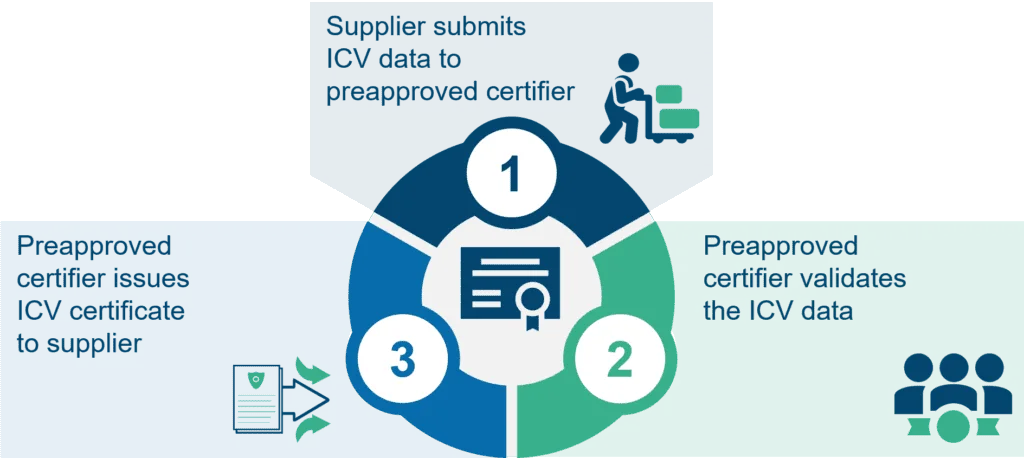
Using the official MoIAT ICV platform (or equivalent), submit your request for quotation to one of the empanelled certifying bodies.
Once you select a certifier, sign an engagement letter and proceed with submission.
The certifier will provide the template, review your submission, and guide on any gaps or improvements needed.
Phase 3: Assessment, Verification, and Issuance
The certifying body reviews your template, verifies supporting documentation, may conduct site visits or interviews.
Upon successful validation, the certifier issues the ICV certificate which states your ICV score and validity period.
The certificate can then be submitted to participating entities as part of tender submissions or supplier evaluations.
Validity Period of the ICV Certificate
Typically the ICV certificate is valid for 14 months from the date of the audited financial statements or the date of issuance of new financials, whichever is earlier.
Some earlier documentation indicated validity up to 18 months; however current MoIAT guidelines mention 14 months.
ICV Renewal: Maintaining Your Certification Status
Prior to expiry, renew your certificate by submitting updated audited financials or management accounts (as required).
Consistent monitoring of your local value-add metrics helps ensure your next certification maintains or improves upon your previous score.
Entities failing to renew may lose competitive standing in tenders or face a score of zero.
Strategic ICV Improvement Plans: Maximizing Your In-Country Value Score
Moving Beyond Compliance: A Proactive Approach to ICV
Instead of treating ICV certification as a one-time checkbox, savvy organizations embed ICV into their strategic planning. This means:
Align your procurement and investment strategy to increase local spend and local sourcing.
Develop workforce strategies to increase UAE national participation.
Invest in local manufacturing, services or infrastructure in the UAE.
View the ICV score as a benchmark, not just as a certificate.
Key Strategies to Enhance Your ICV Score
Local procurement: increase spend on UAE-based suppliers, services and goods.
Emiratization: hire and train UAE nationals, reflect this in your workforce data.
Investment: invest in local facilities, R&D, local supply-chain development.
Local manufacturing/value-add: if applicable, produce goods locally, transform imported materials domestically.
Supplier development: engage local SMEs and Emirati-owned businesses as subcontractors, thus increasing your local value contribution.
Data accuracy & consistency: ensure your audited accounts properly reflect local activities and you maintain strong documentation (this prevents score deductions).
Long-Term Planning for Sustainable ICV Growth
Use annual reviews of your ICV performance and set targets for improvement over successive certifications.
Link ICV metrics into your business KPIs (procurement, employment, investment).
Consider ICV implications when planning new business units, expansion into other Emirates, or cross-licence operations.
Stay abreast of policy updates from MoIAT to ensure no surprise shifts in scoring methodology or templates.
The Link Between ICV and Sustainable Business Practices
Increasingly, ICV certification is not just about economic value-add – it aligns with environmental, social and governance (ESG) themes: local content, national employment, supply-chain resilience, and sustainable manufacturing. Organisations with strong ICV credentials signal not only value-add but also long-term commitment to the UAE economy and its sustainability goals.
Navigating Complexities and Common Challenges in ICV Certification
Ensuring Data Accuracy and Consistency
One of the most frequent challenges is ensuring that the figures submitted in the ICV template accurately reflect audited financials and supporting documentation. Mistakes or inconsistencies can lead to lower scores or delays. Maintain a clear audit trail for your local spend, investment and workforce allocation.
Understanding the Nuances of the ICV Template
Many companies struggle with the template, especially categorising “local procurement” vs “imported” goods, or determining the weighting given to various components. The official guidelines from MoIAT clearly define definitions, but careful interpretation is required.
Common Pitfalls to Avoid During the Assessment
Submitting outdated financial statements (older than two years).
Treating branches as separate legal entities when they could have been combined, or vice versa.
Lack of proper documentation to support local spend or Emiratization efforts.
Switching certifying bodies mid-process without valid cause, which may be disallowed.
Viewing ICV as a one-time effort rather than an ongoing strategic program.
Addressing Specific Industry Challenges
Manufacturing companies may face rigorous scrutiny of local transformation vs. imported components.
Service firms may struggle to raise their “local spend” metric if much of their procurement is outside the UAE.
Multinational companies with regional operations must properly allocate local value within UAE jurisdiction to maximise their ICV score.
SMEs may not yet have full audited accounts, but they can engage early via management accounts and start building local value.
The Importance of Expert Guidance for Regulatory Requirements
Given the complexity of the process, many companies engage specialist ICV certification services in UAE (including in Dubai and Abu Dhabi) to guide them. Experts help interpret templates, liaise with certifying bodies, prepare documentation and advise on score-improvement strategies. Firms like Tulpar Global Taxation (with branches in Dubai, Sharjah and Ajman) can play an instrumental role in supporting companies, while individuals like Ezat Alnajm (FTA-certified Tax Agent in Dubai, UAE) often provide advisory input. Engaging professional help increases confidence, reduces errors and enhances your chances of achieving a strong ICV score.
Choosing the Right ICV Certification Services Provider
The Critical Role of a MoIAT-Authorized Certifying Body
Only certifying bodies authorised by MoIAT can issue valid ICV certificates under the National ICV Program. When selecting a provider, ensure they are listed on the official MoIAT site as an approved certifier, and that they have experience with your industry and the region (Dubai, Abu Dhabi, Northern Emirates).
What to Look for in an ICV Certification Service Provider
Proven track record of issuing ICV certificates for clients in your industry and region.
Clear understanding of the ICV template, score calculation methodology and audit documentation requirements.
Capacity to advise on score-improvement strategies (not just process-compliance).
Transparent pricing (as the cost of ICV certificate varies between providers).
Ongoing support for renewal, improvement and integration of ICV requirements into your procurement or supply-chain strategy.
Local presence or knowledge of UAE business environment (Dubai, Sharjah, Ajman, Abu Dhabi). Example: Tulpar Global Taxation (Dubai, Sharjah & Ajman) is a viable partner for comprehensive advisory.
The Value of Professional ICV Certificate Services
Engaging a specialist provider ensures you:
Meet all compliance requirements and reduce risk of invalid submission.
Optimise your ICV score rather than simply obtaining the certificate.
Integrate ICV into your long-term procurement strategy, offering sustained competitive advantage.
Free internal resources to focus on business operations while experts manage the certification process.
Benefit from proactive advice on evolving policies, which helps you stay ahead of competitors.
The Future of ICV: Trends, Opportunities, and Broader Impact
Evolving Policies and the MoIAT’s Ongoing Vision
The ICV certification framework continues to evolve: MoIAT regularly issues updated guidelines and templates, reflecting updates to the national strategy. Expect increasing weighting of ICV scores in tender evaluations, broader sector coverage, and tighter scrutiny of local value-add metrics.
Connecting ICV with UAE’s Sustainability Goals
There is a growing synergy between ICV certification and sustainability/ESG goals: local manufacturing, workforce development, reduced import dependency and national talent empowerment all contribute to the UAE’s sustainable growth agenda. Companies which align their ICV strategy with ESG credentials will be better positioned for future opportunities.
The Expanding Influence of ICV on UAE Tenders and the Business Landscape
Major procurement frameworks are already applying ICV as a critical evaluation criterion; this trend will deepen across the UAE market.
Suppliers with higher ICV scores are more likely to win contracts or gain preferred status, creating a competitive barrier for those without.
SMEs and local enterprises that embed localization early can leverage the ICV certificate as a growth driver, enabling upward mobility within supply chains.
Strategic Importance for Long-Term Business Growth and Investment in the UAE
For businesses committed to long-term Erfolg (success) in the UAE:
Securing and continuously improving your ICV score becomes a strategic asset.
Investors and stakeholders increasingly regard ICV certification as part of corporate governance and value creation in the UAE context.
The certificate supports market access not just within the UAE but for regional GCC opportunities where local content is emphasised.
FAQs:
An ICV Certificate (In-Country Value Certificate) is an official document that verifies how much value a company adds to the UAE economy through local spending, investment, and employment of UAE nationals. It is issued by MoIAT-authorized certifying bodies.
ICV Certification is essential for companies participating in government and semi-government tenders. A higher ICV score increases competitiveness, improves tender eligibility, and demonstrates commitment to the UAE’s economic development goals.
Any supplier, contractor, or service provider bidding for contracts with government entities or major national companies (like ADNOC) must obtain an ICV Certificate. It is also beneficial for SMEs aiming to expand their local market presence.
To get an ICV Certificate, you must prepare audited financial statements, complete the official ICV template, and submit it through a MoIAT-authorized certifying body. Once verified, the certificate is issued with your company’s ICV score.
You’ll need:
Audited financial statements (as per IFRS)
Trade licence and company documents
Data on local procurement, investment, and Emiratization
Completed ICV template with supporting invoices and records
An ICV Certificate is valid for 14 months from the date of the audited financial statements used for certification or until new financials are released, whichever is earlier.
The cost of ICV Certification in the UAE varies based on the size, complexity, and number of entities. On average, certification fees start around AED 2,000 and can increase depending on the certifying body and business structure.
The ICV score is a percentage showing your company’s local value contribution. It’s calculated based on metrics such as local procurement, investment, Emiratization, and local manufacturing, derived from audited financials.
Yes. Foreign companies with licensed UAE entities can apply, provided they have audited financials and contribute to local procurement, workforce employment, or investment within the UAE.
Only certifying firms approved by the Ministry of Industry and Advanced Technology (MoIAT) can issue valid ICV Certificates. It’s crucial to select a recognized certifier for authenticity and compliance.
Conclusion: Your Partner for ICV Success in the UAE
Obtaining an ICV Certificate in the UAE has evolved into a strategic necessity that drives competitiveness, market access, and alignment with the nation’s economic diversification goals. By understanding the ICV certification process, working with expert providers, and focusing on continuous improvement, businesses can strengthen their local value contribution, enhance tender eligibility, and secure long-term growth. Partnering with professional advisors such as Tulpar Global Taxation (Dubai, Sharjah, and Ajman) or Ezat Alnajm, FTA-certified Tax Agent in Dubai, can help streamline certification, maximize ICV scores, and position your company for sustainable success in the UAE market.
