
Tokenizing Mining Projects for Fundraising in UAE (2026)
Table of Contents

Let's Talk
Sign Up For Free Consultation
Why Tokenizing Mining Projects is Dominating UAE Capital Markets in 2026
The UAE has become one of the world’s most advanced jurisdictions for tokenization, blockchain technology, and digital asset innovation. In 2026, the rise of tokenizing mining projects for fundraising in UAE is no longer experimental, it is a regulated capital market strategy governed by VARA (Virtual Assets Regulatory Authority) and the CMA (Capital Markets Authority) under frameworks such as Decision No. 4/R.M/2026.
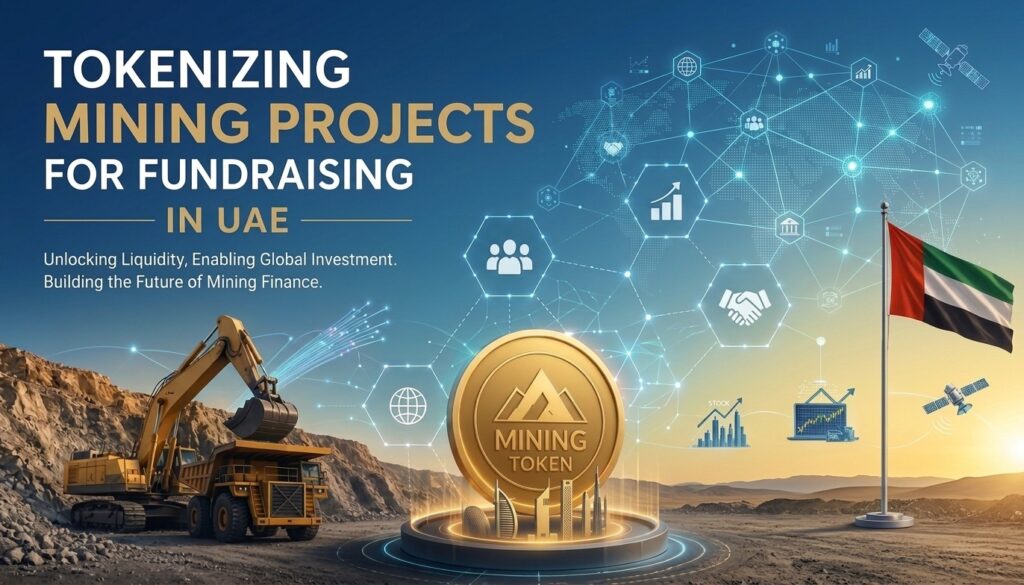
This evolution is reshaping how mining companies, investors, and financial institutions participate in the capital market, enabling compliant, transparent, and globally accessible asset tokenization structures. At its core, tokenization is the process of converting physical assets into digital tokens, creating tokenized assets that can be fractionally owned, traded, and globally distributed through blockchain technology.
This guide explains how mining tokenization works, the process of tokenization, regulatory compliance, and how firms can achieve successful tokenization for global fundraising.
Tokenization in Mining Industry (2026 Regulatory)
Tokenization in mining industry refers to converting mining assets, mining rights, and mining operations into digital tokens on a regulated blockchain infrastructure.
Under UAE 2026 frameworks, this must align with:
- VARA licensing requirements
- CMA securities classification rules
- Decision No. 4/R.M/2026 compliance structure
Each token represents a digital claim on the underlying asset, meaning tokens represent mining assets such as ore reserves, revenue streams, or production output.
Mining tokenization needs in 2026 include:
- Access to global investor base
- Regulatory-approved tokenization services
- Improved liquidity for illiquid mining assets
- Efficient raise capital mechanisms
- Institutional-grade regulatory compliance
- Transparent ownership via smart contract
This is why mining industry tokenization needs are now a strategic priority for UAE-based mining and commodity firms.
Complete Process of Tokenization: How Mining Tokenization Works
Mining tokenization in 2026 follows a structured and regulated framework that combines real-world mining assets with blockchain infrastructure. The process is designed to ensure legal compliance, investor protection, transparency, and liquidity under regulatory systems such as the UAE’s securities and virtual asset frameworks.
Step 1: Asset Evaluation & Commodity Analysis
The first stage involves a detailed assessment of the mining project and its underlying assets. The goal is to determine whether the asset is suitable for tokenization and investment participation.
Key factors evaluated include:
- Current and projected market value
- Historical mining performance
- Reserve verification and production capacity
- Commodity exposure such as gold, copper, lithium, rare earth minerals, or other extractive resources
- Global market demand and price outlook
- Operational risks and environmental considerations
Independent auditors, geological experts, and valuation firms are typically involved to ensure credibility and accuracy.
Step 2: Legal Structuring & Compliance Setup
Once the asset passes evaluation, a compliant legal structure is established. This stage is critical because tokenized mining assets are commonly treated as regulated financial instruments or security tokens.
The structure is aligned with:
- UAE securities regulations
- Virtual Assets Regulatory Authority virtual asset frameworks
- Capital Market Authority or equivalent capital market asset classification standards
- AML (Anti-Money Laundering) and KYC (Know Your Customer) obligations
- Investor disclosure and governance requirements
The ownership rights, revenue participation, profit-sharing model, and investor protections are legally documented before token issuance begins.
Step 3: Smart Contract Deployment
After the legal framework is finalized, blockchain-based smart contracts are developed and deployed.
These smart contracts are programmed to:
- Automate revenue and dividend distribution
- Record ownership transparently on-chain
- Manage investor rights and token transfers
- Execute compliance restrictions automatically
- Maintain immutable transaction records
The smart contract layer becomes the operational backbone of the tokenized mining ecosystem.
Step 4: Token Issuance via Tokenization Platform
The mining asset is then offered to investors through a licensed or regulated tokenization platform.
The platform handles:
- Investor onboarding
- Identity verification (KYC/AML)
- Token subscription and allocation
- Custody and compliance monitoring
- Regulatory reporting
At this stage, security tokens representing economic rights in the mining project are officially issued.
Step 5: Conversion of Assets into Digital Tokens
The approved mining asset is digitized into blockchain-based tokens.
This process enables:
- Fractional ownership of mining operations or reserves
- Lower entry barriers for investors
- Global participation opportunities
- Faster settlement and ownership transfer
- Transparent cap table management
Each token may represent a percentage of:
- Mining revenues
- Commodity-backed reserves
- Production output
- Equity participation
- Royalty streams
This transforms traditionally illiquid mining assets into digitally accessible investment products.
Step 6: Secondary Market Trading & Liquidity
After issuance, tokens may be listed on compliant secondary trading platforms or regulated digital asset exchanges.
This stage provides:
- Market liquidity
- Price discovery
- Cross-border investor participation
- Peer-to-peer transfers
- Continuous trading opportunities
Secondary market access significantly improves the efficiency and attractiveness of mining investments compared to traditional private placements.
Result: A Fully Tokenized Mining Investment Ecosystem
When properly executed, mining tokenization creates a regulated digital investment framework that combines:
- Real-world commodity exposure
- Blockchain transparency
- Fractional ownership
- Automated compliance
- Global liquidity access
By 2026, this model is increasingly being adopted for commodities such as gold, copper, lithium, and strategic minerals, particularly in jurisdictions with advanced digital asset regulations like the UAE.
Why Tokenizing Mining Projects is Transforming Global Fundraising
The rise of tokenizing mining projects is fundamentally changing how capital is raised in the mining sector.
Key transformation drivers:
- Shift from traditional mining finance to digital fundraising
- Growth of DeFi and RWA tokenization
- Increasing need to raise capital more efficiently
- Demand for commodity-backed investment products
- High market volatility in traditional commodity markets
- Expansion of global digital asset ecosystems
Mining companies can now raise funds faster, with broader access to global investors.
Advantages of Tokenization in Mining Sector (2026 Model)

- Enhanced Liquidity: Transforms illiquid mining assets into tradable tokenized mining assets, enabling global liquidity.
- Fractional Ownership: Enables fractional ownership, lowering entry barriers for retail investors and institutional investors.
- Global Capital Market Access: Unlocks participation in international capital markets and cross-border investment flows.
- Reduced Investment Risk: Tokenization reduces the risk through diversification and transparent asset backing.
- Transparency via Blockchain: Full transparency is ensured through immutable blockchain records.
- Efficient Capital Raising: Allows companies to raise capital more efficiently than traditional fundraising models.
Tokenization Platform & Tokenization Services in UAE
The UAE provides advanced tokenization services for firms looking to tokenize mining and commodity assets under regulated frameworks.
A compliant tokenization platform enables:
- Issuance of regulated security token
- Lifecycle management of token holders
- Integration with financial institutions
- Full compliant tokenization structure
- Management of digital asset portfolios
- Alignment with CMA + VARA requirements
This infrastructure supports growing tokenization needs in mining finance.
Real-World Asset (RWA) Tokenization in Mining Sector
RWA tokenization is the backbone of modern mining finance in 2026.
Mining assets such as:
- Mining rights
- Equipment
- Commodity reserves
- Production output
are converted into tokenized assets, creating a digital representation of real-world value.
This process converts real-world assets into digital tokens, enabling global liquidity, transparency, and investment scalability.
Investment Perspective: Mining Investment Opportunities in 2026
From an investment perspective, tokenized mining assets represent a new institutional-grade asset class.
Investor advantages:
- Exposure to global commodity markets
- Entry into structured mining investment opportunities
- Portfolio diversification across mining projects
- Access for both institutional investors and retail investors
- Fractional exposure to high-value mining operations
This expands the global investor base and strengthens mining capital inflows.
Blockchain, Smart Contracts & Digital Asset Management
Blockchain technology is the foundation of mining tokenization in 2026.
Key capabilities:
- Secure digital representation of assets
- Automated smart contract execution
- Transparent managing digital assets systems
- Immutable audit trails
- Efficient digital asset settlement systems
This ensures trust, scalability, and regulatory alignment across tokenized ecosystems.
Market Dynamics: Value, Demand & Mining Performance
Tokenization success depends on:
- Market demand for commodities
- Market value of mining reserves
- Global market conditions
- High market volatility
- Operational mining performance
These factors directly influence tokenization needs, pricing models, and investor returns.
Future of Mining Industry Tokenization - 2026
The future of mining industry tokenization is defined by full integration of blockchain into capital markets under CMA + VARA regulation.
Key trends:
- Expansion of tokenizing mining real-world assets
- Institutional adoption of tokenization services
- Growth of regulated DeFi infrastructure
- Evolution of capital market digital frameworks
- Shift from traditional mining to tokenized ecosystems
- Rising demand for tokenization needs across industries
This represents the next phase of global commodity finance transformation.
Advisory & Compliance Ecosystem in UAE
Regulatory compliance is essential for compliant tokenization in 2026.
Tulpar Global Taxation, with branches in Dubai, Sharjah, and Ajman, provides advisory support for tokenization services, tax structuring, and digital asset compliance frameworks.
Additionally, Ezat Alnajm, an FTA-certified tax agent and certified transfer pricing expert in Dubai, UAE, provides strategic expertise in regulatory compliance, tax optimization, and structuring for tokenization projects and digital asset ecosystems under UAE law.
Conclusion: Tokenizing Mining Projects is the Future of UAE Capital Markets
The rise of tokenizing mining projects for fundraising in UAE represents a structural transformation of global finance under 2026 regulatory frameworks. Through asset tokenization, blockchain technology, and RWA tokenization, mining companies can achieve:
- Faster capital raising
- Global investor access
- Improved liquidity
- Full regulatory compliance
- Transparent digital ownership structures
With VARA, CMA, and Decision No. 4/R.M/2026, the UAE is establishing itself as the global leader in regulated tokenization platforms.
The integration of mining assets, smart contracts, and compliant tokenization structures is redefining how capital is raised, managed and traded, making tokenization one of the most powerful financial innovations of the 2026 global economy.
FAQs:
Yes. Under the 2025-2026 regulatory framework, the UAE allows the tokenization of Real World Assets (RWAs). If the tokens represent a share in the physical output or profits of a mining farm, they are generally classified as Investment Tokens or Security Tokens. These fall under the jurisdiction of the Virtual Assets Regulatory Authority (VARA) in Dubai or the DFSA in the DIFC.
It depends on your location. If you are operating in mainland Dubai or most free zones, VARA is the primary regulator. However, if your token is structured specifically as a security (offering dividends or ownership), you may also need approval from the Securities and Commodities Authority (SCA) or the Financial Services Regulatory Authority (FSRA) in ADGM.
Yes. While personal crypto gains for individuals remain tax-free, commercial mining operations are treated as business activities. If your project’s net profit exceeds AED 375,000, it is subject to a 9% Corporate Tax rate.
Note: Navigating these filings requires expert oversight. Tulpar Global Taxation specializes in aligning crypto-asset structures with the Federal Tax Authority (FTA) requirements to ensure full compliance.
Generally, the FTA treats mining rewards as being outside the scope of VAT because there is no specific recipient of the service (the reward is generated by the protocol). However, if the project provides Mining-as-a-Service to token holders, this could attract a 5% VAT rate. Ezat Alnajm, an FTA Certified Tax Agent, can provide a formal tax opinion to clarify your project’s specific VAT position.
For projects with international branches or Related Parties (e.g., a hardware supplier owned by the same founder), Transfer Pricing rules apply. The transactions must be conducted at market value (the Arm’s Length Principle). As a Certified Transfer Pricing Expert in Dubai, Ezat Alnajm ensures that your internal token allocations and hardware costs meet FTA standards to avoid heavy penalties.
Yes, free zones like DMCC, Hub71 (ADGM), and the Sharjah Research Technology and Innovation Park (SRTIP) are popular. However, to qualify for a 0% Corporate Tax rate as a Qualifying Free Zone Person, your project must meet strict substance requirements and typically only transact with non-resident investors.
As of 2026, the application fee for a Category 1 Virtual Asset Issuance license is approximately AED 100,000, with a recurring annual supervision fee of AED 200,000. These costs do not include the mandatory paid-up capital requirements, which vary based on the project’s risk profile.
While not legally mandatory for registration, the FTA highly recommends using a certified agent for complex sectors like crypto-mining. Tulpar Global Taxation acts as your authorized representative, handling everything from Corporate Tax registration to representing your project during FTA audits, ensuring your fundraising remains legally sound.
Electricity and hardware costs are considered deductible business expenses for Corporate Tax purposes. Properly documenting these costs is vital for reducing your taxable income. Working with a specialist like Ezat Alnajm ensures that your depreciation schedules for ASIC miners are calculated accurately according to UAE accounting standards.
Absolutely. Any entity issuing virtual assets in the UAE must implement a robust Anti-Money Laundering (AML) and Know Your Customer (KYC) framework. Failure to report suspicious transactions can lead to massive fines or the revocation of your business license by VARA or the Central Bank of the UAE.
